0-30 Vdc Stabilized Power Supply

AJ777

Nov 24, 2017
1
Joined
Nov 24, 2017
Messages
1
I created the previous build for this project from this link : http://www.electronics-lab.com/project/0-30-vdc-stabilized-power-supply-with-current-control-0-002-3-a/

I couldn't get the required TL081 so I replaced it with TL071. Now the circuit works well and good. But I have some doubts :

1. The power transistor 2n3055 is connected to a massive heatsink, but the wires drawn from it are single lead wires. Im not sure of how much current it can carry. I did test the PSU using a 100 ohm 5a rheostat and found the transistor heating up. But even at 3a in the output, the wires drawn from the transisitor didn't burn off. I didn't test it for long duration.

so my question is what wires should I replace in the connection. is the single lead wire capable enough to carry 3a? should I get multi threaded wire? If so, of what guage?

2. the PSU when loaded using rheostat couldn't reach the peak voltage of 30v. as soon as the rheostat was connected , the output voltage dropped to he range of 20-22v. Is there any way I can hold the output voltage in the value I deserve? or did the output voltage drop so as to limit the current using the current limiter circuit(which was not turned on when loaded, current knob kept at zero position.

3. how can I test the current varying capability ? at constant voltage obviously...

help out a brother...

cheers


audioguru2

Apr 6, 2004
12,026
Joined
Apr 6, 2004
Messages
12,026
The original project had many overloaded parts including the power transformer. It used TL081 opamps but your TL071 opamps are simply TL081 opamps selected fo low noise (audio applications). Their absolute maximum supply volyage is 36V but this project with a 24VAC transformer produces about 25VAC when the load current is low then its peak is 35.4V which is reduced to about +34V which is the positive voltage for some of the opamps and -5.6V is the negative supply for them. Then they get 34V plus 5.6V= 39.6V which is too high for these opamps so they will fail soon. The improved modified circuit uses opamps rated at 44V and the -5.6V supply is reduced to -1.3V.

Of course the output transistor gets hot when loaded, even with a huge heatsink because it and the driver transistor are overloaded. The improved modified circuit uses a better driver transistor with a proper case that can be bolted to a larger heatsink and TWO output transistors are used to share the heat. Use a fan if you want.

It is easy to find a table of wire size and the current it can handle, and use Ohm's law to calculate its voltage drop. Use #18 AWG wire and solid core or stranded are both able to carry many amps of current with a low amount of voltage drop. The overloaded transformer is rated at 24V x 3A= 72VA but needs a transformer that is 28V x 1.414 x 3A= 119VA instead then its voltage will not collapse when loaded. But then the 44V opamps must be used.

It should be obvious to you that when the current setting is set low (you cannot turn it off) then any load current higher than the setting will reduce the output voltage.

It should have excellent voltage regulation. If the current setting is 2A and you load the project with 1.5A then the output voltage might be 25.0V with the load and the voltage set to 25.0V and when the load is disconnected the voltage might rise to 25.005V, or be 25.0V with 2A and drop to 24.095V without a load. 


detonatorinf

Sep 24, 2017
16
Joined
Sep 24, 2017
Messages
16
For months I've been reading threads about this project to get some confidence boost in building my own.  But at first, my plan was to buy one of these cheap chinese power supplies that provides 30v at 5Amps. My question is about the stability of those chinese power supplys compared to this project. Would be better to invest time building this project or go the easy route?


audioguru2

Apr 6, 2004
12,026
Joined
Apr 6, 2004
Messages
12,026
This project has been copied and is available for a very low price on ebay, Banggood and Amazon.              But it has all the problems of the original kit from Greece. Many parts are overloaded and fail soon. It does not produce 30VDC at 3A. It looks like the Chinese people who copied it never made it and never tested it. 


audioguru2

Apr 6, 2004
12,026
Joined
Apr 6, 2004
Messages
12,026
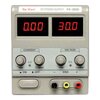
Your photo of a no-name-brand Chinese power supply does not show any specifications and does not show its schematic and parts list.

The photo shows its 30VDC output when its current is zero. The defective Greek kit and Chinese copies do that but cannot produce 30VDC at 3A. Instead they produce about 25VDC with a lot of ripple at 2.5A and the parts are burning.


detonatorinf

Sep 24, 2017
16
Joined
Sep 24, 2017
Messages
16
Your photo of a no-name-brand Chinese power supply does not show any specifications and does not show its schematic and parts list.
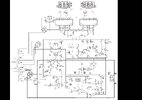
I found this. Since the same model number is shared by other 4 brands. I can't tell if the actual hardware still true to the schematic.

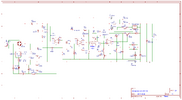
599978a3b763f_EsquemaSchematicfontePs-305dYaxun.jpg.1e5dd519ca41ae7d6536e3a3e962cd9c.jpg


audioguru2

Apr 6, 2004
12,026
Joined
Apr 6, 2004
Messages
12,026
The Chinese power supply uses relays to switch the transformer voltage into voltage ranges so that the output transistor does not get too hot. I do not know if any parts are overloaded and I do not know how good or bad is its regulation. Its LM741 opamps were designed 50 years ago (!).


detonatorinf

Sep 24, 2017
16
Joined
Sep 24, 2017
Messages
16
The Chinese power supply uses relays to switch the transformer voltage into voltage ranges so that the output transistor does not get too hot. I do not know if any parts are overloaded and I do not know how good or bad is its regulation. Its LM741 opamps were designed 50 years ago (!).
Thank you.

I will choose this project in that case.


Apache

Feb 2, 2018
1
Joined
Feb 2, 2018
Messages
1
Hi! ,Everybody 

I made this 30v lab supply using mc34072 and everything is working fine except the voltage at output is not.going below 15mv as it should go to 0 and the current limit is not working below 36ma as the current limit should work till 2ma as stated, please help.

The voltage at 

Voltage pot 1st pin=11.2 v, 3rd pin=0.008

Current pot 1st pin=1.2v, 3rd pin=0.014

Current shunt are two .22ohm resisitors in series which gives me 1.22v voltage drop at 30v 3amp 

My concern is that ,1- voltage should go to zero which is not going and is about to 15mv whe voltage pot turned to zero.

2-current limit is working till only 36ma and not below it..

Please i appreciate any help..


audioguru2

Apr 6, 2004
12,026
Joined
Apr 6, 2004
Messages
12,026
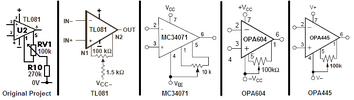
Every opamp has an input offset voltage error. Single opamps like the recommended MC34071 and the TLE2141 have input offset voltage adjustment pins. The project uses trimpot RV1 to null the offset voltage but your MC34072 does not have offset adjustment pins. Since your MC34072 has two opamps then it has double the heating and I think it becomes too hot.

The original project used the wrong value for R10 connected to RV1 and R10 was connected to the wrong voltage. Here is how it was and how it should be:

0V-30V offset adjustment.PNG


detonatorinf

Sep 24, 2017
16
Joined
Sep 24, 2017
Messages
16
What is the consensus about the voltage spikes discussed on older posts? REV8 adds a darlington transistor to solve this problem. But even after that, other solutions are still being presented for the same problem.

 
Last edited by a moderator:

electron234

Nov 22, 2017
6
Joined
Nov 22, 2017
Messages
6
Every opamp has an input offset voltage error. Single opamps like the recommended MC34071 and the TLE2141 have input offset voltage adjustment pins. The project uses trimpot RV1 to null the offset voltage but your MC34072 does not have offset adjustment pins. Since your MC34072 has two opamps then it has double the heating and I think it becomes too hot.

The original project used the wrong value for R10 connected to RV1 and R10 was connected to the wrong voltage. Here is how it was and how it should be:

View attachment 42946


I have a 30V, 8A transformer. Will this do the job. I want to make this project  on Breadboard for professional  purpose.  Is it possible ?

 
Last edited by a moderator:

electron234

Nov 22, 2017
6
Joined
Nov 22, 2017
Messages
6
Every opamp has an input offset voltage error. Single opamps like the recommended MC34071 and the TLE2141 have input offset voltage adjustment pins. The project uses trimpot RV1 to null the offset voltage but your MC34072 does not have offset adjustment pins. Since your MC34072 has two opamps then it has double the heating and I think it becomes too hot.

The original project used the wrong value for R10 connected to RV1 and R10 was connected to the wrong voltage. Here is how it was and how it should be:

View attachment 42946


audioguru2

Apr 6, 2004
12,026
Joined
Apr 6, 2004
Messages
12,026
A solderless breadboard has intermittent contacts that cannot handle the high currents of this project. The many rows of contacts and wires all over the place have capacitance between them that frequently causes a circuit like in this project to oscillate at a high frequency.

In my career I made all my prototypes soldered together on stripboard where I planned the layout to be compact and the strips were cut to length so that each strip was used for many parts of the circuit. Some of the circuits were very complex but worked perfectly and looked good enough to be sold as the final professional product. 


electron234

Nov 22, 2017
6
Joined
Nov 22, 2017
Messages
6
A solderless breadboard has intermittent contacts that cannot handle the high currents of this project. The many rows of contacts and wires all over the place have capacitance between them that frequently causes a circuit like in this project to oscillate at a high frequency.

In my career I made all my prototypes soldered together on stripboard where I planned the layout to be compact and the strips were cut to length so that each strip was used for many parts of the circuit. Some of the circuits were very complex but worked perfectly and looked good enough to be sold as the final professional product. 
Thanks audioguru for  your endless effort to the fulfillment of  passion .

Can i use  30V, 8A transformer  for the Project of  " 0-30V PSU Rev-7, 14-Aug-2014 Latest By Guest-liquibyte ". 

Attached file below. 

Waiting for you.

View attachment 0-30V PSU Rev-7, 14-Aug-2014 Latest By Guest-liquibyte.pdf

 
Last edited by a moderator:

Tintin

Mar 7, 2018
15
Joined
Mar 7, 2018
Messages
15
Hello, I make a PCB with this schematic, with a 24VAC transformer, who give normally 36VDC after main capacitor.
I test my PCB without AOPs and Tmain transistor (BD139 and TIP3055) and I measure Voltage after main capacitor C1 :
-The voltage start to 36VDC and grow up to 44VDC and stabilize.
-After inspection, I remove R1 (in my schematic R1 1K+R1-1 1k2) and I have 36VDC, ok.
-I put a 1K resistor for R1 (R1+R-1) and I have 36VDC for testing.
-I put a 2k2 resistor for R1(R1+R-1) and I have 44VDC...
-I I remove R1(R1+R-1) and I have 44VDC !!!
-I replace 1K resistor and I have finally correct 36VDC...

What is the explanation of this ?

Thanks and sorry for my english.
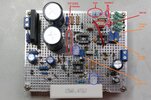
IMGP8086_DxO.jpg

Alimentation_0_30V-afa1cff4a81a4e6380fbe4d075b36b12.png

 
Last edited by a moderator:

audioguru2

Apr 6, 2004
12,026
Joined
Apr 6, 2004
Messages
12,026
This project will not produce 30.0VDC at 3.0A with a 24V transformer. It might produce 25VDC at 2A with a lot of unregulated ripple.The transformer must be 28VAC or 30VAC at 4.2A.

A 24V transformer will produce about 25VDC when it has a small load current which has a peak of 25V x 1.414= +35.4V and the bridge rectifier reduces it to about +34.0V.

Maybe your transformer is cheap and has a small maximum current so it is made to produce a much higher voltage when it has a small load current (your 2.2k resistors) then its voltage drops when it is loaded with your 1k resistor. Or maybe your meter is measuring the AC ripple that is caused by the value of the total capacitance of C1 is too small. 


Tintin

Mar 7, 2018
15
Joined
Mar 7, 2018
Messages
15
This project will not produce 30.0VDC at 3.0A with a 24V transformer. It might produce 25VDC at 2A with a lot of unregulated ripple.The transformer must be 28VAC or 30VAC at 4.2A.

A 24V transformer will produce about 25VDC when it has a small load current which has a peak of 25V x 1.414= +35.4V and the bridge rectifier reduces it to about +34.0V.

Maybe your transformer is cheap and has a small maximum current so it is made to produce a much higher voltage when it has a small load current (your 2.2k resistors) then its voltage drops when it is loaded with your 1k resistor. Or maybe your meter is measuring the AC ripple that is caused by the value of the total capacitance of C1 is too small. 
Hi : I am not sure if you understand my problem : I measure Voltage on the PCB without AOPs and Transistor, to make sure all is ok before put the AOPs.
The voltage I give is on The collector of TIP3055, just after the KBK.

1)My transformer is not cheap : I test him on breadboard with same main capacitor and Resistor, it give me with small charge 27VAC and 36VDC after bridge rectifier on BreadBOARD

2)I don't understand why on my PCB, I have 36VDC after bridge rectifier only with 1K resistor... With 2k2 or without resistor the voltage after bridge rectifier go up to 44VDC...

3) The question is why, with same component, I have a problem only on my PCB... Maybe a ground loop problem ? I checked many times all connections and all is fine, so...


Top