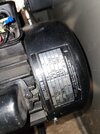
Indeed Dana . . .that is one valid and GOOD supplemental suggestion.
Particularly if this motor is used around woodworking and having micro fine sawdust floating around an depositing in every crevice.
Or having micro fine dust floating around from any other materiel.
In my case it was my motor of twice the speed of that one shown . . . . but still 125V 1 phase powered .
At rare times I'd go to the saw and turn it on and only hear a BUZZ for about his mentioned / described time, until the round KLIXXON thermal cut out breaker would snap and cut power off.
Being in a hurry to get that job done INSTANTLY, I would just lift the motor enough to then be able slide l the drive belt off the end of the pulley.
I wrapped inside of that motor pulley, enough venetian blind "rope", in the direction that will have the motor running in the proper direction. Then done a hard pull on that rope end to get that motor spinning and then flipping on power.
SUCCESS . . . . . IT RAN . . . . I then I dropped the belt into the pulley groove. Left the saw running until job was completed.
THEN at a more convenient time later, I cleaned up the sawdust coated / thereby insulated contacts.
Gauthack . . . . you need to do just that rope trick, as I described, to see if the motor runs, with you providing that initial spinning mechanical boost..
PARTICULARLY, if you put your nose down to the motor vents and don't smell the distinct and acrid odor of burnt magnet wire insulation.
Also, if you used that motor enough you should have noticed there always being an initial powerful noise as the centrifugal switch is starting up being closed and initially has the start up capacitor connected into the start up winding. There is a very distinct snapping noise as that mechanism scissors out and reaches its mechanical travel limit, at the same time the switch portion has opened up and disconnected the start up capacitor, since the motor is now powered solely by the motors running winding.
Centrifugal action of weights keep that switch open circuit, until such time that you cut motor power . Then the slowing down of the motor will
have some spring loaded counterweights hit a speed threshold where you will hear a distinct SNAP again. They now have the switch engaged for the next time you want to power up and start the motor
BUT that absolutely cannot t happen, if you have 2 coated contacts that are not making connection to each other.
I hope that this actually proves to be your problem.
73's de Edd . . . . .