4017 36 LED chaser?

Louis Bates

Oct 21, 2014
19
Joined
Oct 21, 2014
Messages
19
Hello,

I am stuck whilst trying to make a roulette wheel, with 36 LED's. So far I have combined 2 4017 chips to make 18 sequential LED outputs. However, I need 36, is there a way I can add more 4017 chips to get more outputs. I would still like the LED's to be in sequence though.

Here is my circuit so far : rgrgrgrgrgrgrgrgrgr.PNG
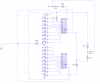
If there are any mistakes feel free to let me know, thanks :)
 

Supercap2F

Mar 22, 2014
550
Joined
Mar 22, 2014
Messages
550
OK, first of all you shouldn't drive the LEDs like that, you need a current limiting resistor for each LED. For more info on why you need to do that see here. Also your clock and reset inputs are floating - You must have the inputs connected to +V or GND at all times, or the 4017 will do weird things.

The 4017s are kind of hard to combine to make a larger synchronous counter, because they are not made for doing that. There is a way to do it though!

What you need to do is hook the 9th output on the first chip to its enable pin, so that when the count reaches 9 the 4017 will be disabled. Then hook a inverters input to the enable pin on the first 4017, and hook the inverters output to the enable pin on the second 4017. So the second 4017 will be disabled when the first one is running, but when the first ones count reaches 9 the first 4017 will be disabled and the second enabled. Make sure you have both of there clocks tied together. Then hook the second 4017s 9th output to the reset pin on the first 4017. This will make it so that when the second one reaches 9 it will reset the first 4017 hence disabling itself. Tie the second 4017s reset to GND.

I pretty sure that would work, but I think it would be good to wait for one of are other forum members to confirm it. ;)
Dan
 

Gryd3

Jun 25, 2014
4,098
Joined
Jun 25, 2014
Messages
4,098
OK, first of all you shouldn't drive the LEDs like that, you need a current limiting resistor for each LED. For more info on why you need to do that see here. Also your clock and reset inputs are floating - You must have the inputs connected to +V or GND at all times, or the 4017 will do weird things.

The 4017s are kind of hard to combine to make a larger synchronous counter, because they are not made for doing that. There is a way to do it though!

What you need to do is hook the 9th output on the first chip to its enable pin, so that when the count reaches 9 the 4017 will be disabled. Then hook a inverters input to the enable pin on the first 4017, and hook the inverters output to the enable pin on the second 4017. So the second 4017 will be disabled when the first one is running, but when the first ones count reaches 9 the first 4017 will be disabled and the second enabled. Make sure you have both of there clocks tied together. Then hook the second 4017s 9th output to the reset pin on the first 4017. This will make it so that when the second one reaches 9 it will reset the first 4017 hence disabling itself. Tie the second 4017s reset to GND.

I pretty sure that would work, but I think it would be good to wait for one of are other forum members to confirm it. ;)
Dan
Sounds good to me. Avoid using the carry pin, and the enable pin would be labeled as a 'clock inhibit' on the datasheet. This would allow you to chain multiple together as long as the last pin9 output is connected to the first clock inhibit. (Pay attention if it's active high or low.. I can't remember) As far as the LED limiting resistor is concerned, if there will only ever be one LED on, wouldn't one resistor be a valid choice?
 

(*steve*)

¡sǝpodᴉʇuɐ ǝɥʇ ɹɐǝɥd
Moderator
Jan 21, 2010
25,510
Joined
Jan 21, 2010
Messages
25,510
OK, first of all you shouldn't drive the LEDs like that, you need a current limiting resistor for each LED.

In this case it's fine as only 1 LED is on at once. If the power supply were any higher, the LEDs that are off would be risking reverse breakdown. I certainly wouldn't operate it at a voltage higher than 9V.
 

Supercap2F

Mar 22, 2014
550
Joined
Mar 22, 2014
Messages
550
As far as the LED limiting resistor is concerned, if there will only ever be one LED on, wouldn't one resistor be a valid choice?
Hmm, I didn't think of that. I guess one resistor would be OK. Good point! :)

The 'clock inhibit' is active high.

I like the 4017s, they where the first IC I ever used right! :p
Dan

EDIT: Thanks for confirming that Steve! Make sense about the reverse break down.
 
Last edited:

Louis Bates

Oct 21, 2014
19
Joined
Oct 21, 2014
Messages
19
OK, first of all you shouldn't drive the LEDs like that, you need a current limiting resistor for each LED. For more info on why you need to do that see here. Also your clock and reset inputs are floating - You must have the inputs connected to +V or GND at all times, or the 4017 will do weird things.

The 4017s are kind of hard to combine to make a larger synchronous counter, because they are not made for doing that. There is a way to do it though!

What you need to do is hook the 9th output on the first chip to its enable pin, so that when the count reaches 9 the 4017 will be disabled. Then hook a inverters input to the enable pin on the first 4017, and hook the inverters output to the enable pin on the second 4017. So the second 4017 will be disabled when the first one is running, but when the first ones count reaches 9 the first 4017 will be disabled and the second enabled. Make sure you have both of there clocks tied together. Then hook the second 4017s 9th output to the reset pin on the first 4017. This will make it so that when the second one reaches 9 it will reset the first 4017 hence disabling itself. Tie the second 4017s reset to GND.

I pretty sure that would work, but I think it would be good to wait for one of are other forum members to confirm it. ;)
Dan

Thank you, I did think this might be the case!

I'll try to get this working today.
 

Louis Bates

Oct 21, 2014
19
Joined
Oct 21, 2014
Messages
19
OK, first of all you shouldn't drive the LEDs like that, you need a current limiting resistor for each LED. For more info on why you need to do that see here. Also your clock and reset inputs are floating - You must have the inputs connected to +V or GND at all times, or the 4017 will do weird things.

The 4017s are kind of hard to combine to make a larger synchronous counter, because they are not made for doing that. There is a way to do it though!

What you need to do is hook the 9th output on the first chip to its enable pin, so that when the count reaches 9 the 4017 will be disabled. Then hook a inverters input to the enable pin on the first 4017, and hook the inverters output to the enable pin on the second 4017. So the second 4017 will be disabled when the first one is running, but when the first ones count reaches 9 the first 4017 will be disabled and the second enabled. Make sure you have both of there clocks tied together. Then hook the second 4017s 9th output to the reset pin on the first 4017. This will make it so that when the second one reaches 9 it will reset the first 4017 hence disabling itself. Tie the second 4017s reset to GND.

I pretty sure that would work, but I think it would be good to wait for one of are other forum members to confirm it. ;)
Dan

Sorry if this is a silly question but what is/are 'a inverters' ?
 

(*steve*)

¡sǝpodᴉʇuɐ ǝɥʇ ɹɐǝɥd
Moderator
Jan 21, 2010
25,510
Joined
Jan 21, 2010
Messages
25,510
Sorry if this is a silly question but what is/are 'a inverters' ?

Not silly at all.

An inverter is a logic gate which produces an output the opposite of its input,

Here is a link to a device that would work with your 4017.
 

Louis Bates

Oct 21, 2014
19
Joined
Oct 21, 2014
Messages
19
Not silly at all.

An inverter is a logic gate which produces an output the opposite of its input,

Here is a link to a device that would work with your 4017.


Ah, a NOT gate? That's what I learnt. (I probably should have worked that one out :))
 

Louis Bates

Oct 21, 2014
19
Joined
Oct 21, 2014
Messages
19
OK, first of all you shouldn't drive the LEDs like that, you need a current limiting resistor for each LED. For more info on why you need to do that see here. Also your clock and reset inputs are floating - You must have the inputs connected to +V or GND at all times, or the 4017 will do weird things.

The 4017s are kind of hard to combine to make a larger synchronous counter, because they are not made for doing that. There is a way to do it though!

What you need to do is hook the 9th output on the first chip to its enable pin, so that when the count reaches 9 the 4017 will be disabled. Then hook a inverters input to the enable pin on the first 4017, and hook the inverters output to the enable pin on the second 4017. So the second 4017 will be disabled when the first one is running, but when the first ones count reaches 9 the first 4017 will be disabled and the second enabled. Make sure you have both of there clocks tied together. Then hook the second 4017s 9th output to the reset pin on the first 4017. This will make it so that when the second one reaches 9 it will reset the first 4017 hence disabling itself. Tie the second 4017s reset to GND.

I pretty sure that would work, but I think it would be good to wait for one of are other forum members to confirm it. ;)
Dan
Is this not only 18 LEDs though? You never mention a third chip??
 

Supercap2F

Mar 22, 2014
550
Joined
Mar 22, 2014
Messages
550
Do you understand how it works with two 4017s? If you do then you should be able to cascade more into the setup. If not, I guess me or one of the other members could draw you up a quick schematic of how to do it.

BTW: you really shouldn't post a new thread when you already have one on the same topic... It makes everything kind of confusing. o_O
Dan
 

Louis Bates

Oct 21, 2014
19
Joined
Oct 21, 2014
Messages
19
Do you understand how it works with two 4017s? If you do then you should be able to cascade more into the setup. If not, I guess me or one of the other members could draw you up a quick schematic of how to do it.

BTW: you really shouldn't post a new thread when you already have one on the same topic... It makes everything kind of confusing. o_O
Dan
Just confused my self, but yeah I understand how 2 works, so would I simply add another on following the rules for adding the 2nd 4017 onto the first as you described first?
 

Supercap2F

Mar 22, 2014
550
Joined
Mar 22, 2014
Messages
550
Yeah pretty much. Why don't you draw up a schematic of how you think it would work, and then we could confirm it. :)
Dan
 

Louis Bates

Oct 21, 2014
19
Joined
Oct 21, 2014
Messages
19
I don't feel as though it went right, but you never know.

(sorry if it went awfully wrong xD)

Thanks for helping me

Also I will hook up the other pins later as I understand those, I didn't want to do all that if this was wrong.
 

Attachments

  • 4 4017 attempt.PNG
    4 4017 attempt.PNG
    10.4 KB · Views: 365

Supercap2F

Mar 22, 2014
550
Joined
Mar 22, 2014
Messages
550
I just realized that it gets a little bit more complex when you add more then two 4017s. I always thought that it worked the same as I described in post #3. I did some hard thinking on the subject and then also realized that the data sheet outlines how to cascade more than two. Adam was totally right in posting the link to the data sheet in the first place! Have a look-see at page 3-55 fig 19, and see if you can't figure it out. :)
Dan
 

Louis Bates

Oct 21, 2014
19
Joined
Oct 21, 2014
Messages
19
I just realized that it gets a little bit more complex when you add more then two 4017s. I always thought that it worked the same as I described in post #3. I did some hard thinking on the subject and then also realized that the data sheet outlines how to cascade more than two. Adam was totally right in posting the link to the data sheet in the first place! Have a look-see at page 3-55 fig 19, and see if you can't figure it out. :)
Dan
Okay thanks :)
 

Louis Bates

Oct 21, 2014
19
Joined
Oct 21, 2014
Messages
19
I just realized that it gets a little bit more complex when you add more then two 4017s. I always thought that it worked the same as I described in post #3. I did some hard thinking on the subject and then also realized that the data sheet outlines how to cascade more than two. Adam was totally right in posting the link to the data sheet in the first place! Have a look-see at page 3-55 fig 19, and see if you can't figure it out. :)
Dan
Thank you so much, I have cracked it! :) It's actually quite simple now I look at it, but I would never have worked it out :)
 

Louis Bates

Oct 21, 2014
19
Joined
Oct 21, 2014
Messages
19
Can I ask you one more thing? Because I can only have 8 outputs and 8 doesn't go into 36, if I were to add 5 4017s to get 40 outputs which would cover the 36, would I be able to make it skip past the last 4 outputs as I preferably want 36.
 
Top