Amps higher than voltage possible?

Agriias

Oct 16, 2014
17
Joined
Oct 16, 2014
Messages
17
Hi guys,

I have a question.

From how I understand it Voltage and Amps are proportional to each other. e.i. 120V/8R= 15amp. In a short circuit you could have 120v and 120A (is it possible to pull higher amps off a powerline? assuming the circuit could handle the amps without burning up)

However, I have noticed there are car batteries that at 12V can product many hundreds of amps... How is this possible? Is it because it is a chemical reaction in the battery? Is this possible through a transformer?

Also, this high amount of amps would simply be for the purpose of starting the car I would imagine?

Thanks,
Agriias
 

Gryd3

Jun 25, 2014
4,098
Joined
Jun 25, 2014
Messages
4,098
Hi guys,

I have a question.

From how I understand it Voltage and Amps are proportional to each other. e.i. 120V/8R= 15amp. In a short circuit you could have 120v and 120A (is it possible to pull higher amps off a powerline? assuming the circuit could handle the amps without burning up)

However, I have noticed there are car batteries that at 12V can product many hundreds of amps... How is this possible? Is it because it is a chemical reaction in the battery? Is this possible through a transformer?

Also, this high amount of amps would simply be for the purpose of starting the car I would imagine?

Thanks,
Agriias
Redo the math on your short circuit.
How many Ohms in a short circuit? 1Ω, 0.5Ω, perhaps 0.1Ω depending on how and where it shorted out.
 

BobK

Jan 5, 2010
7,682
Joined
Jan 5, 2010
Messages
7,682
You are forgetting that the resistance can be less than 1!

Bob
 

Arouse1973

Adam
Dec 18, 2013
5,178
Joined
Dec 18, 2013
Messages
5,178
With 120 Volts at 120 Amp, this is with a 1 Ohm resistive load. This is not a short circuit necessarily. Now if you have a 0.5 Ohm resistor then what do you get? 240 Amps. The amount of current you can pull from any power line would depend on other factors like wiring and fuse ratings. Please don't go messing around with power lines.

Large car batteries can produce this much current due to their very low resistance but they can't sustain this for very long. Their capacity is governed by the surface area of their plates. With a the right transformer, yes you can get these sort of currents.

Adam
 

Agriias

Oct 16, 2014
17
Joined
Oct 16, 2014
Messages
17
Ah yeah. so I guess mathematically the amount of amps can by far exceed the voltage if the ohms is truly that low... I guess in practice though anything with that little resistance would probably be burned up unless it was rather large in diameter.

There must be in practice some limit to the amount of amps a given voltage can realistically supply though?

For examples 120v/0.001R = 120,000A.... I can't imagine that's possible.
 

Gryd3

Jun 25, 2014
4,098
Joined
Jun 25, 2014
Messages
4,098
Ah yeah. so I guess mathematically the amount of amps can by far exceed the voltage if the ohms is truly that low... I guess in practice though anything with that little resistance would probably be burned up unless it was rather large in diameter.

There must be in practice some limit to the amount of amps a given voltage can realistically supply though?

For examples 120v/0.001R = 120,000A.... I can't imagine that's possible.
That would be in a perfect world... but the battery, or generator, etc... anything supplying the power has an internal resistance that must be included in your calculation. So using a power source with a lower internal resistance will let you get closer to those numbers...
(A capacitor can deliver a particularly high current for example)
 

Bluejets

Oct 5, 2014
7,374
Joined
Oct 5, 2014
Messages
7,374
For examples 120v/0.001R = 120,000A.... I can't imagine that's possible.

Believe it.
Unless there is some current limiting device or factor.
This is the exact reason why those who know tell you not to fool around with mains supply or high capacity battery systems.
 

KrisBlueNZ

Sadly passed away in 2015
Nov 28, 2011
8,393
Joined
Nov 28, 2011
Messages
8,393
From how I understand it Voltage and Amps are proportional to each other.
No, that is not generally true, and making that assumption will mislead you. Voltage and current are only proportional to each other in an ohmic component. Resistors are ohmic, but most of the components you will encounter, and almost all of the circuits and subcircuits you will encounter, are not ohmic, and voltage and current in them are not proportional.

It is almost always true that increasing the voltage applied to a component or circuit will increase the current flow (or at least, will not reduce the current flow), but the relationship is not often linear.
 

BobK

Jan 5, 2010
7,682
Joined
Jan 5, 2010
Messages
7,682
We won't even mention negative resistance devices :eek:

Bob
 

Agriias

Oct 16, 2014
17
Joined
Oct 16, 2014
Messages
17
negative resistance components??? what would that be? superconductors?
 

Gryd3

Jun 25, 2014
4,098
Joined
Jun 25, 2014
Messages
4,098
negative resistance components??? what would that be? superconductors?
Superconductors have 0Ω... negative resistance components like certain lighting components have a resistance when they are cool or not in use... and the resistance will decline further and further as you put more current in... If not properly controlled they create a 'runaway' condition in which they will allow too much current to pass through and burn themselves out.
Typically these components require a higher startup current that should then be limited to prevent this from happening. This math behind this can get quite complicated... which is why it is not covered in detail in this thread.
Take a look here for an example : http://en.wikipedia.org/wiki/Fluorescent_lamp#Electrical_aspects_of_operation
 

KrisBlueNZ

Sadly passed away in 2015
Nov 28, 2011
8,393
Joined
Nov 28, 2011
Messages
8,393
I thought it would be helpful to show some examples of components and circuits, along with their V-I graphs, so I simulated four of them using LTSpice. Here is the schematic:
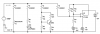
272366 schematic.png
The "RAMP" generator at the left generates a linear voltage ramp from 0V to +10V over the simulation period of 10 seconds. This voltage is applied to four separate circuits through current shunts I1~4, and the currents through these shunts are graphed below.
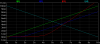
272366 curves.png

These traces show the V-I (voltage vs. current) behaviour for the four circuits.

The green trace shows the current through I1, which feeds the resistor named "RESISTOR". It has a resistance of 1 kΩ so as the voltage rises from 0V to +10V, the current rises from 0 mA to +10 mA.

The green trace indicates an ohmic component, because the V-I (voltage vs. current) graph trace (a) is perfectly straight for its entire length, (b) is angled between 0° and 90°, and (c) intersects the origin (the (0,0) point) of the graph, i.e. when V=0, I=0.

The green trace is the only example here that can be said to have a simple resistance.

The blue trace shows the current through an LED with a 1 kΩ series resistor. As you can see, the current doesn't really start taking off until the voltage reaches about 1.7V, when the LED's forward voltage is reached and it starts to conduct. Beyond that, the trace appears to be straight.

The blue trace is not straight for its whole length, so the circuit (LED plus series resistor) is not a simple resistance. The main angled part is close enough to straight that it's meaningful to take a section of it and calculate the incremental resistance. This is calculated as the change in voltage divided by the change in current for a section of the graph.

For example, take the rightmost division of the graph, where the voltage increases from +9V to +10V. The change in voltage is 1V. The current increases from 7.183 mA to 8.1721 mA, which is a change of 0.9891 mA. Therefore the incremental resistance at that point in the graph is 1011Ω. 1000Ω comes from the series resistor and 11Ω is the incremental resistance of the LED at an operating current of around 7~8 mA.

The red trace shows the V-I relationship for a simple circuit using a transistor as a common emitter amplifier. This curve is typical of a more complicated circuit: very little current flows until the voltage reaches a certain point, then the current starts to increase. In many circuits the increase will not be nice and linear like it is here.

The red trace's incremental resistance can also be calculated. In the 9~10V section of the graph, the current changes from 9.774 mA to 11.861 mA, an increase of 2.087 mA, so the incremental resistance of the circuit is 479Ω in that portion of the graph. It comes from the base circuit (about 11,660Ω) in parallel with the collector circuit (about 500Ω, mostly in R5, 470Ω).

The light blue trace shows the V-I relationship for a negative resistance circuit built with an op-amp, U1. This circuit is specifically designed to provide a voltage vs. current relationship that "goes the other way" - increasing the voltage at the circuit's connection point actually decreases the current it draws!

That circuit provides a carefully controlled, well-defined, linear negative resistance over a useful range of voltages. Negative resistance also occurs over certain parts of the V-I curve in other components such as gas-filled tubes, but in those cases it is not as clean, linear and predictable.

These traces only show part of the big picture. They show the circuits' behaviour for positive voltages only, and they don't show how the V-I relationship can be time-dependent, which is an important characteristic of capacitors and inductors, and dependent on other factors, such as the state of the component or circuit. The test setup simply runs a ramp voltage into each circuit and graphs how the current varies as a result.
 
Last edited:
Top