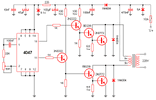
Another INVERTER we can talk about..

K

Kasamiko

Jan 1, 1970
0
Guys check this out.
another DC to AC power inverter based on 4047 chip with adjustable frequency..
What can you say?? worth discussing?? :D


Rhonn ;) ;)

4047_Inverter.gif


audioguru2

Apr 6, 2004
12,026
Joined
Apr 6, 2004
Messages
12,026
Hi Rhonn,
Oh goody, another one!
I figure that it will give about 200W. A few comments:
1) Those nice 2N3772s cost nearly 3 times as much as ordinary 2N3055s. If you parallel two 2N3055s on each side, the performance will be the same but cost less.
2) The BD239s will be running at their limit of 2A. I recommend BD243s which are rated for 6A and cost nearly the same.
3) Those 100 ohm resistors will dissipate 1/2W. Use 1W.
4) 100 ohms will be fine instead of those 6.8 ohm ones.
5) Use a higher current anti-reverse diode. The little one might protect the fuse then it will say "c'mon" to the rest of the circuit. ;D
6) Why have such a wide range of adjustable frequency? A SPST switch can select a fairly accurate 50Hz and 60Hz.

 
K

Kasamiko

Jan 1, 1970
0
@Ante
The circuit will guarante 100 watts I think.. ???

@Audioguru
A swith approach is better I think..Pls tell me how to do it..

Here's the whole article: (Please somebody can translate it)

"Para reducir o elevar una tensión determinada nada se adapta mejor que un transformador, pero este componente no funciona en corriente continua, que es la disponible en baterías o vehículos. Entonces debemos colocar un oscilador que genere una alternancia en la CC para así tener en la bobina del transformador CA. El circuito integrado (4047) es un oscilador cuyas salidas son una inversa con respecto de la otra. Esto quiere decir que mientras una está en estado alto la otra está bajo y viceversa. Estas señales son demasiado débiles para mover el trasformador así que se implementa un driver formado por tres transistores en cadena. El diodo en paralelo con cada uno de los transistores finales evita que la corriente inversa producida al retirar la corriente del bobinado queme el transistor. El diodo de 5A colocado en paralelo con la línea de alimentación genera un cortocircuito cuando la polaridad es accidentalmente invertida, haciendo que el fisible salte. El preset de 50K permite ajustar la frecuencia del oscilador, que es directamente proporcional con la frecuencia de la CA producida en el trafo. Para que el oscilador trabaje estable se ha dispuesto el resistor de 220 ohms como limitador de corriente y el zener de 9.1v junto con sus capacitores de filtrado. Este conjunto hace que sin importar los cambios en la batería la tensión en el oscilador sea de 9v.

El transformador puede ser uno común de los que se emplean para hacer fuentes de alimentación, solo que en este equipo lo usaremos inversamente. En vez de aplicar tensión en el devanado de 220v y retirarla por el de 18v lo que haremos es ingresar la tensión por el devanado de 18v y retirarla por el de 220v. En realidad los cálculos de este elemento dan como necesario un bobinado de 220v y otro de 9.3v+9.3v, pero como no es común este tipo de valores hemos implementado uno de 9+9 que es muy habitual en los comercios. Dado que esto genera algo mas de 220v si quiere puede emplear un transformador de 10+10 (que también está disponible) pero la tensión generada, alimentando el conjunto con 12v será de 204v. Ud. decide. En nuestro caso empleamos el de 9+9. La capacidad del mismo debe ser de 100VA

Los transistores de salida deben ser colocados sobre disipador de calor. Respetar las potencias de los resistores en los casos que sea indicado. Comprobar la posición de los diodos y capacitores electrolíticos. Utilizar cables de sección adecuada para la conexión de la batería. Cables demasiado delgados pueden causar caídas de tensión o funcionamiento errático. Una buena alternativa para comprobar el funcionamiento visualmente es colocar un indicador de neón en la salida de 220V. Así, solo cuando el sistema trabaje adecuadamente el indicador brillará.

Calibración: Basta con alimentar el sistema y colocar un frecuencímetro ú osciloscopio en la salida del trafo. Girar el preset de 50K ubicado en el 4047 hasta que la frecuencia medida sea de 50Hz. Luego de esto la calibración habrá concluido. Simple.

IMPORTANTE:
Este equipo genera corriente alterna cuya forma de onda es cuadrada. Esto es así porque los transistores están dispuestos en corte / saturación. Esto no presenta problemas para los equipos resistivos, como soldadores, lámparas o fuentes. Pero equipos de TV o grabadoras de vídeo que empleen como referencia la frecuencia y onda de la red pueden no funcionar correctamente.


Nota: Todos los esquemas aquí puestos son en parte recopilados de la red así como otros son de creación propia o bien desde algún aporte. Por tanto no han sido todos testeados y verificados. Si alguien se anima a armar alguno están bienvenidos los resultados y inconvenientes que se tuviesen en el camino así como también los pcb
 
Last edited:

ante1

Jan 24, 2004
4,138
Joined
Jan 24, 2004
Messages
4,138
Rhonn,

Yes 100VA is almost 100W but you can


audioguru2

Apr 6, 2004
12,026
Joined
Apr 6, 2004
Messages
12,026
Hi Sasi,
Where is your schematic?
I agree that MOSFETs are better, but are not available everywhere like 2N3055 transistors are.
Those MOSFETs cost the same as 2N3055s in Canada, and they are both very cheap.

Hi Rhonne,
To switch the frequency of the 4047, use a 47K resistor for 100/50Hz, and switch a 220K or 240K in parallel for 120/60Hz. Permanently join one side of the resistors. Long switch wires might pickup interference.


ante1

Jan 24, 2004
4,138
Joined
Jan 24, 2004
Messages
4,138
Sasi,

Look good, a few points: Why not use a 230VAC changeover relay, this will lower the cost and component count (one transformer, one rectifier, and one cap). At least remove the capacitor to get a quicker changeover? But don


audioguru2

Apr 6, 2004
12,026
Joined
Apr 6, 2004
Messages
12,026
Hi Sasi,
Congratulations, that's a nice simple circuit and a good PCB layout.
What is the relay for? It looks like a relaxation oscillator, where the gate drivers start running then quickly turn-off then start again, etc.
What are the paralleled 0.01 ohm resistors for?
How much current does the inverter draw from the battery without a load?
At full 500W load, don't the MOSFETs get only a little bit warm when mounted on a fairly small heatsink?


audioguru2

Apr 6, 2004
12,026
Joined
Apr 6, 2004
Messages
12,026
Ohhhhhh! I get it! Thanks.
The relay is for the inverter to give automatic changeover so that it can be a backup AC power supply when the mains fails.
Your gamble is that the inverter will be overloaded for a moment if the load is a straining motor or an appliance with a huge filter capacitor, due to the inrush current after the relay delay. Those 50A MOSFETs have a combined rating of 200A(!), so they should be able to handle it and your wiring will limit that huge current anyway.

Sasi,
I am interested about its current without a load because most heating of the MOSFETs may occur when both sides are turned-on at the same time during their switching. Using a biased LM393 (it is an 8-pin dual) fast-turnoff comparator and pullup resistors on its outputs (it has open-collector output), instead of the slow opamp may help that. You can do a lot of simple timing tricks with a comparator (small delay before gate turn-on, etc.)
And the inductance of a transformer that is used backwards may not be enough to make it efficient with light loads.


audioguru2

Apr 6, 2004
12,026
Joined
Apr 6, 2004
Messages
12,026
Hi Ante,
Sure, the SG3524 will do a pretty good job here, and in addition to providing an adjustable "dead time", it can provide output voltage regulation and current-limiting, too. But its age shows in its single-ended outputs, designed for driving bipolar transistors, not high-gate-capacitance MOSFETs. Nowadays a maker must have a modern SMPS IC with push-pull outputs.
A quick look at IR showed that their 330W IRF2804 MOSFET with its 2.3milliohm on-resistance is coming down in price. A single pair on a small heatsink will easily give an inverter a 500W output.

 
K

Kasamiko

Jan 1, 1970
0
It looks like a complete UPS system for me.. minus the sine wave output;D
I thought I was the only interested in inverter circuit here since BLACK-OUT is part of our daily life. :'(
Mosfet is very effecient for this work but very hard to find in my place and to tell you, a good quality of 2N3055 cost about US$1.00 here. A single MOSFET? almost 3X the price of 2N!!!

Rhonn ;) ;)


MP1

Dec 7, 2003
3,399
Joined
Dec 7, 2003
Messages
3,399
Sasi, nice inverter drawing. Are you using a 24 Volt supply? I see + 12V and - 12V Battery connections on the drawing. Or does this refer to the + and - posts of a single 12 volt battery buss?

Here is also something to consider on your inverter projects: Bigger is not better as in what you get from the power grid. From your power company, you have a meter and you will only be charged for what you are drawing. The inverter will always be using the battery power as long as it is connected to the battery. The more watts, the more draw. If you are connected to solar panels, this means a lot since you have to buy more panels to keep the batteries up. A good solution is to use several smaller inverters which are isolated from the battery when nothing is plugged in to them ...or if it is a backup system, isolate the battery drain when the mains are on. It will save you $$.

MP


audioguru2

Apr 6, 2004
12,026
Joined
Apr 6, 2004
Messages
12,026
The relay will function as a bypass, if there is a presence of AC mains the inverter will not start, it will just bypass the mains line to load.

when the mains fails the inverter will start and load will energised, and when the mains come back it stop the inverter automatically. If there is no voltage in oscillator section the mosfets will remain in maximum resistance, will not draw any current from battery.
MP,
Sasi's backup system circuit has RLY Pole #1 to "isolate the battery drain when the mains are on".
 

MP1

Dec 7, 2003
3,399
Joined
Dec 7, 2003
Messages
3,399
That is not isolation. The circuit is only turned off. If he were to use a DPDT relay, and the second section was where the fuse is, then this would be considered isolation. Isolation means not connected.

MP


audioguru2

Apr 6, 2004
12,026
Joined
Apr 6, 2004
Messages
12,026
MP,
I'm sorry, the circuit is not truly isolated but instead simply reduces battery current drain. Sasi cleverly used a fairly fast-switching low current relay contact to accomplish this, instead of your recommended slow-switching high current relay.
I thought that you were concerned that the circuit was running all the time which will drain the battery.
With Sasi's relay turning the circuit off, it doesn't need complete isolation since the MOSFETs' uA of leakage current is much less than the self-discharge current of the battery.


ante1

Jan 24, 2004
4,138
Joined
Jan 24, 2004
Messages
4,138
Audioguru,

I like an inverter for car use and I need it to be sine wave output 230-240VAC 50Hz @ 300W. It would be very nice if it where variable 0


audioguru2

Apr 6, 2004
12,026
Joined
Apr 6, 2004
Messages
12,026
Hi Ante,
An inverter with 300W sine-wave output but without much heat?
Sure, it's nearly the year 2005, isn't it?
I'll look at using a class-D audio amp driver IC (but it will probably be surface-mount) and discrete MOSFETs. An output transformer will step-up the voltage and a low-power volume control will adjust the output voltage.

 
Top