Bench Power Supply

SOLARWIND

Jul 18, 2014
5
Joined
Jul 18, 2014
Messages
5
Hi chopnhack,

Check out your negative side: it also contains a positive regulator and would not work as connected. The output should be connected to the common rail and the GND of the 1084 should become the negative output.
See figure 26 on the TI data sheet:
http://www.ti.com/lit/ds/symlink/lm1084.pdf
 

Arouse1973

Adam
Dec 18, 2013
5,178
Joined
Dec 18, 2013
Messages
5,178
Yes I noted that but he did say he had not set the values yet, just the layout.
Thanks
Adam
 

chopnhack

Apr 28, 2014
1,576
Joined
Apr 28, 2014
Messages
1,576
Why do you need a bleed resistor? If you need a bleed resistor then place it across C2.
Adam
The bleed resistor is carried over from the initial design so I am not sure its completely necessary. I recall using it to protect the IC from capacitor discharge and to make sure the caps bled out over time.

I also noticed that I forgot to include the bridge rectifiers to the meters!!

@SOLARWIND - Thanks! I did see that in the datasheet, but that is for a fixed negative supply. I wanted to create an adjustable one. I read in that same document that the pinout is the same as the lm317, so when I was drawing this out, I repeated some of the original diagram.

I must say, after watching Dave at EEV, I am having to rethink my decision to "keep it simple"! As a bench supply, using a linear may not be a good choice since I will be inputing ~26-28V into the regulator and sometimes using as low as 5V, the rest must be dissipated as heat!! Major oversight on my part in the initial design. SMPS is a much better choice for this particular project.

For future reference, apparently linear regulators do well in tight range control, i.e. - input and output are close together while SMPS excels when the ranges are further apart.

Thanks everybody, I will be back - I need to do some research on SMPS - if you are not familiar with them, I love how Dave broke them down in his video, check it out!
 

Arouse1973

Adam
Dec 18, 2013
5,178
Joined
Dec 18, 2013
Messages
5,178
Hey Adam! Thanks for the reply.

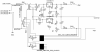
The second transformer is a small one to power two combination volt/ammeter LED displays. From what I read and as others have mentioned it needs to be powered separate from the power source. The black boxes at the bottom are the meters - 1 pair of wires for voltage sensing, other pair split the circuit to allow for measuring current, last pair, opposite is for powering the meter itself. One will meter the positive (top) rail and the other the lower negative rail.

I'm not sure I understand negative voltage very well. Where should R2 be placed if it is to be the bleed resistor for C2? Is current flowing from the common rail to the negative rail? If so, should the resistor be place between the bottom of C2 and the negative rail?

Thanks in advance :)

Cover the top part of the circuit with a bit of papper. Lable common as say 12 volts and the negative as common, you should be able to work things out from there. It then gets interesting if your vircuit allows it, when you find positive regulators make better negaive regulators than dedicated negative regulators :)
Adam
 

HellasTechn

Apr 14, 2013
1,579
Joined
Apr 14, 2013
Messages
1,579
I would rather stay with this simpler technology.


Linear psu is the best to use as a bench psu. SMPS are usefull, small and lightweight but not recommended for circuits that require stable noise free power input (eg. audio amplifiers).
 

chopnhack

Apr 28, 2014
1,576
Joined
Apr 28, 2014
Messages
1,576
Cover the top part of the circuit with a bit of papper. Lable common as say 12 volts and the negative as common, you should be able to work things out from there. It then gets interesting if your vircuit allows it, when you find positive regulators make better negaive regulators than dedicated negative regulators :)
Adam

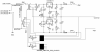
Not quite sure what you mean by this Adam, I get it, but when I go to draw the schematic I am left confused. For example, if I do as you say, when I set up my lower v.reg, would the output then go to the former common now labeled 12V? I thought the output of the IC was going to be the negative rail??

I have left the critical connections where I am confused omitted - can you help me figure out where they go?

upload_2015-4-13_1-10-36.png

Even if I blindly follow through, I come with the output unconnected - see the ??? marks.

upload_2015-4-13_1-31-30.png
 
Last edited:

chopnhack

Apr 28, 2014
1,576
Joined
Apr 28, 2014
Messages
1,576
Linear psu is the best to use as a bench psu. SMPS are usefull, small and lightweight but not recommended for circuits that require stable noise free power input (eg. audio amplifiers).
My concern is that in using this power supply with μ-processors that only need 5v, this unit will have to bleed off ~18-19v, if I have peripherals hooked up to the PIC and am using 1/2A, that would be ~9watts of heat lost. This is why I was thinking of perhaps using a SMPS supply. They are certainly more stable, but I wasn't sure if that much power being lost as heat was reasonable.
 

davenn

Moderator
Sep 5, 2009
14,470
Joined
Sep 5, 2009
Messages
14,470
yeah but building a SMPS that has a wide adjustable output voltage is more difficult
and the chances are you would still just use linear regulators to produce the adjustable output

unless you are referring to the DC-DC boost / buck converters ??

Dave
 

chopnhack

Apr 28, 2014
1,576
Joined
Apr 28, 2014
Messages
1,576
yeah but building a SMPS that has a wide adjustable output voltage is more difficult
and the chances are you would still just use linear regulators to produce the adjustable output

unless you are referring to the DC-DC boost / buck converters ??

Dave
Hi Dave, my thought was to rectify the AC from a transformer and use a buck converter - thus providing the necessary isolation from mains.
 

Arouse1973

Adam
Dec 18, 2013
5,178
Joined
Dec 18, 2013
Messages
5,178
Not quite sure what you mean by this Adam, I get it, but when I go to draw the schematic I am left confused. For example, if I do as you say, when I set up my lower v.reg, would the output then go to the former common now labeled 12V? I thought the output of the IC was going to be the negative rail??

I have left the critical connections where I am confused omitted - can you help me figure out where they go?

View attachment 19623

Even if I blindly follow through, I come with the output unconnected - see the ??? marks.

View attachment 19624

Um ok so it might not work quite so well for your design. But most people can't get there head around circuits which have negative voltages. To switch it to something you can understand as far as where all the current is going you can label the common as +V and the negative as common. Some people find it helpful.
Adam
 

chopnhack

Apr 28, 2014
1,576
Joined
Apr 28, 2014
Messages
1,576
Um ok so it might not work quite so well for your design. But most people can't get there head around circuits which have negative voltages. To switch it to something you can understand as far as where all the current is going you can label the common as +V and the negative as common. Some people find it helpful.
Adam

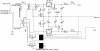
I think I get it - its a vector thing - its just the direction of flow, so the negative rail is just more negative than common, thus charge flows from more negative to common. Really no different than flow of charge moving from common to positive rail, if I got it right.

And if the above is true, then the adjust of the IC on the negative rail will get split between an adjustable voltage divider just like in the top half.
What do we think?


upload_2015-4-14_0-27-37.png
 

davenn

Moderator
Sep 5, 2009
14,470
Joined
Sep 5, 2009
Messages
14,470
you still have a LM1084H in the negative supply
you cannot do that, its a positive adjustable regulator you need a negative one

still trying to find one suitable

the best I can find is a LM333 3A and adjustable voltage
parallel 2 of them and you would have your 5 - 6 Amps
went through a dozen sites and couldn't find anything higher than 3 A


Dave
 
Last edited:

chopnhack

Apr 28, 2014
1,576
Joined
Apr 28, 2014
Messages
1,576
I see where I goofed again - solarwind pointed it out, but I misunderstood the datasheet. I'll post a new schematic tonight.

Thank you Dave! Its rather hard to find a good design!!
 

Arouse1973

Adam
Dec 18, 2013
5,178
Joined
Dec 18, 2013
Messages
5,178
I think I get it - its a vector thing - its just the direction of flow, so the negative rail is just more negative than common, thus charge flows from more negative to common. Really no different than flow of charge moving from common to positive rail, if I got it right.

And if the above is true, then the adjust of the IC on the negative rail will get split between an adjustable voltage divider just like in the top half.
What do we think?


View attachment 19675

Yes you got it. But remember common is more positive than the negative rail, so conventional current will be from the common rail (zero volts) to the negative rail this is what confuses people because they see zero volts as nothing.
Adam
 

HellasTechn

Apr 14, 2013
1,579
Joined
Apr 14, 2013
Messages
1,579
I think I get it - its a vector thing - its just the direction of flow, so the negative rail is just more negative than common, thus charge flows from more negative to common. Really no different than flow of charge moving from common to positive rail, if I got it right.

View attachment 19675

Moveing from Positive rail to Common (if you preceive the positive rail as sypply line).
 

HellasTechn

Apr 14, 2013
1,579
Joined
Apr 14, 2013
Messages
1,579
Yes you got it. But remember common is more positive than the negative rail, so conventional current will be from the common rail (zero volts) to the negative rail this is what confuses people because they see zero volts as nothing.
Adam

Some times i wonder. what is better to use the conventional current flow or the real current flow which is from negative pole to positive.
 

Arouse1973

Adam
Dec 18, 2013
5,178
Joined
Dec 18, 2013
Messages
5,178
Some times i wonder. what is better to use the conventional current flow or the real current flow which is from negative pole to positive.

yeah I know what you mean. I use both depending on what I am trying to work out. But unfortunately the circuit symbols we use make it even more confusing if you try and use actual current direction.
Adam
 

davenn

Moderator
Sep 5, 2009
14,470
Joined
Sep 5, 2009
Messages
14,470
But unfortunately the circuit symbols we use make it even more confusing if you try and use actual current direction.

ohhh ? like what ?
ok maybe transistors, but not diodes ;)
 

Arouse1973

Adam
Dec 18, 2013
5,178
Joined
Dec 18, 2013
Messages
5,178
Directional arrows like on Transistors and Diodes perhaps!
 
Top