Hi friend Walid,
I'm sorry you don't understand me, I'm not a teacher nor an author.
walid said:
90% of Audioguru answers are obscure at least for me. Take a look at these examples:
(1) autir ask: How did you choose the Ib (2.4uA) to I(R1R2) (27uA) ratio?
Audioguru's answer: A 10:1 ratio in a voltage divider doesn't allow the divided voltage to change much when a low gain transistor causes a 5:1 ratio or a high gain transistor causes a 20:1 ratio.
The resistors could also be 360k for R1 with 51k for R2.
I try to understand it fore an hour but could not.
Each part number and each sample of transistor has a different current gain. Transistors have very reduced gain at high currents. Therefore I calculate the current in the voltage divider to have about 10 times the transistor's
base current, not 1/7 times the emitter current as in your tutorial, nor 1/20 times the emitter current as taught elsewhere.
The transistor I selected has a typical gain of 230 and a minimum gain of about 100 with my chosen 0.55mA emitter current. Therefore its max base current is about 5.5uA. So the minimum ratio of divider current to max base current is actually 4.82:1, not 5:1 as I said.
The divider could be 330k and 47k or 360k and 51k and the results would be the same.
You shouldn't neglect the base current because it affects the divider's voltage.
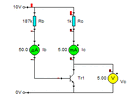
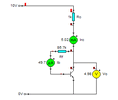
The voltage of the divider without any base current is 1.25V. With a transistor's typical base current of 2.4uA, the voltage at the base of the transistor is 1.15V. Therefore its emitter current will be 0.5V, its emitter voltage will be 0.5V and its collector voltage will be 5.0V, not 5.5V like I planned. With its max 5.5uA of base current, a low gain transistor would change the base voltage to 1.05, its emitter voltage will be 0.4v and its collector voltage will be 6V.
If you used your tutorial's formula of having a divider current equalling 1/7 of the emitter current then the divider will have a current 3 times as much as mine, and the collector voltage will change less with changes in the transistor's gain. The tutorial's author wrongly calls the divider's current the "base current".
If you used your tutorial's formula of having a divider current equalling 1/7 of the emitter current then with a power transistor having low gain at high current, the divider current won't be enough but my formula still works.
(2) autir ask: The Ib/Ic ratio in your circuit is proof of the hfe value of the transistor you used. Why, then, does it work the same with different hfe's? Does this mean that the Ib/Ic ratio can be decided by me without any consenquences regarding the circuit's function?
Audioguru's answer: I selected a transistor whose hFE is never less than half its typical, nor more than double. The circuit would need more current in the R1/R2 divider if a transistor with a lower minimum hFE was used.
walid: hfe in Audioguru's design = IC/IB = 0.55mA/27uA = 20.37 and this is less than half its typical.
I don't understand what you are asking because my divider's current is a multiple of the base current, not a fixed fraction of the emitter current.
I don't see where Walid said that. My transistor has IC/IB = 230.
(3) autir ask: The gain factor is calculated by the R3/R4 ratio, if I'm not mistaken?
Audioguru's answer: it is long and far from a direct answer
I said the correct and accurate formula for the gain and everything that should be considered when calculating gain. Autir's simple formula would calculate a gain of infinity if the emitter resistor was zero or bypassed which is plainly wrong. Frequently, a correct answer to a question in electronics is "long and far from being direct".
(4) In his reply to Alun, Audioguru surprised that ther is no RE and no R2, why i don't know.
I tell him that this circuit called a self biased and is found as the first circuit in a small sig amp in any electronic book and this circuit is used in realty, i see it many times in areal designs.
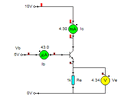
Alun's circuit isn't self-biased. A self-biased circuit has its base resistor connected to its collector, not its supply, for negative feedback which controls its operating point when a transistor having a different gain is used or the temperature changes.



 >
>
