BJT power supply

walid1

Jun 27, 2004
749
Joined
Jun 27, 2004
Messages
749
What the difference between:
1- Using one 12VDC power supply connected to RC, and
2- Using two power supplies; +6VDC connected to RC & -6VDC connected to RE, thanks.


audioguru2

Apr 6, 2004
12,026
Joined
Apr 6, 2004
Messages
12,026
The base or collector voltage will be at or closer to ground with a dual polarity supply.


prateeksikka

Jun 19, 2004
736
Joined
Jun 19, 2004
Messages
736
But it is always advisable to keep ground at 0 rather than a negative supply!

 
A

Alun

Jan 1, 1970
0
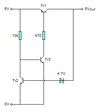
Here''s a low dropout regulator I designd a while ago, it was designed for low power useage (<100mA) and I've never needed to build it. I have a feeling it will form an oscilator as it's effectively  a 3 stage high gain amplifier, does anyone here know how to compensate it properly to prevent oscilation?

Low_dropout.GIF


ante1

Jan 24, 2004
4,138
Joined
Jan 24, 2004
Messages
4,138
Hi Alun,

Why not use modern components like mosfets instead?
Or an LM2931-5?

 
A

Alun

Jan 1, 1970
0
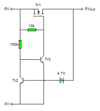
Yes but this is more of an experiment more than anything else, besides it's cheaper than an LM2931-5. ;D a MOSFET would work very well in fact because it's on resistance is so low the dropout voltage might be even lower than the LM2931-5.

Oscillation might still be a problem though, I wonder if a capacitor on the output would get rid of it or whether I should add other compensation capacitors between the different stages.

Low_dropout_FET.GIF

 
Last edited:

audioguru2

Apr 6, 2004
12,026
Joined
Apr 6, 2004
Messages
12,026
Hi Alun,
I think a big output capacitor or small one at the collector of Tr3 to ground will compensate it pretty well. ;D


ante1

Jan 24, 2004
4,138
Joined
Jan 24, 2004
Messages
4,138
A 1 volt drop!  :eek: Not good enough! ;D

I will find out how to do it! ;D

 
A

Alun

Jan 1, 1970
0
Low voltage dropout regulators can be very useful, for example you might want to power some sensitive 12V electronic appliance from a car battery. The normal voltage on a full car battery is 13.8V and spikes as high as 15V can appear. Modern regulators with dropout voltages of less than 100mV at several amps have been developed and these are ideal for this application.


ante1

Jan 24, 2004
4,138
Joined
Jan 24, 2004
Messages
4,138
Hi Alun,

Yes, it’s for a vehicle application and I need about 2A at 12.0V. I found a good circuit for this app I think. I will put a zener in to protect the 555 from spikes though. Any suggestions for further improvements on this circuit? 8)

View attachment 37509

 
A

Alun

Jan 1, 1970
0
Ante said:
Hi Alun,

Yes, it’s for a vehicle application and I need about 2A at 12.0V. I found a good circuit for this app I think.
Yes I thin this a is a good idea.


I will put a zener in to protect the 555 from spikes though. Any suggestions for further improvements on this circuit? 8)
This isn't such a good idea, the circuit relies on the voltage double formed by D1, D2, C2 and C3 on the output of the 555. T1 needs the gate voltage to be higher than it's source to turn on witout this voltage doubler the dropout voltage would be much >2V. C2 is a programable shunt regulator that looks at the output voltage and adjusts the gate voltage on T1 accordingly.

I've built my circuit and it works very well, I added a 100n and 100uf capacitor on the output and a 100uf on thie input. I didn't use any other compensation capacitors since the transistors aren't passing much current their gain is too low for oscilation and the 100uf & 100nf on the output did their job very well. I needed to add a 620ohm resistor from Tr's base to ground because there was too little current flowing though the zener to establish a sizable voltage drop across it, with a 4.3V zener the output was only 2.4V, I used a 5.1V one in the end to give 5.6V.

Both circuits will have a dropout voltage = Ron * current (Ron = MOSFET on resistance) but yours will be better as N channel MOSFETS generly have a lower on resistance. Your circuit might be able to be improved by using an op-amp and a precision voltage reference.

Do you have a technical description of this circuit?
 

Kevin Weddle

Feb 23, 2004
1,620
Joined
Feb 23, 2004
Messages
1,620
Alun, if you have definitely identified a voltage doubler circuit and you know approximately what the voltages are, could you please explain the circuit.


ante1

Jan 24, 2004
4,138
Joined
Jan 24, 2004
Messages
4,138
Hi Alun,

I can’t see any problem with a zener to protect the 555???
Can you explain why this is not a good idea?


audioguru2

Apr 6, 2004
12,026
Joined
Apr 6, 2004
Messages
12,026
Kevin,
The voltage doubler is the standard 555 driving a boost capacitor, 2 diodes and a filter capacitor for a low current voltage that is higher than the supply voltage. The gate voltage of the source-follower Mosfet needs to be up to 6V higher than its source voltage (the supply voltage) for it to turn on. ;D

 
A

Alun

Jan 1, 1970
0
Ante said:
Hi Alun,

I can’t see any problem with a zener to protect the 555???
Can you explain why this is not a good idea?
Where do you want to put the zener?

If it's across C3 then it's a bad idea because it would absorb the high voltager on the doubler, if it's on pin 3 then it wouldn't serve any purpose because the 555 isn't switching an inductive load so there's no chance the voltage on pin 3 can be higher than the power supply.

Perhapps putting one across the power supply might be a good idea to remove any voltage spikes on the power supply but this would be a good idea for any electronic circuit run off a noisy automotive power supply. I personally wouldn't bother unless I was sure the transient  could be higher than 16V which is the highest I've come across on an automotive supply.
 

audioguru2

Apr 6, 2004
12,026
Joined
Apr 6, 2004
Messages
12,026
With the engine driving the alternator, high voltage spikes are caused when a battery terminal makes poor contact with the battery. Many cars have cruddy battery posts and people replace the "failing battery" instead of cleaning and tightening the connections. ;D


ante1

Jan 24, 2004
4,138
Joined
Jan 24, 2004
Messages
4,138
Alun; The plan was to put it right across the supply for the 555, where else should I put it if I wanted to protect the 555??

Audioguru; I know how to take care of the battery poles but I still like to protect circuits I build from unnecessary damage. ;D  When a battery is well taken care of and in good condition it serves as a large capacitor which will prevent most of the spikes and interference in the vehicles electronic environment. However you have to connect your gizmos close to the battery and keep the wires shielded or short curse the wiring (like an antenna) picks up spikes and pulses from all kinds of sources which will be of higher amplitude the longer the wiring goes from the battery! In this case I need a long wire that’s why I use a zener!;D ;D


audioguru2

Apr 6, 2004
12,026
Joined
Apr 6, 2004
Messages
12,026
Hi Ante,
Are you feeding your 555 from the little fused wire for the fuel pump? In my son's car, the fuel pump was getting only 9V and couldn't pump enough fuel for his boosted turbo until much heavier wire was installed for it.
Install your own wire for the 555 from the battery and you won't have voltage spikes.
If your car is very rusty then also install a ground wire.
I think that only millivolts of spikes will be inductively and capacitively coupled from other wires to the extremely low impedance of a piece of wire. ;D


ante1

Jan 24, 2004
4,138
Joined
Jan 24, 2004
Messages
4,138
Hi Audioguru,

Why would I use the wire for the fuel pump! ;D  The only time I use the pump wiring is when I fit a fake alarm (blinking LED) to someone’s car. Then I use the positive pump wire as negative feed for the blinking LED, this goes to ground through the motor. This way the fake alarm goes out when you switch the ignition on. I this case I am experimenting with a laser module (15W) which requires 12.0V. I have seen many spikes on the scope when probing vehicle electric systems in the hundreds of volts magnitude. Wires in parallel with other wires for AC compressor clutches is one example of what can cause big spikes. :eek:

 
Top