Capacitor charging using low voltage supply

hubble

Jul 5, 2007
46
Joined
Jul 5, 2007
Messages
46
Hello, is there a good way to charge 10mF 63v capacitor to, say, 50v from a 5v 1.5khz source?

Thanks.


Hero999

Oct 28, 2007
2,433
Joined
Oct 28, 2007
Messages
2,433
More information is needed.

Where are you getting the 5V 1.5kHz signal from? What's the wave from? Is it 5V peak, peak to peak or RMS?

A capacitive voltage multiplier or a transformer with a rectifier on the output would work.


hubble

Jul 5, 2007
46
Joined
Jul 5, 2007
Messages
46
In my previous thread, I had posted a question regarding the nature of waveform generated by stepper motor. I measured emf generated by motor using DMM and the Vrms was just over 5V. As I am not having the oscilloscope, I tried to theoretically calculate the frequency of the wave. It is a 200 step motor rotating at 4 RPS, so 200*4=800 before rectification. After it passes through the rectifier it is 800*2=1600Hz (I took 1.5khz). I am not sure whether it is a correct way to calculate.

Thanks. 


Hero999

Oct 28, 2007
2,433
Joined
Oct 28, 2007
Messages
2,433
What do you intend to power with the capacitor?

How about gearing it up to increase the speed?


hubble

Jul 5, 2007
46
Joined
Jul 5, 2007
Messages
46
Capacitors are the fastest components to charge according to me. They are great for storage, especially super capacitors. I had earlier planned to use planetary gear system to increase the rpm five fold but they are not readily available here nor can I design the system myself and have them fabricated(or 3D printed) because of lack of resources. And, the motor rotary mechanism is quite small so it is really very difficult to use other type of gear mechanism.

Thanks.


Hero999

Oct 28, 2007
2,433
Joined
Oct 28, 2007
Messages
2,433
That may be true but capacitors don't store much energy, compared to batteries and will only charge as quickly as the energy is supplied to them. If your 5V generator only gives 1mA once it's been boosted to 50V, then it will take 500s to charge up, assuming the current is constant.


hubble

Jul 5, 2007
46
Joined
Jul 5, 2007
Messages
46
I am okay with the amount of energy stored by the capacitor. Batteries, according to my information, are slow charging devices when compared with capacitors. By the way, how do I step up the voltage? Can I use some boost converter to raise it to considerable level and then use voltage doubler or something like that to achieve some efficiency? I was struggling to calculate the time required to charge the capacitor to a particular voltage. How did you calculate the capacitor charging time?

Thanks.


Hero999

Oct 28, 2007
2,433
Joined
Oct 28, 2007
Messages
2,433
A fairly good description of a voltage multiplier can be found on Wikipedia:
http://en.wikipedia.org/wiki/Voltage_multiplier

The charge rate of a capacitor can be calculated by rearranging the following formula:
Q = CV
Q = It


hubble

Jul 5, 2007
46
Joined
Jul 5, 2007
Messages
46
Thanks for providing the link and the equation. However, can boost converter be used here in this case after rectification to raise the voltage to something around 25 to 30 volts and then use multiplier? 


Hero999

Oct 28, 2007
2,433
Joined
Oct 28, 2007
Messages
2,433
What do you think?

A boost converter increases the voltage of a DC supply. The voltage multiplier circuit I linked to converts AC to DC, as well as boosting it, unless you're talking about the CMOS charge pump.


hubble

Jul 5, 2007
46
Joined
Jul 5, 2007
Messages
46
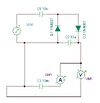
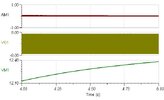
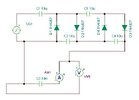
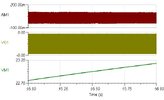
After days of trying to choose between different ways, I chose to go with the CW multiplier. Tried to charge for more than 30 sec with 1n4007 and 10 nF cap system, the 10 mF cap got charged to only 500 mV. I think I have chosen wrong value cap. Here, I tried to simulate with 7 VA 800Hz source, and different stages of 10 uF cap and 1n4007 in TINA, got this result as shown in the attachment. Where am I going?

circuit.JPG

tinadiag.jpg

circuit2.JPG

tinadiag2.jpg


Hero999

Oct 28, 2007
2,433
Joined
Oct 28, 2007
Messages
2,433
Your circuit is working, at least in simulation. Increasing the values of the capacitors in the voltage multiplier circuit will speed things up. Try replacing the 10uF capacitors with 100uF capacitors.

The maximum voltage on the capacitor will always be lower than expected, due to the diode losses. Using Schottky diodes may help this but the reverse leakage current is normally a bit higher.

In reality there's also a limit on how fast the capacitor will charge as the stepper motor will have an internal impedance which will slow it down.

 
Last edited by a moderator:

hubble

Jul 5, 2007
46
Joined
Jul 5, 2007
Messages
46
I apologize for delay in getting back. Actually, my mom met with an accident so I had to take care of her and couldn't do any other work in these 20-25 days. But, now she is recovering well. In the meanwhile, I dropped the idea of using voltage multiplier and instead thought of using transformer. I had a 230 VAC / 12 V 200 mA adapter. Took a transformer out and connected the secondary coil to the stepper motor and measured the output at the primary: the rectified output was around 85 - 90 V. Upon connecting 22 kohm resistor, the output dropped to around 50 V. Can I use this transformer to safely charge a 63 V capacitor to 50 V?

Thanks.


Hero999

Oct 28, 2007
2,433
Joined
Oct 28, 2007
Messages
2,433
Sorry to hear about your mum.

A transformer is a good idea but bear in mind the reading on the meter is the RMS voltage, not the peak, so if you rectify 50VAC you'll get 50*sqrt(2) = 70.7V minus the losses in the bridge rectifier.

Use a 230V:24V transformer or a 120V:12V transformer.


hubble

Jul 5, 2007
46
Joined
Jul 5, 2007
Messages
46
Thanks for your response. Can I use 50 - 51 V zener diode after the voltage is rectified? Won't I be wasting lots of energy in the process? I shall try to find the 230 V to 24 V transformer.

Thanks.


audioguru2

Apr 6, 2004
12,026
Joined
Apr 6, 2004
Messages
12,026
The heating of a zener diode wastes power. It is simply the voltage across it times the current in it to give the number of Watts of heating.


Hero999

Oct 28, 2007
2,433
Joined
Oct 28, 2007
Messages
2,433
The zener diode only wastes power when the capacitor has charged to 50V.

You may be able to make a precise 50V zener diode from the TL431. The problem is it's only rated to 36V but a common base amplifier can be added to boost it to 50V. The extra gain may cause oscillation though. I haven't tested it.

The efficiency of this circuit will be poor anyway.

View attachment 42538

 
Last edited by a moderator:

hubble

Jul 5, 2007
46
Joined
Jul 5, 2007
Messages
46
I am not able to understand the point of using transistor here. Can I not just connect the 10 mF capacitor across the zener diode to charge it?

Thanks.


Hero999

Oct 28, 2007
2,433
Joined
Oct 28, 2007
Messages
2,433
The TL431 is not an ordinary zener diode. It's an op-amp with a buit-in voltage reference. Unfortunatly its maximum voltage rating is 0nly 36V so a transistor is used to buffer it.
http://www.ti.com/lit/ds/symlink/tl431.pdf

 
Top