You are using an out of date browser. It may not display this or other websites correctly.
You should upgrade or use an alternative browser.
You should upgrade or use an alternative browser.

Scroll to continue with content
Regarding thermal dissipation - the 78M05 datasheet says that the RθJA is 92 deg C/W. Does that mean the IC would approach roughly 65 deg. C?
Being in an enclosed box, I think that is fairly hot.
Would it be a good idea to put a buck converter in front of the v. regulator?
Being in an enclosed box, I think that is fairly hot.
Would it be a good idea to put a buck converter in front of the v. regulator?

- Joined
- Nov 28, 2011
- Messages
- 8,393
That figure, 92 °C/W, applies to the package itself, with no heatsinking. I suggested an SMT package so you can provide a copper area to spread and dissipate the heat. This reduces the thermal resistance to ambient.
The data sheet for the Infineon 78M05 in TO-252 (DPAK) package says the thermal resistance from junction to ambient is 52 °C/W if the device is mounted on an area of copper 17 x 17 mm (specifically, 300 mm2) on a single sided PCB. I assume this copper must not be covered by a solder mask. If you can place a similar pad on the other side, and use thermal vias to connect them together thermally, the thermal resistance from junction to ambient will be a lot less than 52 °C/W. Probably less than 40 °C/W. And the extra thick copper will help too.
If the maximum dissipation is 750 mW that would be a temperature rise of 30 °C above ambient, maximum. That would be reasonable wouldn't it?
There are some interesting PDFs available - Google thermal resistance of PCB copper.
The data sheet for the Infineon 78M05 in TO-252 (DPAK) package says the thermal resistance from junction to ambient is 52 °C/W if the device is mounted on an area of copper 17 x 17 mm (specifically, 300 mm2) on a single sided PCB. I assume this copper must not be covered by a solder mask. If you can place a similar pad on the other side, and use thermal vias to connect them together thermally, the thermal resistance from junction to ambient will be a lot less than 52 °C/W. Probably less than 40 °C/W. And the extra thick copper will help too.
If the maximum dissipation is 750 mW that would be a temperature rise of 30 °C above ambient, maximum. That would be reasonable wouldn't it?
There are some interesting PDFs available - Google thermal resistance of PCB copper.
Thanks Kris. A 30 degree rise would be fine, that would essentially be slightly above ambient temp. - however after reading http://www.ti.com/lit/an/snva419c/snva419c.pdf
I see some difficulty cramming all this into a 10cm or smaller PCB!
The link states that the theta figures are based on JEDEC standard test boards which are total of 3"x4" - I assume that this is free space for convection, my total board is little larger than the entire test board.
I have more vertical room that I do linear room, should I not choose the TO-220 package which has very low θJC?
I see some difficulty cramming all this into a 10cm or smaller PCB!
The link states that the theta figures are based on JEDEC standard test boards which are total of 3"x4" - I assume that this is free space for convection, my total board is little larger than the entire test board.
I have more vertical room that I do linear room, should I not choose the TO-220 package which has very low θJC?
- Joined
- Nov 28, 2011
- Messages
- 8,393
Using a TO-220 package won't help much unless you use a heatsink. θJC is a fairly small part of the total thermal resistance, θJA, and although it's important to keep the silicon cool, the most important temperature is that of the case and the PCB surface, which isn't affected by θJC; it depends on θCA (and the power dissipation and ambient temperature, which aren't variables we can change).
So we need to minimise θCA, thermal resistance from case (or PCB surface, for an SMT device) to ambient.
Have a look at the first two paragraphs on page 6 of that document.
The second paragraph makes it clear that having an airtight enclosure significantly hinders heat dissipation. They don't quantify the effect, but I think it's fair to assume it will be equal whether the heat is being radiated from the PCB copper or from a heatsink. Of course a heatsink provides a lower θCA to start with, because of its better thermal conductivity and its larger surface area.
The second paragraph also mentions the importance of the copper extending to the edges of the board. I don't know why this is so important, but it suggests that you should put the regulator's copper heat spreading pad in a corner of the board, or fully across one end of it. I'm not keen on that idea because the regulator is potentially live, and anything electrically connected to it should be contained within the PCB, and not able to make contact with any mounting or metalwork.
They mention that copper on both sides helps, but it's not clear whether they've assumed that thermal vias will be present. I suspect not; in that case, adding thermal vias will improve θCA.
I guess you could put large copper areas (e.g. 2 in2 or more) on both sides, possibly in a corner or across an end, with thermal vias, fit a DPAK device, and see how it goes. You could include holes for a TO-220 device and mounting holes for one or more sizes of heatsink, so if the copper heatsinking turns out to be inadequate you could change to a TO-220 regulator with a proper heatsink. How does that sound?
So we need to minimise θCA, thermal resistance from case (or PCB surface, for an SMT device) to ambient.
Have a look at the first two paragraphs on page 6 of that document.
The second paragraph makes it clear that having an airtight enclosure significantly hinders heat dissipation. They don't quantify the effect, but I think it's fair to assume it will be equal whether the heat is being radiated from the PCB copper or from a heatsink. Of course a heatsink provides a lower θCA to start with, because of its better thermal conductivity and its larger surface area.
The second paragraph also mentions the importance of the copper extending to the edges of the board. I don't know why this is so important, but it suggests that you should put the regulator's copper heat spreading pad in a corner of the board, or fully across one end of it. I'm not keen on that idea because the regulator is potentially live, and anything electrically connected to it should be contained within the PCB, and not able to make contact with any mounting or metalwork.
They mention that copper on both sides helps, but it's not clear whether they've assumed that thermal vias will be present. I suspect not; in that case, adding thermal vias will improve θCA.
I guess you could put large copper areas (e.g. 2 in2 or more) on both sides, possibly in a corner or across an end, with thermal vias, fit a DPAK device, and see how it goes. You could include holes for a TO-220 device and mounting holes for one or more sizes of heatsink, so if the copper heatsinking turns out to be inadequate you could change to a TO-220 regulator with a proper heatsink. How does that sound?
Sounds ok, I just dont understand how I could fit the required heatsink surface area on the board - even if I used both sides with thermal vias, we are talking about using 1 sq in. per side as a heat sink - the entire board is less than 15 sq inches! That is a lot of real estate on a pretty crowded board. I read that section that you referenced and it gave me pause - I figured the TO-220 form would have a better chance at dissipating the heat since it stands off the board and can be attached to a heatsink. The article talks about using 12mil vias.
I tried to workout the math, but physics was not my major. I will post my equations as soon as I finish reading some more on heatsinks!
I tried to workout the math, but physics was not my major. I will post my equations as soon as I finish reading some more on heatsinks!
Last edited:
- Joined
- Nov 28, 2011
- Messages
- 8,393
Yes, using PCB copper would waste a lot of space. You're probably right, a heatsink will be needed. Steve wrote a good introductory article on heatsinking: https://www.electronicspoint.com/resources/do-i-need-a-heatsink-how-big.29/
I have been looking at that on and off today to try and figure out the RthetaSA of the 78M05 TO-220 package. I came up with the figure of 130deg C/Watt which doesn't make any sense. I am sure I am just doing the math wrong... I was using 0.75W of power to be dissipated, 2.5 deg C/W for Rtheta JC and 0.5 deg C/W for Rtheta CS, Tj 150 deg C and Ta at no more than 50 deg C. I will look again shortly after dinner... maybe some nutrition will provide clarity ;-)
- Joined
- Nov 28, 2011
- Messages
- 8,393
By RθSA do you mean thermal resistance from the un-heatsinked package to ambient? Do you think that's too high? The metal part of the package doesn't have much surface area...
RθJC of 2.5 °C/W sounds right, and 0.75W is the worst case power dissipation. What does RθCS mean?
Edit: Oh, do you mean the thermal resistance from the case tab to the heatsink?
I don't think you need to worry much about TJ. You need to keep TS below around 100 °C otherwise the board will discolour! I think RθSA should be under 30 °C/W, or 40 °C/W maximum.
RθJC of 2.5 °C/W sounds right, and 0.75W is the worst case power dissipation. What does RθCS mean?
Edit: Oh, do you mean the thermal resistance from the case tab to the heatsink?
I don't think you need to worry much about TJ. You need to keep TS below around 100 °C otherwise the board will discolour! I think RθSA should be under 30 °C/W, or 40 °C/W maximum.
I got RθSA from Aavid's catalog :thermal resistance from mounting surface to ambient or thermal resistance of heat sink in C per watt.
Aavid's catalog has the equation I was trying to use on page 9 http://www.aavid.com/sites/default/files/literature/Aavid-Board-Level-Heatsinks-Catalog.pdf
The cooler the better so that the IC has a long life, but space is quite limited. The vertical heatsink will certainly free up some space, I will have to be careful in orientation of the regulator to ensure the heatsinks final orientation in the installation.
Did you have any thoughts on the buck converter? I came across it and it seemed like a good idea to reduce the voltage prior to the regulator. I admit that I am not sure of what problems or complexity it may add, but it seemed like an interesting potential solution.
Aavid's catalog has the equation I was trying to use on page 9 http://www.aavid.com/sites/default/files/literature/Aavid-Board-Level-Heatsinks-Catalog.pdf
The cooler the better so that the IC has a long life, but space is quite limited. The vertical heatsink will certainly free up some space, I will have to be careful in orientation of the regulator to ensure the heatsinks final orientation in the installation.
Did you have any thoughts on the buck converter? I came across it and it seemed like a good idea to reduce the voltage prior to the regulator. I admit that I am not sure of what problems or complexity it may add, but it seemed like an interesting potential solution.
- Joined
- Nov 28, 2011
- Messages
- 8,393
OK, you're absolutely right, a switching supply is the answer to all of the problems caused by the "creeping load current" issue caused by first one, then two Allegro chips. I should have suggested it a long time ago, when it became clear that this wasn't going to be a design that could be kept simple.
If we use one with a high input voltage rating, we can change the unregulated rail back to 48V, and use a relay with a 48V coil, which draws half the current of a 24V relay. Also, a switching converter multiplies the current as it divides the voltage, so if the 5V part of the circuit needs 30 mA maximum (which it does), the load on a 48V rail is a lot less - under 4 mA!
Buck converters are regulated, so it will replace the 78x05 completely.
And I found the PERFECT device! The Texas Instruments TPS54062 (http://www.digikey.com/product-detail/en/TPS54062DGKR/296-28780-1-ND/2666522). It's cheap (USD 2.53), operates from up to 60V, includes the switching MOSFET and a synchronous rectifier, and is rated for 50 mA output. Unfortunately it comes in a tiny SMT package that will be difficult to hand-solder, and it needs a few support components, but it solves so many problems that it's definitely worth it.
The data sheet has lots of guidance on component choices and advice on PCB layout, which is important. There's also information on the undervoltage lockout (UVLO) feature. We will need to use this feature to prevent the device from starting up too quickly. In a switching supply, assuming 100% efficiency, output power is equal to input power. Power is the product of voltage and current. If you think carefully about it, you can see that for a given output power, the input current is inversely proportional to the input voltage.
It's only because the input voltage is 48V that the input current is so low. If the regulator tried to start up at a much lower voltage, it would draw too much current, and the circuit would "stall", to use a mechanical analogy. So the TPS54062 needs to wait until its input voltage is fairly high - say, 35~40V - before it tries to start up. This can be done using a two-resistor voltage divider feeding the UVLO pin.
So recalculating the maximum current budget (these calculations supersede post #97):
13 mA (Allegro chip #1 max operating current) at 5V
+ 13 mA (Allegro chip #2 max operating current) at 5V
+ 1 mA (MCU and misc) at 5V
+ 2 mA (power LED) at 5V
= 29 mA at 5V
× 5V (to convert to a power figure)
= 145 mW
/ 0.8 (assuming 80% efficiency in the TPS54062, which is conservative)
= 181 mW
/ 48V (to convert back to a current figure)
= 3.8 mA on V48 rail
+ 0.1 mA (TPS54062 max quiescent current) on V48 rail
+ 9.3 mA (relay coil maximum current, from 5760 ohms - 10% at 48V) on V48 rail
= 13.2 mA maximum load on the V48 rail.
That large reduction in maximum load current on the V48 rail allows us to reduce the input capacitor, C1, from 2.2 µF ±10% to 1.0 µF ±10%.
With this change, we need to recalculate the power dissipation in D5, the zener diode, whose voltage will now be about 48V. Under worst case conditions (high mains input voltage, C1 = 1.0 µF + 10%, relay OFF, minimal regulator load (2 mA)), it's about 1.6 watts! This is a problem, and I think the solution is to use several zeners in series. For example, using four 12V zeners, each zener will dissipate 0.4W maximum while the relay is OFF.
I've run out of time to work on this message. Could you have a look on Digikey for SMT 12V zeners rated for 1W or somewhat higher, download the data sheets and do a thermal analysis assuming 400 mW dissipation in each of four zeners? And tell me what you think.
Summary of design changes:
If we use one with a high input voltage rating, we can change the unregulated rail back to 48V, and use a relay with a 48V coil, which draws half the current of a 24V relay. Also, a switching converter multiplies the current as it divides the voltage, so if the 5V part of the circuit needs 30 mA maximum (which it does), the load on a 48V rail is a lot less - under 4 mA!
Buck converters are regulated, so it will replace the 78x05 completely.
And I found the PERFECT device! The Texas Instruments TPS54062 (http://www.digikey.com/product-detail/en/TPS54062DGKR/296-28780-1-ND/2666522). It's cheap (USD 2.53), operates from up to 60V, includes the switching MOSFET and a synchronous rectifier, and is rated for 50 mA output. Unfortunately it comes in a tiny SMT package that will be difficult to hand-solder, and it needs a few support components, but it solves so many problems that it's definitely worth it.
The data sheet has lots of guidance on component choices and advice on PCB layout, which is important. There's also information on the undervoltage lockout (UVLO) feature. We will need to use this feature to prevent the device from starting up too quickly. In a switching supply, assuming 100% efficiency, output power is equal to input power. Power is the product of voltage and current. If you think carefully about it, you can see that for a given output power, the input current is inversely proportional to the input voltage.
It's only because the input voltage is 48V that the input current is so low. If the regulator tried to start up at a much lower voltage, it would draw too much current, and the circuit would "stall", to use a mechanical analogy. So the TPS54062 needs to wait until its input voltage is fairly high - say, 35~40V - before it tries to start up. This can be done using a two-resistor voltage divider feeding the UVLO pin.
So recalculating the maximum current budget (these calculations supersede post #97):
13 mA (Allegro chip #1 max operating current) at 5V
+ 13 mA (Allegro chip #2 max operating current) at 5V
+ 1 mA (MCU and misc) at 5V
+ 2 mA (power LED) at 5V
= 29 mA at 5V
× 5V (to convert to a power figure)
= 145 mW
/ 0.8 (assuming 80% efficiency in the TPS54062, which is conservative)
= 181 mW
/ 48V (to convert back to a current figure)
= 3.8 mA on V48 rail
+ 0.1 mA (TPS54062 max quiescent current) on V48 rail
+ 9.3 mA (relay coil maximum current, from 5760 ohms - 10% at 48V) on V48 rail
= 13.2 mA maximum load on the V48 rail.
That large reduction in maximum load current on the V48 rail allows us to reduce the input capacitor, C1, from 2.2 µF ±10% to 1.0 µF ±10%.
With this change, we need to recalculate the power dissipation in D5, the zener diode, whose voltage will now be about 48V. Under worst case conditions (high mains input voltage, C1 = 1.0 µF + 10%, relay OFF, minimal regulator load (2 mA)), it's about 1.6 watts! This is a problem, and I think the solution is to use several zeners in series. For example, using four 12V zeners, each zener will dissipate 0.4W maximum while the relay is OFF.
I've run out of time to work on this message. Could you have a look on Digikey for SMT 12V zeners rated for 1W or somewhat higher, download the data sheets and do a thermal analysis assuming 400 mW dissipation in each of four zeners? And tell me what you think.
Summary of design changes:
- Change the input capacitor C1 from 2.2 µF to 1.0 µF (±10% tolerance);
- Change the name of the V24 rail to V48;
- Change D5 from a single 27V zener to four 12V zeners in series (details to be confirmed);
- Change the relay coil voltage from 24V to 48V;
- Replace the 78x05 with a TPS54062;
- Add undervoltage lockout to TPS54062 so it doesn't start too soon;
- Move the power LED to the 5V rail (change the series resistor for 2 mA current from 5V);
- Reduce C2 from 220 µF to 100 µF and increase its rated voltage to at least 63V
Wow, Kris! Thank you for your efforts. I wasn't sure if it was a good idea or not! I will look into the diodes tonight. Some questions before I begin, why SMT for the diodes? I have found several 1W or greater 12v zener diodes, so I think they will be able to dissipate the energy required, but I will look more in depth tonight. Also, with diodes in series, would there be a chance for thermal runaway and then destruction of the circuit?
- Joined
- Nov 28, 2011
- Messages
- 8,393
SMT because normal cylindrical, axial THT diodes are difficult to heatsink. THT components have a closer thermal connection to the PCB. I've never seen zeners in heatsinkable packages, apart from one stud mount one that Digikey have, which is the wrong voltage and quite expensive. Any other suggestions would be welcome though.
A possibility is the active shunt regulator, where a transistor is added to dissipate most of the power - see http://www.google.com/search?q=zener transistor shunt regulator&tbm=isch. We could use a through-hole transistor in a heatsinkable package. Suitable low-power zener: http://www.digikey.com/product-detail/en/1N5261B/1N5261B-ND/977636; suitable transistor: BD237: http://www.digikey.com/product-detail/en/BD237STU/BD237STUFS-ND/975660 - this one is in a TO-126 package, aka TO-225AA and SOT-32, which is somewhat smaller than a TO-220 and has an exposed metal surface on the back, but no tab.
No, there would be no reason for thermal runaway with multiple zeners connected in series.
A possibility is the active shunt regulator, where a transistor is added to dissipate most of the power - see http://www.google.com/search?q=zener transistor shunt regulator&tbm=isch. We could use a through-hole transistor in a heatsinkable package. Suitable low-power zener: http://www.digikey.com/product-detail/en/1N5261B/1N5261B-ND/977636; suitable transistor: BD237: http://www.digikey.com/product-detail/en/BD237STU/BD237STUFS-ND/975660 - this one is in a TO-126 package, aka TO-225AA and SOT-32, which is somewhat smaller than a TO-220 and has an exposed metal surface on the back, but no tab.
No, there would be no reason for thermal runaway with multiple zeners connected in series.
I found a 2w 12v zener diode http://www.digikey.com/product-detail/en/DZ2412000L/DZ2412000LCT-ND/3594986
I understand the concept of linking the diodes in series, they would effectively share the job of dissipating the heat from the circuit in a similar fashion to lower wattage resistors in series. I also found a link that goes in depth on the heating of the diode http://www.thermengr.net/An_Introduction_to_Diode_Thermal_Measurements6.pdf
They make mention of the forward voltage changing as the unit heats up as well as give some equations, but I am lost on calculating heat dissipated from the diode. I assume that the units are sufficiently sized to accommodate the heat loss required to keep cool and functioning. The information you are looking for is whether or not the dissipation of 400 mW will create an allowable delta T and whether the unit can continuously shed the heat, preferably with no additional heat sink. I just dont know how to come up with a formula to describe this situation!
The shunt regulator is an interesting idea as well. The BD237 states a max 25w dissipation, which should be more than enough for our use.
I understand the concept of linking the diodes in series, they would effectively share the job of dissipating the heat from the circuit in a similar fashion to lower wattage resistors in series. I also found a link that goes in depth on the heating of the diode http://www.thermengr.net/An_Introduction_to_Diode_Thermal_Measurements6.pdf
They make mention of the forward voltage changing as the unit heats up as well as give some equations, but I am lost on calculating heat dissipated from the diode. I assume that the units are sufficiently sized to accommodate the heat loss required to keep cool and functioning. The information you are looking for is whether or not the dissipation of 400 mW will create an allowable delta T and whether the unit can continuously shed the heat, preferably with no additional heat sink. I just dont know how to come up with a formula to describe this situation!
The shunt regulator is an interesting idea as well. The BD237 states a max 25w dissipation, which should be more than enough for our use.

- Joined
- Jan 21, 2010
- Messages
- 25,510
Thanks Kris. A 30 degree rise would be fine, that would essentially be slightly above ambient temp.
Just as a quick correction here. That would be 30ºC above ambient (unless you're cooling your board by 25ºC from ambient
 )
)I realise you've moved on from here, but I thought I would mention it.
If you've had a hard time with my heatsink resource, please make some comments as to where it is complex. I know I need to simplify it
Thanks Steve, you are correct, I forgot it was rise above ambient! I will make some comments on the resource. I have read it over a few times!Just as a quick correction here. That would be 30ºC above ambient (unless you're cooling your board by 25ºC from ambient
I realise you've moved on from here, but I thought I would mention it.
If you've had a hard time with my heatsink resource, please make some comments as to where it is complex. I know I need to simplify it
Diode Heat Dissipation:
Lead Temperature should be determined from TL = θLA * PD + TA
so for our example, 0.4w per zener, θLA assumed from a reference in MicroNotes 204
TL = 50 deg C/W * 0.4W + 25 deg C
TL = 45 deg C
Junction Temperature determined from TJ = TL + ΔTJL
with ΔTJL = θJL * PD
so TJ = TL + θJL * PD
θJL taken from OnSemi pdf for power diodes
TJ = 45 deg C + 25 deg C/W * 0.4W
TJ = 55 deg C
ΔV = θVZ * ΔTJ
Assuming that ΔTJ = TJ - TA
ΔV = 8.8mV/C * 30 deg C
ΔV = 0.26 V
Assuming a 1/4 volt drop per each zener, and we are looking at roughly 47V. Not sure if this is a significant loss, nor am I sure if this is the analysis you were looking for. I can't seem to get a straight answer on how much heat the actual diode will dissipate - I can't find the theta case to surface figure!!
How did you come up with 0.4w per zener? When I looked at your figures of 13.2mA on the 48V rail I couldn't follow how you came up with 1.6W dissipated. If we are dropping the mains (120v) to 48V and the current is 13.2mA, I get about 0.95W of power to dissipate 72V * 0.0132W = 0.95W. Spreading this amongst 4 diodes that are each capable of handling 2w should be more than ample. Please double check me as I am not sure how the 1.6W was derived.
I assume that R1's value changes since there is a lower current required. I know you said that R1 is responsible for preventing current inrush and acting as a fuse, but does it also set the current on the V24 rail (old schematic)? R1 yields 1.2A, should we now look for a higher value fusible resistor, something like 9.090k ohm? Or something smaller so that we have more than the needed amps in the circuit? Also, I didn't find any fusible resistors with higher values, would a PTC be more useful in this role and then a standard ~9k ohm? The Vf of the diode I found is 1.2V at 0.2A - does this mean that we must supply at least 200mA before current will flow? Would 20mA at 12v be considered the same?
I have more questions, LOL, but I am sure you are tired if you made it to here! Thanks again for your continued tutelage!
Lead Temperature should be determined from TL = θLA * PD + TA
so for our example, 0.4w per zener, θLA assumed from a reference in MicroNotes 204
TL = 50 deg C/W * 0.4W + 25 deg C
TL = 45 deg C
Junction Temperature determined from TJ = TL + ΔTJL
with ΔTJL = θJL * PD
so TJ = TL + θJL * PD
θJL taken from OnSemi pdf for power diodes
TJ = 45 deg C + 25 deg C/W * 0.4W
TJ = 55 deg C
ΔV = θVZ * ΔTJ
Assuming that ΔTJ = TJ - TA
ΔV = 8.8mV/C * 30 deg C
ΔV = 0.26 V
Assuming a 1/4 volt drop per each zener, and we are looking at roughly 47V. Not sure if this is a significant loss, nor am I sure if this is the analysis you were looking for. I can't seem to get a straight answer on how much heat the actual diode will dissipate - I can't find the theta case to surface figure!!
How did you come up with 0.4w per zener? When I looked at your figures of 13.2mA on the 48V rail I couldn't follow how you came up with 1.6W dissipated. If we are dropping the mains (120v) to 48V and the current is 13.2mA, I get about 0.95W of power to dissipate 72V * 0.0132W = 0.95W. Spreading this amongst 4 diodes that are each capable of handling 2w should be more than ample. Please double check me as I am not sure how the 1.6W was derived.
I assume that R1's value changes since there is a lower current required. I know you said that R1 is responsible for preventing current inrush and acting as a fuse, but does it also set the current on the V24 rail (old schematic)? R1 yields 1.2A, should we now look for a higher value fusible resistor, something like 9.090k ohm? Or something smaller so that we have more than the needed amps in the circuit? Also, I didn't find any fusible resistors with higher values, would a PTC be more useful in this role and then a standard ~9k ohm? The Vf of the diode I found is 1.2V at 0.2A - does this mean that we must supply at least 200mA before current will flow? Would 20mA at 12v be considered the same?
I have more questions, LOL
, but I am sure you are tired if you made it to here! Thanks again for your continued tutelage!
Last edited:
- Joined
- Nov 28, 2011
- Messages
- 8,393
I think we should use an "active zener" with a transistor dissipating most of the power. I suggest the BD237 in a TO-126 case, which can have a heatsink attached. I think that's the best solution.Assuming a 1/4 volt drop per each zener, and we are looking at roughly 47V. Not sure if this is a significant loss, nor am I sure if this is the analysis you were looking for. I can't seem to get a straight answer on how much heat the actual diode will dissipate - I can't find the theta case to surface figure!!
The circuit uses a "capacitor-fed" power supply. C1 passes current from the mains into the bridge rectifier (D1~4) and to the 48V rail. For a given mains frequency and voltage, current is proportional to the capacitance of C1. So a higher C1 capacitance will pass more current.How did you come up with 0.4w per zener? When I looked at your figures of 13.2mA on the 48V rail I couldn't follow how you came up with 1.6W dissipated. If we are dropping the mains (120v) to 48V and the current is 13.2mA, I get about 0.95W of power to dissipate 72V * 0.0132W = 0.95W. Spreading this amongst 4 diodes that are each capable of handling 2w should be more than ample. Please double check me as I am not sure how the 1.6W was derived.
The capacitance of C1 must be high enough to ensure that the 48V rail will not drop below 48V while it is supplying the maximum possible current. Worst case conditions for this calculation are: minimum mains input voltage; minimum C1 value (due to capacitance tolerance); minimum relay coil resistance; maximum current load from the Allegro chips via the regulator. So I ran a simulation with all of those worst case conditions, and found that C1 needs to be 1 µF to ensure that the 48V rail rises reasonably quickly at power-up and stays comfortably at 48V under those worst case conditions.
This means that there is actually quite a bit more current coming into the 48V rail than the relay and the other loads will need. This would cause the 48V rail to rise a lot higher than 48V, especially when the relay is not activated, because the relay coil current is about 80% of the total maximum load current on the 48V rail.
That's why a shunt regulator is needed. It responds to the 48V rail voltage, and conducts current as necessary to keep the voltage correct. It "shunts" some of the incoming current to 0V, to keep the 48V rail voltage correct, hence the name "shunt regulator". A zener is the simplest kind of shunt regulator; as the voltage approaches the zener's reverse breakdown voltage, the zener starts to conduct, and holds the rail at the desired voltage (roughly).
The shunt regulator (whether it's zener diodes or a low power zener controlling a transistor, a circuit called an "active zener") is forced to pass the most current when the load on the 48V rail (from the relay coil, and via the regulator) is lowest. It also has to pass more current if the mains voltage is high, and if C1's actual capacitance is high due to component tolerances. The biggest factor is whether the relay is ON or OFF.
I calculated the 1.6W total dissipation for the shunt regulator assuming high mains voltage, high C1 capacitance, relay OFF, and low operating current for the Allegro chips.
No, R1 doesn't affect the input current much. Mostly the input current is determined by the mains voltage, and the reactance of C1 at the mains frequency. Reactance is a quantity that behaves kind of like resistance, in that it limits the current flow, but its value depends on the frequency. Also, although C1 does drop the voltage down from 110V AC to 48V, it doesn't dissipate any significant power, and it doesn't get hot. This is why capacitor-fed power supplies are so nifty. Look up capacitive reactance on Google or Wikipedia for more.I assume that R1's value changes since there is a lower current required. I know you said that R1 is responsible for preventing current inrush and acting as a fuse, but does it also set the current on the V24 rail (old schematic)? R1 yields 1.2A, should we now look for a higher value fusible resistor, something like 9.090k ohm? Or something smaller so that we have more than the needed amps in the circuit? Also, I didn't find any fusible resistors with higher values, would a PTC be more useful in this role and then a standard ~9k ohm?
The capacitive reactance of C1 can be calculated as:
XC = 1 / (2 pi f C)
where XC is the capacitive reactance, in ohms;
f is the frequency, in hertz;
C is the capacitance, in farads.
XC = 1 / (2 pi f C)
= 1 / (2 × 3.14 × 60 × 1×10-6)
= 2650 ohms.
This swamps R1. R1 is really just a fast fuse.
No, and VF is not normally relevant for a zener; zeners are normally only operated in their reverse breakdown region, not their forward conduction region.The Vf of the diode I found is 1.2V at 0.2A - does this mean that we must supply at least 200mA before current will flow? Would 20mA at 12v be considered the same?
I have more questions, LOL
You're welcome
I hope it's making sense.As I said at the start, I think we should use an active zener, using a BD237 transistor which can be heatsinked. It will be dissipating 1.6W absolute maximum worst case. Assuming a maximum case temperature of 70 °C and a maximum ambient of 30 °C, maximum temperature rise will be 40 °C for 1.6W dissipation, so the heatsink must have a thermal resistance of no more than 25 °C/W from the device's case to ambient, with no airflow.
The BD237 is a TO-126 package, which is somewhat smaller than a TO-220 (see http://www.google.com/search?q=to-126 package&tbm=isch), but we can use a TO-220 heatsink if necessary; we can also change to a TO-220 transistor if you prefer - a TIP29, or a Darlington e.g. TIP112 with the base-emitter resistor changed from 220Ω to 470Ω.
Can you look into heatsink options?
Here's an updated schematic.
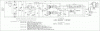
Are you keeping a parts list with Digikey part references? If so, can you update it? Several components have new component references and some have different values.
Here are my recommendations for the new capacitors related to the buck regulator.
C3: 2.2 μF, 100V, X7R (multi-layer ceramic):
SMT: http://www.digikey.com/product-detail/en/HMK325B7225KN-T/587-1778-1-ND/1212794
SMT: http://www.digikey.com/product-detail/en/C1812C225K1RACTU/399-6786-6-ND/3307193
THT: http://www.digikey.com/product-detail/en/FK11X7R2A225K/445-8268-ND/2815198
C5: 39 nF, 50V, PPS:
SMT: http://www.digikey.com/product-detail/en/ECH-U1H393JX5/PCF1347CT-ND/353819
C6: 33 pF, 50V, C0G/NP0 (ceramic):
SMT: http://www.digikey.com/product-detail/en/C0603C330J5GACTU/399-1055-1-ND/411330
THT: http://www.digikey.com/product-detail/en/FK28C0G1H330J/445-4720-ND/2050069
C7: 10 µF, 10V, X7R (multi-layer ceramic):
SMT: http://www.digikey.com/product-detail/en/LMK316B7106KL-TD/587-2596-1-ND/2329128
SMT: http://www.digikey.com/product-detail/en/LMK325B7106KN-T/587-1370-1-ND/931147
THT: http://www.digikey.com/product-detail/en/FK26X7R1C106K/445-8549-ND/2815479
I've marked several resistors as 1% tolerance, but nowadays it's normal to use 1% metal film resistors everywhere, including the ones that aren't marked as 1%.
Also, U1 itself: http://www.digikey.com/product-detail/en/TPS54062DGKR/296-28780-1-ND/2666522
Last edited:
Fantastic Kris, thank you for the explanation and the pointer to capacitive reactance. I am going to check that out, very cool property!! I am understanding some things more clearly, but since there are more than one way to do something with electrical components, its not always clear. Case in point, I thought the resistor was setting the current for the circuit - like it does with the simple LED examples. I never thought the capacitor could do that!
As for the transistor, can we use the TIP29? The TO-220 package has more heatsinking solutions available. On digikey, a search for TO-126 heatsinks yields 7 options of which only 2 are stocked. And the stocked items don't conform to the 25deg C/W requirement.
There is a potential problem with the heat sink - physical layout. The entire board will be installed into the wall mounted box such that the component side will be facing out of the enclosure, the thin edges of the board will be vertical. This would leave the heatsink oriented such that the top would be sticking out of the case - one face of the heatsink would be facing down - would that reduce the effectiveness of the heatsink since heat rises? If so, with careful layout, its possible to have the transistor bend over other parts after they are installed.
I found several smaller heatsinks: http://www.digikey.com/product-detail/en/V7237C/A10753-ND/3476145
http://www.digikey.com/product-detail/en/V8508G/A10755-ND/3476154
http://www.digikey.com/product-detail/en/V8508C/AE10842-ND/3511474
http://www.digikey.com/product-detail/en/V8508B/A10746-ND/3476147
U1 is tiny!! It's going to be a challenge to solder that one, I assume that I would have to use flux gel and drag solder it to be successful or cook it with solder paste. That should be interesting. I think it would be wise to do that chip first and perhaps test for shorts?
As for the transistor, can we use the TIP29? The TO-220 package has more heatsinking solutions available. On digikey, a search for TO-126 heatsinks yields 7 options of which only 2 are stocked. And the stocked items don't conform to the 25deg C/W requirement.
There is a potential problem with the heat sink - physical layout. The entire board will be installed into the wall mounted box such that the component side will be facing out of the enclosure, the thin edges of the board will be vertical. This would leave the heatsink oriented such that the top would be sticking out of the case - one face of the heatsink would be facing down - would that reduce the effectiveness of the heatsink since heat rises? If so, with careful layout, its possible to have the transistor bend over other parts after they are installed.
I found several smaller heatsinks: http://www.digikey.com/product-detail/en/V7237C/A10753-ND/3476145
http://www.digikey.com/product-detail/en/V8508G/A10755-ND/3476154
http://www.digikey.com/product-detail/en/V8508C/AE10842-ND/3511474
http://www.digikey.com/product-detail/en/V8508B/A10746-ND/3476147
U1 is tiny!! It's going to be a challenge to solder that one, I assume that I would have to use flux gel and drag solder it to be successful or cook it with solder paste. That should be interesting. I think it would be wise to do that chip first and perhaps test for shorts?
- Joined
- Nov 28, 2011
- Messages
- 8,393
Yeah, with AC, capacitors and inductors do some pretty funky things!I thought the resistor was setting the current for the circuit - like it does with the simple LED examples. I never thought the capacitor could do that!
Yes, fair enough. TIP29B or TIP29C will be fine. (The suffix indicates the maximum collector-emitter voltage.)As for the transistor, can we use the TIP29? The TO-220 package has more heatsinking solutions available. On digikey, a search for TO-126 heatsinks yields 7 options of which only 2 are stocked. And the stocked items don't conform to the 25deg C/W requirement.
Yes, I would say that's a problem. Heatsinks are supposed to be mounted so air flows along the surfaces of the fins. If the upward airflow is blocked by the solid part of the heatsink this is bound to affect heat dissipation.There is a potential problem with the heat sink - physical layout. The entire board will be installed into the wall mounted box such that the component side will be facing out of the enclosure, the thin edges of the board will be vertical. This would leave the heatsink oriented such that the top would be sticking out of the case - one face of the heatsink would be facing down - would that reduce the effectiveness of the heatsink since heat rises? If so, with careful layout, its possible to have the transistor bend over other parts after they are installed.
How about bending the TO-220 leads so the device sits parallel to the board, and sandwiching the heatsink between the device and the board with a screw through all three of them? That wastes a lot of PCB area but it might be the best solution. Make sure there are no tall components blocking the airflow.
Even if there is no ventilation to the outside world, there will still be airflow over the heatsink fins.
They all look pretty small. I was thinking of the finned aluminium type, not the bent steel ones, but if they meet the thermal resistance requirements, fine.I found several smaller heatsinks:
Yes, good idea. It should be possible to hand-solder with a very fine tip. As long as there is solder mask between the pads, and you use liquid flux, you should be OK.U1 is tiny!! It's going to be a challenge to solder that one, I assume that I would have to use flux gel and drag solder it to be successful or cook it with solder paste. That should be interesting. I think it would be wise to do that chip first and perhaps test for shorts?
You can put a very small blob of solder paste over all the pads, then heat all the pins simultaneously so the paste separates out, or use very thin solder and do each pad separately. The latter method allows you to tack down the corner pins and get the positioning accurate before you solder all of the pins. If pins bridge together, remove some solder using solder wick. Reapply flux as necessary to make the solder flow cleanly.
Similar threads
- Replies
- 3
- Views
- 2K
- Replies
- 16
- Views
- 1K

- Replies
- 9
- Views
- 1K
- Replies
- 5
- Views
- 702
- Replies
- 2
- Views
- 1K