Sir Mark Bollack . . . . .
Looks like you need to supply the whole schematic for getting any better initial analysis..
FROM . . . only that which I am able to see . . .seems
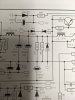
Like the main power generated from the main SMPS is originating at the left side of inductor L4 as raw DC and then passes to the right to pick up some filtering with C11 and 12 , and then take on a pair of 18K bleeder resistors , being used at power turn off. Then a final "sacrificial " ZD2 47 VDC Zener diode, in case of a severe over voltage output.
Then the power passes further to the right to the L5 filter inductor and then to the POWER switching relay K1 and you can just see its one power contact, with the relay coil its and its back EMF damping diode being just below.
Looks like there is being a minor VCC supply up in the top left and a minor-12VDC supply at the left bottom corner.
HOWEVER, our point of interest would be the line coming in just below that -12 source and ends up at C17 for minor filtering, then it passes upward to the right as a sub supply [ Hereafter called THE supply ] that powers the coil of the K1 relay and passes by your area of interest, where the ZD9 and D10 diode that has completely isolated any leakage thru the series D10 companion, until the zener threshold is met, but additionally introduces D10's 0.7 VDC in the series combination.
Then THE SUPPLY passes on up and to the right, past Q7 and probably then encountering some independent and isolated circuitry for current sensing of the main supply .
To me that looks unit like a metal film resistor casing and not any housing of a zener diode that I have ever seen.
How about taking said Unidentified Flying Component and then refer to and use my post #17 of
https://www.electronicspoint.com/threads/anyone-know-what-type-of-resistor-this-is.288104/
and find out what resistance(s) you can then read or interpolate out a proportional segment of.
PLUS supply the whole schematic
The photo shows the area between the two heatsinks as having the main POWER switchmode to the FAR right and this central area as the output from the unit, with the left heatsink probably having that mounted left power semiconductor as being a dual Schottky rectifier and your two puffed filter electrolytics being above at center, then the DC POWER output gets switched by K1 relay contacts and is fused and finally goes out the two black leads at the frontal foreground.
Check that SCHOTTKY, as it could have failed from excess ripple from the filters and its heating and a final "I CAN'T TAKE IT ANYMORE" and shorted and then " the component failed " . . . . or at least got vewy-vewy HOT.
ADD
Considering that R24 is being the resistor just to the right of R64 and looking at the healthy foil width paths associated with it, it looks like it might be a very low value resistor, being used for thru current sensing.
Thasssssit . . .
73's de Edd . . . . . . .17.6 miles from you