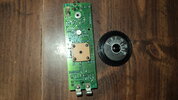
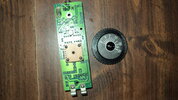
How to repair 3 boards not working. Auto spark voltmeter using neon bulb?

russwr

Dec 20, 2019
39
Joined
Dec 20, 2019
Messages
39
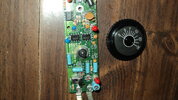
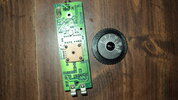
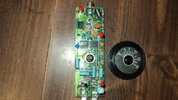
Unable to determine fault on these 3 boards meters . With proper volts present, one of 2 neons glows depending on polarity of auto engine spark . The adjustment of wheel/pot lights up bulb until max point and reduces. The reduced point is the highest voltage. These types were used before the advent of miniature oscilloscopes and probe wires.
 

Attachments

  • DSC01847.JPG
    DSC01847.JPG
    305.8 KB · Views: 18
  • DSC01848.JPG
    DSC01848.JPG
    238.5 KB · Views: 16
  • DSC01849.JPG
    DSC01849.JPG
    296.8 KB · Views: 16
  • DSC01850.JPG
    DSC01850.JPG
    344 KB · Views: 15
  • DSC01851.JPG
    DSC01851.JPG
    227.6 KB · Views: 18
  • Scan.jpg
    Scan.jpg
    133.8 KB · Views: 17

Harald Kapp

Moderator
Moderator
Nov 17, 2011
14,270
Joined
Nov 17, 2011
Messages
14,270
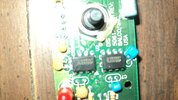
Sorry, I don't see the jumper and U1 does not look destroyed either.
@russwr : can you post close-up images of teh respective sections, please?
 

Delta Prime

Jul 29, 2020
2,987
Joined
Jul 29, 2020
Messages
2,987
That doesn't read right.
Thank you for all you do.
Like helping me.
U1 looks bulged as if something was busting out
of it.
1725393393900.png
 

Bluejets

Oct 5, 2014
7,374
Joined
Oct 5, 2014
Messages
7,374
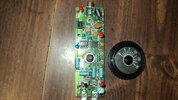
With proper volts present, one of 2 neons glows depending on polarity of auto engine spark .
I can only see one neon on the board (Rear side)....Which I Imagine would be reference to any spark signal.
there are 3 LED's which I imagine you are referring to when you say "neon"
Polarity of the spark does not come in to the equation as it is always the same.

Polarity of the incoming power would I imagine be protected with a diode in which case if correct, LED adjacent to the switch would (I imagine) come on.
All three IC'c appear to be the same (dual comparator) so if you are familiar with the use of a multimeter, you should be able to trace incoming power through the board to each of these IC's at least.
You should also get some variable voltage output on the centre pin of the pot and ground as you turn the knob one way or the other.
Taking care not to short anything while doing so.
That at least should be a starting point.
A description of what the meter actually does would also be of some assistance.

Normally one thing to check in aged-electronics such as this would be the condition of all electrolytic capacitors.
To achieve this, a decent capacitor/ component tester would be required with at least one leg of each device removed from the pcb.
 

russwr

Dec 20, 2019
39
Joined
Dec 20, 2019
Messages
39
The upper 2 red bulbs are the polarity type. Ignition spark can be positive or negative output, depending on arrangement of primary wires of step up autotransformer. The lower bulb is just for the on/off switch. None of the 3 meters work. Cable clip goes to thick insulation of plug wire as pick up. Other cable goes to ground. 9v battery turns on initial bulb. Rotation of pot turns until glowing goes down. At that point, reading is taken of Max high volts. Manufacturer has no repair sheets/ data. I had checked the cables and pots with ohmmeter. Years ago, I had repaired someone's engine timing light. The owner had hooked up the battery clips backwards. The internal large capacitor was charged up backwards. Shorting the cap restored the timing light. I was also recently tinkering with reversed high voltage. - However, the meter was to respond both ways anyway. I read the manual. Electrical parts do deteriorate over time. Does the input NEON bulb on board reduce volts to balance of board? It is not seen on outside of outer case. Only 3 red bulbs available. Maybe Neon is open / unusable?
I had recently purchased the cheap CHINA hand held oscilloscope, the power supply, and voltage reducer probe by 10,000volts. A reading of 3v of screen,would be 30,000v ignition. (open board type, DSO 138 as "welded" only as soldered completed, and probe Hantek HT-25.
 
Last edited:

Bluejets

Oct 5, 2014
7,374
Joined
Oct 5, 2014
Messages
7,374
Unusual to find any cheap or otherwise scope able to withstand ignition pulse voltages without the use of some form of specific interface device.
 

russwr

Dec 20, 2019
39
Joined
Dec 20, 2019
Messages
39
The upper 2 red bulbs are the polarity type. Ignition spark can be positive or negative output, depending on arrangement of primary wires of step up autotransformer. The lower bulb is just for the on/off switch. None of the 3 meters work. Cable clip goes to thick insulation of plug wire as pick up. Other cable goes to ground. 9v battery turns on initial bulb. Rotation of pot turns until glowing goes down. At that point, reading is taken of Max high volts. Manufacturer has no repair sheets/ data. I had checked the cables and pots with ohmmeter. Years ago, I had repaired someone's engine timing light. The owner had hooked up the battery clips backwards. The internal large capacitor was charged up backwards. Shorting the cap restored the timing light. I was also recently tinkering with reversed high voltage. - However, the meter was to respond both ways anyway. I read the manual. Electrical parts do deteriorate over time. Does the input NEON bulb on board reduce volts to balance of board? It is not seen on outside of outer case. Only 3 red bulbs available. Maybe Neon is open / unusable?
I had recently purchased the cheap CHINA hand held oscilloscope, the power supply, and voltage reducer probe by 10,000volts. A reading of 3v of screen,would be 30,000v ignition. (open board type, DSO 138 as "welded" only as soldered completed, and probe Hantek HT-25.
 

russwr

Dec 20, 2019
39
Joined
Dec 20, 2019
Messages
39
how does a neon bulb fail to flash?

A neon bulb might fail to flash for several reasons:

  1. Insufficient Voltage: Neon bulbs require a minimum voltage to ionize the gas inside and start glowing. If the applied voltage is too low, the bulb won't flash. This can happen if there's an issue with the power supply or if the bulb is connected in a circuit that doesn't provide enough voltage.
  2. Faulty or Worn-Out Bulb: Over time, the electrodes inside a neon bulb can degrade, or the gas inside can become depleted. If the bulb is old or damaged, it may not flash properly or at all.
  3. Connection Issues: If the bulb isn't properly connected to the circuit, or if there's a loose or corroded connection, it may fail to flash.
  4. Circuit Problems: Neon bulbs often require a specific type of circuit to operate correctly, such as those with a suitable transformer or a neon bulb driver. If the circuit components are malfunctioning or if the circuit design is incorrect, the bulb may not flash.
  5. Defective Starter or Trigger Circuit: Some neon bulbs rely on a starter circuit or a trigger mechanism to initiate the flash. If these components are defective or malfunctioning, the bulb may not flash as expected.
  6. Environmental Factors: Extreme temperatures or humidity can sometimes affect the performance of a neon bulb. If the conditions are not within the operating range specified for the bulb, it might not function properly.

Can this single input Neon bulb be acting as a part of a voltage divider circuit?? Then the neon would be necessary to run the whole board.
These 3 test meters are very old.
The farmers use a electric fence test meter for high volts. It has an in series group of neon bulbs with resistors. several bulbs light up depending on the voltage level. Each neon has to be good for the meter to work.
 
Last edited:
Top