Hi folks, first time poster here.
I am just getting back into hobby electronics after close to 40 years! As everything in my life, I've forgotten more than I ever knew. And learning arduino and esp32?...thats a whole different level!!
OK, here's my question...
As part of an led fit out of a large spaceship 3d print, I am trying to run a circuit for the engines. I want them to be either light blue/cool white or run a blue led and a white frosted led into each of the two "engines" to simulate flickering engine exhaust. To get the flicker, I am taking the easy way out and have salvaged flickering leds from some dollar store tealights. As a sidebar, I put one of them in a circuit last night with a 220ohm resistor and ran 5v from my bench power supply. It looks like the flicker led has a max forward voltage of 2.6 and its about the standard 20mA.
Now, the whole circuit will have two 3.7V 3000mAh 18650 batteries in series powering it. I am hoping to not use three cells but can if I have to. I already know what you're thinking so hear me out.
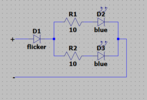
I am hoping I can find some frosted blue (don't even know if they exist) LEDs. If I can, the circuit is easy...From the main line I would have two parallel branches (one for each engine) and each branch would have the appropriate resistor, salvaged flickering LED, and frosted blue LED in series. Easy peasy. But if I can't find a frosted blue/cool white with enough blue tint LED, I will need to get the flickering LED output to then branch into two parallel circuits (since not enough voltage to run three LEDs in series from what I can figure, off of 7.4V), and have a blue LED on one of these branches and a white one on the other. Questions:
1) I have enough voltage and current to do this as far as I can figure. Tell me if I am missing something. If I am correct, is there any reason why this plan wouldn't work?
2) Most importantly, how do I calculate the proper resistors? With one before the flickering LED, I realize that if I just have a frosted blue one after the flicker LED that I only need the one resistor. But if I have two parallel circuits (one to each engine), then a resistor and flicker LED in each which in turn split to 2 parallel circuits on each branch, my thinking is that I do not need a resistor before each subbranch in the final parallel circuit because voltage was already reduced by the resistor before the flicker LED. Am I correct in my thinking?
3) If no to the above, how do I calculate the resistor that would be needed before the blue and white LED subbranches? Use the voltage at the flicker led output as V1 and just calculate each resistor as always by subtracting the forward voltage of the blue LED for its resistor and the white's resistor separately?
Thanks in advance!
PS. I know I could achieve the same results by having the LEDs flicker via PWM from an arduino but I'm trying to make these circuits as simple as possible.
I am just getting back into hobby electronics after close to 40 years! As everything in my life, I've forgotten more than I ever knew. And learning arduino and esp32?...thats a whole different level!!
OK, here's my question...
As part of an led fit out of a large spaceship 3d print, I am trying to run a circuit for the engines. I want them to be either light blue/cool white or run a blue led and a white frosted led into each of the two "engines" to simulate flickering engine exhaust. To get the flicker, I am taking the easy way out and have salvaged flickering leds from some dollar store tealights. As a sidebar, I put one of them in a circuit last night with a 220ohm resistor and ran 5v from my bench power supply. It looks like the flicker led has a max forward voltage of 2.6 and its about the standard 20mA.
Now, the whole circuit will have two 3.7V 3000mAh 18650 batteries in series powering it. I am hoping to not use three cells but can if I have to. I already know what you're thinking so hear me out.
I am hoping I can find some frosted blue (don't even know if they exist) LEDs. If I can, the circuit is easy...From the main line I would have two parallel branches (one for each engine) and each branch would have the appropriate resistor, salvaged flickering LED, and frosted blue LED in series. Easy peasy. But if I can't find a frosted blue/cool white with enough blue tint LED, I will need to get the flickering LED output to then branch into two parallel circuits (since not enough voltage to run three LEDs in series from what I can figure, off of 7.4V), and have a blue LED on one of these branches and a white one on the other. Questions:
1) I have enough voltage and current to do this as far as I can figure. Tell me if I am missing something. If I am correct, is there any reason why this plan wouldn't work?
2) Most importantly, how do I calculate the proper resistors? With one before the flickering LED, I realize that if I just have a frosted blue one after the flicker LED that I only need the one resistor. But if I have two parallel circuits (one to each engine), then a resistor and flicker LED in each which in turn split to 2 parallel circuits on each branch, my thinking is that I do not need a resistor before each subbranch in the final parallel circuit because voltage was already reduced by the resistor before the flicker LED. Am I correct in my thinking?
3) If no to the above, how do I calculate the resistor that would be needed before the blue and white LED subbranches? Use the voltage at the flicker led output as V1 and just calculate each resistor as always by subtracting the forward voltage of the blue LED for its resistor and the white's resistor separately?
Thanks in advance!
PS. I know I could achieve the same results by having the LEDs flicker via PWM from an arduino but I'm trying to make these circuits as simple as possible.