Low voltage cutout help

SimpleJoe

Jan 10, 2016
26
Joined
Jan 10, 2016
Messages
26
A while back i created a low voltage cutout and alarm for a Li-ion battery pack using a LM339 (with a large amount of help from this forum, picture below). I have since made another of these circuits, but as i am reusing salvaged relays the new system tends to not be stable. The circuit has a cut out voltage of 13.2v (3.3 on each cell) which i am happy with, it is when the circuit restarts that is giving me trouble. It will only turn on once the input voltage reaches 14.8v or higher and as it is used to power an amplifier for a speaker system so the initial startup requires a large amount of power. The speakers and the lm339 circuit are both run off the same source and this startup drain is high enough to switch off the relay and will flicker until the startup finishes.

My questions are:
is this an easy fix (i'm thinking i might just have to throw some capacitors at it either on the amp or relay input)
can i lower the restart voltage easily
can i somehow soft start the amp to avoid all this

for the record the relay is: http://pdf1.alldatasheet.com/datasheet-pdf/view/149095/FUJITSU/FTR-K1AK022T-.html

Thanks in advanced for your help,
SimpleJoe
 

Attachments

  • voltage checker.JPG
    voltage checker.JPG
    46.7 KB · Views: 101

Mongrel Shark

Jun 6, 2012
260
Joined
Jun 6, 2012
Messages
260
That data-sheet is for a whole range of relays. Which one is yours?
Probably not that important, but it could be a factor.

It sounds like your start up current is pulling the cell voltage down. Depending on how much start up is required it could be cheap or expensive.

The first thing to try is a big cap across the main power rails of your battery pack/circuit. The cap will provide some current and reduce the short term load on the battery's. You could try a 100μf electrolytic, but for lithium cells to drop that much you must be pulling a lot of amps. I'd be looking for something in the 1000μf- 5 farad range. But thats starting to get a bit silly big and expensive and may only provide minor relief. Not to mention creating the same problem, as the caps fill they will momentarily pull the battery voltage down. If you have a few largish caps handy you could try and see.

You probably need to add more lithium cells in parallel to improve the current delivery...
Pulling as much current as you are won't be doing the batteries any long term favors.
You have 4 series cells. Try 4s and 2-3parralel. It will solve the problem and may be cheaper than supercaps...
 

SimpleJoe

Jan 10, 2016
26
Joined
Jan 10, 2016
Messages
26
The relay is an AK022T (with no other suffixes). I also forgot to mention that for my testing i was running it from a power supply. So through a little testing i found start up spikes to 3.7 amps which is about 2C of the batteries which should be fine (shouldn't it?) But it can still start with the current limited to a max of 2.5 amps. Now all thats left its how to bring the reactivation voltage lower (this is why i referenced the spec sheet). The previous version i had to add a PNP transistor to help activate it but that is beyond me (i tried it on this system and nothing would turn on at all, i dont know if it was dead or it didnt supply enough power)

Thanks,
SimpleJoe
 

(*steve*)

¡sǝpodᴉʇuɐ ǝɥʇ ɹɐǝɥd
Moderator
Jan 21, 2010
25,510
Joined
Jan 21, 2010
Messages
25,510
that circuit should turn on and off at the same voltage.

if it requires a substantially higher voltage to turn the relay on, you may need a more sensitive relay.
 

Mongrel Shark

Jun 6, 2012
260
Joined
Jun 6, 2012
Messages
260
Yep. I agree with Steve.

The AK022T relay needs 22v to operate (note the 22 in AK022T). Its probably only barely activating at 14.8v and any circuit of lower resistance is stealing its current. so it switches off....

Either get a different relay or a 22v supply....

or if your really keen/broke. I have salvaged wire from relays. If you can get it open you could shorten its coil by almost half.. I can't promise it will work but it will put more current through the coil. Failing that re-wind it with thicker wire if there is room... Probably not a recommended fix...
 

duke37

Jan 9, 2011
5,364
Joined
Jan 9, 2011
Messages
5,364
Yep. I have salvaged wire from relays. If you can get it open you could shorten its coil by almost half.. I can't promise it will work but it will put more current through the coil. Failing that re-wind it with thicker wire if there is room... Probably not a recommended fix...
I have thought about this in the past and cannot get my brain cell around it.
If you take half the turns off, you get double the current with the same voltage and so the same ampere-turns and the same magnetic force.
Am I wrong?
 

(*steve*)

¡sǝpodᴉʇuɐ ǝɥʇ ɹɐǝɥd
Moderator
Jan 21, 2010
25,510
Joined
Jan 21, 2010
Messages
25,510
The problem (or at least one problem) is that the relay is being driven directly by the output of an op-amp which may not be able to provide the extra current.
 

SimpleJoe

Jan 10, 2016
26
Joined
Jan 10, 2016
Messages
26
Ok, I may try to open one of the relays like you said, i really have no other use for them so at the very least i'll learn what the insides look like. So there is no simple fix (like adding a transistor) to remedy this because the voltages are too different? and finally if i am to buy another relay what specs should i be looking for, will a 12 volt relay handle up to 16.4 volts (i assume its a minimum operating voltage but i've been wrong before) and will the logic current from the lm339 be enough to trigger it? (i tried looking at the spec sheet for this but i have no idea what i'm looking for :p, if someone could translate for me that would be excellent)
Lm339 datasheet:
http://www.onsemi.com/pub_link/Collateral/LM339-D.PDF

EDIT:
Maybe a new relay like this?
http://au.rs-online.com/web/p/non-latching-relays/5330895/

Thanks for all the help so far,
SimpleJoe
 
Last edited:

(*steve*)

¡sǝpodᴉʇuɐ ǝɥʇ ɹɐǝɥd
Moderator
Jan 21, 2010
25,510
Joined
Jan 21, 2010
Messages
25,510
Yeah, adding a transistor would probably help, especially if you modify the relay. Also your schematic does not show a diode connected across the relay (which is required to protect the transistor (or op-amp) that is switching the relay.

edit: a 9V to 12V relay would probably be what you're looking for. (if lower than 12V, ensure it's OK up to 15V)
 

Mongrel Shark

Jun 6, 2012
260
Joined
Jun 6, 2012
Messages
260
I have thought about this in the past and cannot get my brain cell around it.
If you take half the turns off, you get double the current with the same voltage and so the same ampere-turns and the same magnetic force.
Am I wrong?

I was wondering about that too. My logic is the relay is sort of switching now. so more current might just do it. But sacrificing turns will weaken the magnet, so a lot more current is needed. I think its something you could debate endlessly (with yourself or others) but a few tests would clear it up quickly.

Perhaps just remove 50-100 turns at a time and test to see if it gets better or worse.


I'm just learning op-amps, but it looks like that one can only drive 2-2.5ma. Adding a transistor to amplify its output could help a lot! removing turns would be pointless if your driving directly from that op-amp. Its a simple mod.
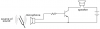
If you replace the Mic in this circuit with the op amp and instead of a speaker you use your relay coil...03097.png You want a transistor with a gain at least 100, ideally over 200. I got a bag of 2n2222 on ebay for 50c... Lots of transistors that will do the job in almost any electrical appliance. Audio video stuff would be the first place I would look for salvage.


The alternate relay you have selected looks ideal. The coil is rated for 3-24v and it switches on at 9v. Its got a 720Ω coil rated for 200mw. Depending on exact voltages to the coil, its going to need 12-20ma so the op amp will still be struggling to provide enough current if I read that data sheet right.

Also if you have salvaged parts, A FET of some kind could be used instead of the relay and you could probably avoid adding a transistor amp.
 

(*steve*)

¡sǝpodᴉʇuɐ ǝɥʇ ɹɐǝɥd
Moderator
Jan 21, 2010
25,510
Joined
Jan 21, 2010
Messages
25,510
you will need to use this transistor as a high side switch with a pull up on the output of the 339.

The emitter goes to +ve, collector to the relay, base, via a resistor (around 1k) to the output of the 339. The base should also be connected to +ve via another 1k resistor. The other end of the relay goes to ground and a diode is placed across the relay coil with the anode (non-striped end) to ground.
 

SimpleJoe

Jan 10, 2016
26
Joined
Jan 10, 2016
Messages
26
So i finally got the replacement relays and setup the circuit as above and im still having pronlems with the switch on and switch off voltages being different (the relay will only trigger above 16v but will stay on until below 12.5v). Also this turn off voltage cannot be increased past 12.5 no matter what position the 5k pot is at.

SimpleJoe
 

(*steve*)

¡sǝpodᴉʇuɐ ǝɥʇ ɹɐǝɥd
Moderator
Jan 21, 2010
25,510
Joined
Jan 21, 2010
Messages
25,510
replace the relay with a LED and a resistor. That way you can check when power is being applied and removed. With the relay it's not quite so simple.

I have a feeling it's always being powered (i.e. you have an error in your circuit)
 

SimpleJoe

Jan 10, 2016
26
Joined
Jan 10, 2016
Messages
26
ok so i did one better... i think. i videoed all out the outputs at certain stages, the voltage on the right is the input voltage.

1: the output from the lm339 (switching to ground after reaching an input of ~14.4v)

2: the output from the transistor (jumping from ~6v to ~14v once ~14.4v, i think that this might be the problem, the 8v is enough to keep the contacts closed but not enough to close them)

3: finally the resistance between the contacts of the relay (the relay activates at 14.4v but it 'latches' until much lower voltages)

i really think the output from the transistor is the problem but i am unsure how to get it to drop fully to ground like the LM339 does.

Thanks for sticking with this for so long :p

SimpleJoe
 

SimpleJoe

Jan 10, 2016
26
Joined
Jan 10, 2016
Messages
26
so as a test i put a 5.6v zener diode (preferably i would use a 3v but didn't have one on hand) on the output of the transistor so that the i would get a constant voltage drop and it worked! I'm reasonably happy with it, although it does flicker the relay at certain voltages with ai thought a small cap could filter (maybe not... i dunno) but i just wanted to make sure this is a good idea stability and longevity wise (i have very little knowledge in this area) or if there is an easier way to fix this.

Thanks,
SimpleJoe
 

Sunnysky

Jul 15, 2016
573
Joined
Jul 15, 2016
Messages
573
A good relay will have specs that MUST switch ON at 70% of rated voltage ( even if it may switch slowly at 50~60% ) and MUST switch OFF at 10% of rated V ( even though it may chatter off at 25% )
If your supply causes a big drop when turned on , then that is an indication of low State of Charge.
 

SimpleJoe

Jan 10, 2016
26
Joined
Jan 10, 2016
Messages
26
That is good to know Sunnysky, do you have any ideas on how to fix the issue i am having?
 

Sunnysky

Jul 15, 2016
573
Joined
Jul 15, 2016
Messages
573
I am not sure of complete schematic , battery and power load , so I can only guess.

There are a few subtle behaviors of relays, comparators and batteries you need to understand regarding hysteresis. A complete schematic would help.

Batteries have memory. So when weak and unloaded, the voltage will rise x% so the comparator needs x+1 % hysteresis using a positive feedback ratio.

Relays have huge hystereis and what I indicated 75% and 10% are guaranteed worst case levels not consistent with best case.

They also have a net power gain from input coil power to contact max rated switched power of about 500x for DC, while AC ouput switched power can be more as the AC helps quench arc current faster.

Bipolar transistor switches on the other hand are limited by current gain when saturated and are rated as Vce(sat) fur a current gain of only 10x, which in your case drops to 0.7V on Vce. You can drive it expecting a current gain of 20x but Vce will rise until the current gain rises.,50x may rise to 2 to 3V drop.

However this is a general purpose part and ones design for low Vce will be recommended as such for power switches, while MOSFET's now do a much better job since input current is very low and switch resistance only needs to be a x% percentage of load coil resistance for 1-x% efficiency or effective switch loss in voltage drop. i.e. if coil is 100Ω, Rdson can be 1-2 Ohms for 1-2% drop while on your PNP even with base current being 10% of collector coil current will drop 0.7V /14V or 5% for example.


My guess is your base current R is too big. and you have no hysteresis on comparator.
Make Vout to Vb ,or Rb = <10x the coil resistance. .e.g. if coil is 100Ω, Rb =<1000Ω

Relay coils have a max power and voltage rating due to heat, so instead of a relay, a MOSFET will do a much better job. Then add a few % positive feedback on comparator for battery hysteresis (memory rise unloaded) up to 10%. The R ratio for Vin+ and the the added feedback Rfb to output defines this ratio if the pullup is to the same V+.

ensure coil has reverse diode clamp.

now where is your full schematic?
 

SimpleJoe

Jan 10, 2016
26
Joined
Jan 10, 2016
Messages
26
ahhh... i think i understood a few of those words :p but here is a schematic of what i currently have setup and working as intended
 

Attachments

  • speaker circuit.JPG
    speaker circuit.JPG
    37.9 KB · Views: 122
Top