Making an electric furnace.

mixos1

Administrator
Jul 13, 2003
581
Joined
Jul 13, 2003
Messages
581
Take a look at this article from Circuit Cellar, may help you.

Lacoste-168.pdf


Attachments

  • Lacoste-168.pdf
    727.1 KB · Views: 17

Dazza

Jun 21, 2004
591
Joined
Jun 21, 2004
Messages
591
You are probably right MP :), although I don't think there would be a significant difference in cost to using gas, it would really depend on where you are from, cost of gas/LPG and electricity in your country.

Once I get every think up and running, I'll workout the cost of electricity to produce a certain volume of melted aluminium, it may be difficult to compare the two, as I haven't come across any information of cost of gas for a melt. Although if I find the cost of electricity to excessive, I will soon knock a whole in the bottom of the furnace and put a burner in their ;).


mixos, Thanks for the article I haven't read it all yet, seems a bit to advenced for what I need, but you never know.


ante1

Jan 24, 2004
4,138
Joined
Jan 24, 2004
Messages
4,138
Hi Dazza,

Do you have streetlights on your street? Why not work nights at your foundry? What is the distance to the nearest lamppost? You figure out the rest! ;D


MP1

Dec 7, 2003
3,399
Joined
Dec 7, 2003
Messages
3,399
;D ;D

Midnight engineering? ;D

MP


Dazza

Jun 21, 2004
591
Joined
Jun 21, 2004
Messages
591
Hi MP, Ante,

There was a new story on TV tonight about the cost of running an air-conditioner, they said that it cost about 80 cents to run an average air-conditioner for an average size bedroom for 10 hours, that is for an air-conditioner around 950W.

So it looks like I won't have to climb that very tall light pole after all ;D ;D.

I have about 80 percent of the furnace finished :), I now have to wait a couple of days for the refractory to cure >:(. I decided to hold of making the new light dimmer switch, and use the one I have, just for the heat treatment of the refractory and to get an idea on how it is going to perform. Then I'll make the new one, and see if I can't melt some aluminium ;). I managed to add an extra heat sink to the existing one, so it will now continuously run at around 1300W without any problems.


View attachment 36526


Dazza

Jun 21, 2004
591
Joined
Jun 21, 2004
Messages
591
Hi Ante,

It's pretty much as you described ;), the picture below shows three of the four ingredients for the refractory, top left is the perlite, below that is the silica sand and the third is Portland cement, the fourth ingredient to be added after these three are mixed and moistened, is fireclay or bentonite.

The pic on the right shows two spiralling formers, which will create the cavity for the heating elements, with insulating tape joining the two to help create a taper, that will allow the heat from the elements to escape into the main cavity more freely. The spiral formers are glued to the main former body, the tape at the ends of the formers are to hold the ends down until the glue has taken.

Top left shows three drinking straws passing through the outer shell penetrating into the spiral formers, at the point where the heating elements will be connected with machine screws passing through to the outside. There are steel rods inside the straws to prevent them from moving and deforming under the wait of the refractory.

It hasn't all gone without any glitches :(, I'm pretty sure I got a few air pockets in the refractory, which is bad news for when I fire it up, it's likely that it will shatter :eek:. I fully expected to run into these sorts of problems, it's a learning experience with some trial and error ;), and the expense of making a mistake is very little 8).


View attachment 36528


ante1

Jan 24, 2004
4,138
Joined
Jan 24, 2004
Messages
4,138
Hi Dazza,

Thanks, that explains a couple of things. So, you worry about air pockets in there? Is the mixture very dry when you work with it? With a wet mixture you could vibrate it to avoid cavities. Just a thought. ;)


Dazza

Jun 21, 2004
591
Joined
Jun 21, 2004
Messages
591
Ok, so far so good, every think is coming along nicely better than I expected :), I have applied heat to the furnace for several hours to drive out moisture, a few more hours and she should be right to crank up the heat, once I make the new heat controller unit, and install the second element 8).

Ante, It is said to use this refractory mixture fairly dry, like cookie dough. It is also said that this concoction is sticky as I don't know what and it certainly is, what a nightmare to work with :eek:. Yes Ante, I was thinking the same thing ;), but then I realised if I made it to wet there would be too much shrinkage, I did wet it more than I knew I should, and still this gunk did not want to play nice >:(. Now that I have first-hand experience and know how nasty this stuff is, I'm pretty sure I have worked out a way to tame the beast, and make it do what I want :),

Oh yes did I mention this stuff is very nasty to work with ;D ;D ;D ;D.

I don't understand what's going on when I measure the voltage out from the heat controller unit, it measures around 330VAC ???

Here is a couple more pics :)


View attachment 36540


ante1

Jan 24, 2004
4,138
Joined
Jan 24, 2004
Messages
4,138
Hi Dazza,

I am sure you know what you are doing, I find this project very interesting. I suppose the 330Volts must be the peak value of the mains voltage that you see on the meter. Please keep reporting as you proceed! ;D


Dazza

Jun 21, 2004
591
Joined
Jun 21, 2004
Messages
591
Hi Ante,

It's just about finished 8), if all goes well I'll post a pic of the first melt, which should be Saturday :D.


Dazza

Jun 21, 2004
591
Joined
Jun 21, 2004
Messages
591
Well it looks like it works 8), and I am ahead of schedule :). In the first pic you can see my you beaut trolley ;D ;D, with the furnace mounted on it, I was planning on salvaging the wheels from this old lawnmower to use for making a trolley, then I thought why do that when all I have to do is sit the furnace on it and she's all done.

The other pic shows her in action, the aluminium was not properly melted down, it would of taken about another 15 minutes to melt down to the point where it would have been right to go, unfortunately I had to cut this test run short :(.

Sorry for the bad pic quality, there wasn't enough light :-\.


View attachment 36547

 
Last edited by a moderator:

ante1

Jan 24, 2004
4,138
Joined
Jan 24, 2004
Messages
4,138
Hi Dazza.

Ah, a furnace mover! ;D
What went wrong, why did you abort the process?


Dazza

Jun 21, 2004
591
Joined
Jun 21, 2004
Messages
591
Hi Ante,

Nothing went wrong, it was just that I had to go out and I didn't want to leave the furnace running unattended, always safety first ;).

I have fired her up again this morning, the furnace temperature control works great, with a large heat sink it doesn't get hot enough to need to use a cooling fan. Here's a couple of better quality pics 8).


View attachment 36552


ante1

Jan 24, 2004
4,138
Joined
Jan 24, 2004
Messages
4,138
Hi Dazza,

This looks really great, like a professional device! If you run it down the street people would think you are part of the bomb squad on a mission! ;D Just kidding, I think this is a very smart way to handle a devise like this. If something goes wrong it

 
A

Alun

Jan 1, 1970
0
Dazza,

Just a few questions:

What are you planning to use as a mold?

How long does it take to melt the aluminium?

Do you think it would be more efficent to use a higher powered heater?


Dazza

Jun 21, 2004
591
Joined
Jun 21, 2004
Messages
591
Hi Ante, Alun

Melting point for aluminium is around 660C. I don't know what the temperature should be for pouring into the mould ???, when I was working in the foundry we knew it was at the right temperature, by its texture and colour and it was very rare that we ever got it wrong, hopefully I still have that ability 8).

This is the most common method for a backyarder to use as a mould, green sand (http://www.backyardmetalcasting.com/book_sc.html) and this is the method that I'll be using to begin with, there are many other methods as well for example, the loss foam method and dry sand.


The time it takes to melt the aluminium, is about 2 to 3 hours, each melt after that takes about 30 to 45 minutes roughly,

High-powered heaters, will help to a certain point, that is to reduce the time it takes to raise the furnace temperature up to its maximum temperature, which is governed by the maximum temperature the elements can handle which is 1200C, for the elements that I'm using, Nichrome 80.


So now it looks like I'm going to have to maintain a constant temperature in the furnace, if I want to avoid the temperature rising above that of which the elements can handle and to help them last as long as possible. I was really hoping that I wouldn't have to do this, man nothing is simple is it.

Ok, I can get a K type Thermocouple that is rated to over 1200C, for 13.00$ that is meant to be used with a DMM, that I think should do the job. Next I will need a Thermocouple Preamp, I have been searching the net for a circuit, that uses commonly available components, I haven't had any luck yet. I already have a LCD digital panel meter, that I could use to monitor the temperature, once I get that sorted out I don't know what to do, that is how to connect it to my existing temperature control circuit? Maybe I could connect a relay between the DIAC and the gate of the TRIAC, to switch the power on and off to the elements, this might be the simplest way for me to do it, but I would much prefer to be able to have the output from the temperature sensor, to very the power to the elements to maintain a preset temperature, I will also have to be able to set a maximum, as I do now or the elements will burnout straightaway.

Any help please, I don't really know what I'm doing, this project is beginning to become more complicated than I expected


View attachment 36567


ante1

Jan 24, 2004
4,138
Joined
Jan 24, 2004
Messages
4,138
Hi Dazza,

Which range on the DMM do you use for the thermocouple? Is it perhaps possible to drive a LED instead through an inverting op-amp, and then you could swap R4 for an LDR and put both of them in a tube or similar. I think you get the idea it just might work. Please speak up anyone if I am way of here! :-\

 
A

Alun

Jan 1, 1970
0
Ante you're on the right track but you can buy special Triac opto isolators for this purpose.

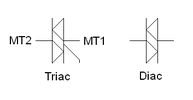
Dazza you've used the wrong symbols for the Triac and Diac. The symbols you've used are N-channel JUGFET for the traic and a rectifier diode for the Diac, here are the correct symbols:

Triac_Diac.gif

 
Last edited:

Dazza

Jun 21, 2004
591
Joined
Jun 21, 2004
Messages
591
Hi Ante,

Yes Ante I do get the idea, and it is a good one, and I think it will work.
Your idea means that I won't have to worry about mains power, while trying to get it to work.

I have no idea what range is used on the DMM, the thermocouple that I'll be using, is meant to be used with a DMM that is designed for measuring temperature.

I guess the most important thing to know, would be how much current a K type thermocouple can handle.
I'll also be wanting to use a LCD panel Meter to display the temperature, as well as drive the LED.

The accuracy of the LCD temperature display and the temperature regulation, doesn't have to be all that accurate, near enough will be plenty good enough, for this application :).

 
Top