Making an electric furnace.

Dazza

Jun 21, 2004
591
Joined
Jun 21, 2004
Messages
591
Hi Alun,

I don't know much but Yes I did know they were the wrong symbols ;), ExpressSCH unfortunately didn't have them available, so I went with near enough, I could have made a custom component but I guess I was being lazy ;D.

It is very likely I will make mistakes along these lines in the future, I do hope you will keep an eye on my future projects :), thanks for your reply Alun.

Alun, what do you think of Ante's idea :D, do you think using a optoisolator would be better, I do have available to me a(4N25) optoisolator, I would like to try to keep things as simple as possible.
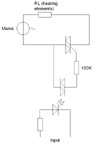
 

ante1

Jan 24, 2004
4,138
Joined
Jan 24, 2004
Messages
4,138
Alun,

Yes I know about optoisolators, but the once I have used are digital not analogue as was needed here. The idea was to replace the pot with the LDR and use the rest of the circuit as is. If I was to use digital (on / off) isolators I must convert the measuring voltage to PWM or a schmidt trigger circuit with a max and min temp on / off. This would mean a completely different triac circuit, that


Dazza

Jun 21, 2004
591
Joined
Jun 21, 2004
Messages
591
Ante, I'm going with the LDR and LED ;), I just need to find a thermocouple Preamp circuit, that uses commonly available components to work from, I'm just not to good at starting from scratch :-\.


Dazza

Jun 21, 2004
591
Joined
Jun 21, 2004
Messages
591
This is all I have been able to find so far :-\.


View attachment 36574

 
A

Alun

Jan 1, 1970
0
Ante, look at the attached data sheet and you'll se what I mean.

The circuit Dazza is useing is a Phase control power controler put simply R2, R3 & R4 form a timeing circuit with C2 when the voltage is high enough the Triac is triggered, if it's triggered at the start of the AC cycle the power will be high and if it's and the end of the cyle the power will be low.

See this link for a more detailed explanation: http://www.opamp-
electronics.com/tutorials/semi_theory_ch_007.htm


Phase controllers are very good for light dimmers but they do produce a lot of RF interference. This opto isolator I've shown here has a built in zero crossing unit this means the triac is only triggered at the 0V point of the cycle, this makes it power efficient (you could get away with a smaller heat sink). The only thing with this is the power is either on or off but this doesn

moc3041.pdf


Attachments

  • moc3041.pdf
    171.3 KB · Views: 7
Last edited:
A

Alun

Jan 1, 1970
0
This is how simple your circuit could be, obviously include a fuse though.

Triac_opto.gif

 
A

Alun

Jan 1, 1970
0
The power control doesn't need to be continuously variable, a simple on/off switch will do the job very well. Most temperature regulated heaters don't use analogue control, they use a bi-metalic switch, electromechanical relay or solid state relay.

If you set an electric iron to a specific temperature it will turn off the element when it's hot enough and back on again when it cools down. These devices often have some hysteresis to prevent the switching frequency from being too high. A springy bi-metal strip has some hysteresis, and a device using an electromechanical relay uses an op-amp to give this hysteresis.

Now as Dazza's circuit is using a solid state relay the switching speed is unimportant and as long as it's less than 100Hz there wouldn't be a problem. The furnace has a relativity large mass it would the have a long enough thermal time constant to prevent the frequency from being this high anyway.

So I would recommend connecting a comparator with some hysteresis (just in case) to the input of this solid state relay. You wouldn't even have to reprint the circuit board, just make the following modifications:
Remove R3
Replace R2 with the triac side of the opto-isolator
Remove C1 & C2
Replace the diac and R1 with tinned copper wire.
And there you have it, a solid state relay.
The comparator circuit could be on a separate board and will depend on the nature of the thermocouple.

 
Last edited:

Dazza

Jun 21, 2004
591
Joined
Jun 21, 2004
Messages
591
Alum, thank you so much for your help and advice :), what you are suggesting, would basically mean a complete do over , I think that the big problem that I will find with the switching on and off, is that it may be very stressful on the type of elements I am using Nichrome 80 wire. This is one of the reasons why I wanted to avoid using a on off type of control. With Ante's idea, all I have to do to the original circuit is replace R4 100K with an LDR which will be varied by a LED, the LED has to be varied accordingly to the temperature I want to maintain, I also want the temperature displayed on an 3.5 LCD panel Meter,

I could really use some help on getting started on this circuit, any suggestions of a suitable opamp that is commonly available, and some resistor values to get me going please :-\.


View attachment 36577

 
A

Alun

Jan 1, 1970
0
Dazza,

What you need is an inverting amplifier that turns and LED fully off when the furnace is up to temperature and fully on when it's cold. You also said it might cause a problem if the elements are suddenly turned on and off (though I personally disagree with this) you will need a soft start because when the furnace is first turned on it will be cold so you need to turn the power up slowly until it reaches it's temperature.

With incandescent filament in light bulbs switching can shorten the life but they run at 3000C, not 660C. Sudden switching of this furnace is not likley to be a problem an electric oven doesn't use phase control nor does any other heating appliance (at least to my knowledge) So I would still recommend the switching idea.

The circuit's lot simpler too and there's less experimentation, you use a comparator (- pin) to look at the voltage on the thermocouple and set the (+pin) to the voltage given by the thermocouple when the furnace get too hot. You may need some hysteresis and depending on the thurmocoupler output you may need a pre-amp but this is very simple and I can easily fix that for you - I will need to look it up though.

Ante, PWM for AC is called bust control, a zero crossing unit is used and the load is turn on for a certain number of cycles and off for a number of cycle, and the switching frequency is - very low typically <10Hz

Anyway Dazza forgive me if you've already answered this question before but what voltage does the thermocouple give when the furnace is hot?


Dazza

Jun 21, 2004
591
Joined
Jun 21, 2004
Messages
591
Hi Ante, Alun :),

The op amps that you suggested Ante, are not easy for me to get, that is not available from Jaycar or Dick Smith >:( but luck is on my side this time, I have two recycled (TL061) that should be ok :D.

Yes the calculating thing, haven't got the hang of that yet :eek:, and there is still that problem of having nothing on top, to pull out ;D ;D.

My thermocouple hasn't arrived from Jaycar yet :( , so I'm not sure what the voltage output will be, I know it's in the very low millivolt range. I do have a thermocouple that I think is from a convection oven or something like that, I connected it to my DMM set to the 200m range and applied heat, it rose to 00.6mV and went no further, although I don't really know if this thermocouple is working properly ???.


Alun, Yes it is true that thermal shock will damage this kind of element Nichrome 80 :), when they are first fired the aluminium within the wire burns off, creating a protective layer around the wire preventing oxygen from entering and rapidly deteriorating the wire, I have read about this on the net, and unfortunately I have already discovered it to be true, after I had fired my elements, I found that there was a small portion of the element protruding out from the furnace wall, I made a small kink in the wire to fix the problem and sure enough after a while it burnt out, not only where I made the kink, it burnt out in several places where I touched it.

Alun, I really wish I could go with the way you are suggesting, I really do it would make things so much simpler 8), but from what I have read it strongly suggests, to avoid switching the power on and off to these elements and it is also a good idea to leave the top on the furnace to allow the temperature to decrease slowly, to avoid thermal shock and the same would apply for heating the furnace up.

Ok I think I need to plan my angle of attack for this project, this is what I am thinking, start with getting the thermocoupler to register the temperature on my 3.5 LCD panel meter. Then I can use the output of the op amp to the LCD, to drive an LED via another op amp, I think I need to try to get it this far, then work on what needs to be done after that, does this sound like the way to go.

 
A

Alun

Jan 1, 1970
0
The best solution for this is to soft start the furnace by using phase or burst control (I would recommend the latter) then when it's up to temperature use the switching method to control the temperature. For example you increase the power gradually, when the temperature reaches 700C you turn it off then when it drops below 690C you turn it back on again. This 10 degrees of hysteresis will reduce the system's susceptibility to noise and I a 10 degree temperature change is unlikely to damage the element.


Dazza

Jun 21, 2004
591
Joined
Jun 21, 2004
Messages
591
Hi Ante, Alun,

Ok, I have the thermocouple and some more pic too ;D. On the 200mV range, my DMM reads 18.0mV.

It doesn't seem to want to go higher than that, the aluminium is Molten but not hot enough for casting, and I don't think I can give any more power to the elements :(, hmm maybe I need another element, or the refractory isn't keeping the heat in good enough, well this doesn't matter for now, I think I should concentrate on getting this temperature control sorted out first :).


View attachment 36621


Dazza

Jun 21, 2004
591
Joined
Jun 21, 2004
Messages
591
I have a little more to add, the temperature did eventually rise to the point where it would have been suitable for casting 18.7mV.

I also measured the temperature of the molten aluminium 25.2mV, unfortunately I didn't think to measure the resistance of the thermocouple ::), that probably would have been handy.

 
A

Alun

Jan 1, 1970
0
Hi Dazza,

The reason the furnace is taking so long is the thermal insulation is not good enough and i't also black - very good colour for radiating heat. Try wrapping it in aluminium foil this shoul reduce the heat loss by radiation. Just as long as the external furnace temperature isn't hot enough to melt aluminium it should be fine. Even if you don't see how this can help please humour me and try it anyway, really do believe it will help.

I'm still in the process of thinking of a way to increase the power to the furnace slowly.

How slowly do you trun the power on?

Do you start a low power and turn it up a bit every 10 miniutes and leave it on full power after an hour?

Do you turn if off immediately or do you power down slowly?

 
A

Alun

Jan 1, 1970
0
Just thinking you could use an op-amp PWM circuit like the dome lamp dimmer and either connect it to a lamp and use an LDR like Ante says or reduce the frequency of the PWM circuit to about 5Hz and connect it to a solid state relay circuit as I would strongly reccomend.

Either way you're going to need a ramp generator that generates a ramp as long as a few hours - I don't think you can do this easily with simple RC circuit as you would need a very big low leakage capacitor. Maybe a DAC with a binary counter would do the job, even so I don't think this would be too complicated.


ante1

Jan 24, 2004
4,138
Joined
Jan 24, 2004
Messages
4,138
Alun, Dazza;

I would prefer to wrap the furnace with the kind of bandage you use for turbo exhaust manifolds (the kind you can touch at full working temperature) and on top of that you just might put some foil (shiny side inwards). This will save some energy and time for you. 8)
BTW, I can see you have got the LF PWM to stick now. ;D But what

 
A

Alun

Jan 1, 1970
0
Hi Ante,
I would agree with everything you said but I would put the foil matt side down. If you dont't believe me the you could do my Thermos flask experiment. :) Take 3 plastic bottles wrap on in foil with the shiny side up, the other with the shiny side down and leave the last one unwrapped as a control. Fill them up with hot water and leave them to cool.

I don't really know whether shiny side up is better than shiny side down I don't think it will make that much difference in this case. I just know that the more shiny a surface is the less will radiate the heat. The side of the foil touching the hot surface can't reflect the radiation back as it's in physical contact with the surface so the heat will be conducted straight to it. I don't really want to discuss this at great length just do the experiment and see. :D

About the ramp generator
Regardless of whether Dazza wishes to use your idea or mine a ramp generator is required. Because Dazza says that the nichrome wire will be damaged if the furnace is turned on too quickly it needs to be turned up very slowly. When the power is first applied the ramp generator could be connected to the PWM unit that's connected to a bulb coupled to the phase controller via and LDR or as I recommend a lower frequency PWM unit could be connected directly to a solid state relay, as there are no bulbs or spiky RF causing waveforms to worry about.

To make a ramp generator you use a constant source to charge a capacitor. A 1F capacitor will take 1 second to charge to 1V with a constant current of 1A, So for 10s to 1

 
Last edited:
Top