Mosfet Latching

Kiwi Bruv

Dec 23, 2004
36
Joined
Dec 23, 2004
Messages
36
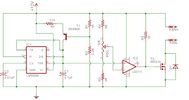
I built the circuit out of bits and bobs so now I need to buy a new amp I might as well build it out of an LM324 quad.

Will this allow me to have the pwm at 20kHz? Where do I look in the datasheet to show me this?

Circuit I have in mind is at www.cpemma.co.uk/pwm_erg.html


audioguru2

Apr 6, 2004
12,026
Joined
Apr 6, 2004
Messages
12,026
The circuit you posted has an LM324 operating at only about 91Hz.
The LM324 is low-power and old, so is even slower than a 741. It has trouble above about 5kHz.

View attachment 37858


audioguru2

Apr 6, 2004
12,026
Joined
Apr 6, 2004
Messages
12,026
The TL072 dual opamp is so popular in stereo equipment that it costs less than a 741 single opamp. It is low noise, low distortion and wideband. I have used it for about 20 years.

View attachment 37859

 
A

Alun

Jan 1, 1970
0
Audioguru, you're an audio guru so you love your audio op-amps but here it's being used as a comparator so a linear low noise amplifier isn't needed so a much

KiwiBruvs_circuit_LM311.PNG

 
A

Alun

Jan 1, 1970
0
audioguru said:
Hi Alun,
Ha, your boosted-output 741 circuit was used with gain in a Korean (Goldstar, now called LG Electronics) speakerphone that I had to install and service in 1980. It had the worst pcb that I've ever seen. The copper was poorly stuck on the pcb with rice stuff. Users all complained about the buzzy sound so I added a resistor to fix it.
I let the opamp drive the speaker through the resistor until there was enough current producing enough voltage drop to allow the transistors to take over for more current.

When word (sound?) got around then I had to fix every phone in every company's office, a big job.
I know the feeling you do something good and then you have to pay for it.

I've built a Class B amplifier that had very low crosover distortion and without a resistor like the one in your drawing. I used darlingtons with two diodes  for the output stage so the gain stage only had to jump 0.7V and for the gain stage I used a darlington with a FET with the gate connected to it's source as a constant current load. With the feedback resistors giving a unity gain and the darlington having a GBWP of 300MHz it could jump the 0.7 in no time at all so crosover distortion wasn't visible on a scope and it sounded good enough too!
 

ante1

Jan 24, 2004
4,138
Joined
Jan 24, 2004
Messages
4,138
Formulas for Alun!  ;D

[attachment deleted by admin]


audioguru2

Apr 6, 2004
12,026
Joined
Apr 6, 2004
Messages
12,026
Yeah, it might be better to use an LM311 comparator in that circuit but it might oscillate at the zero crossings.
A TL071 opamp would also work pretty well, wouldn't oscillate, wouldn't need a pull-up resistor on its output, is a little cheaper and slews almost the speed of an LM311 comparator. Its 13V/us slew-rate is very quick. A TLC071 audio opamp is even quicker. ;D

View attachment 37861

 
A

Alun

Jan 1, 1970
0
Thanks Ante, that  book has made me realize that some maths revision is in order. ;D

Audioguru,
Oscillation can be eliminated with comparators by using a feedback resistor to give positive feedback and the LM311 is cheaper than the TL072 where I live.


audioguru2

Apr 6, 2004
12,026
Joined
Apr 6, 2004
Messages
12,026
The best way to add some positive feedback in that circuit would be to swap the comparator's inputs and turn upside-down the pot and its resistors. ;D

 
A

Alun

Jan 1, 1970
0
I've just noticed another thing, Tr3 is an IRF9510 which is a p-channel MOSFET. The motor would run at full power all the time, unless it was connected as a source follower in which case it'd drop a voltage equal to the gate threashold so it'd heat up and the motor would never run at full speed. :eek:

 
A

Alun

Jan 1, 1970
0
Sorry my mistake I don't know where I got that 9 from.

 
Top