Opamp circuit clarification

Electric1

Nov 29, 2025
49
Joined
Nov 29, 2025
Messages
49
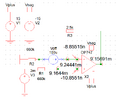
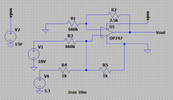
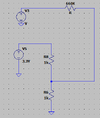
I am trying to analyze the below Opamp circuit
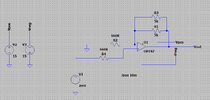
1775660828019.png

I have picked a random opamp in Ltspice. I can understand that it is non inverting amplifier and gain is Vout = V1(1 + (R1 || R3) / R2)
Vout = 2mV * (1 + 2.5KOhm/660KOhm) = 2mV but i get result of 9mV, why? If i simulate without R4 i get the result of 2mV.
My understanding is as there is no current flowing into the noninverting terminal the voltage drop across R4 shall be 0. So, it should not make any difference if R4 is there or not.
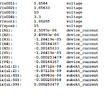
I get the following LTspice results
with R4

1775661271227.png
and without R4
1775661305706.png
 

bertus

Moderator
Nov 8, 2019
3,835
Joined
Nov 8, 2019
Messages
3,835
Hello,

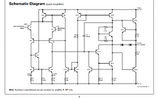
An ideal opamp would have zero input current.
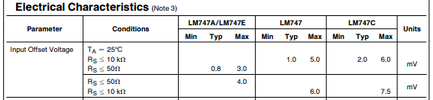
The LM747 has an input current between 80 and 500 nA.
LM747_input bias current.png
I do not know what current is used as input current by LTspice.

Bertus
 

Attachments

  • LM747_national.pdf
    162.6 KB · Views: 4

danadak

Feb 19, 2021
1,062
Joined
Feb 19, 2021
Messages
1,062
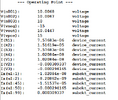
I get the following -

1775687646752.png


The NSC datasheet shows -

1775688001599.png

1775688056473.png


The markers closest to opamp inputs are current measuring, all the others V.

You are seeing offset and bias currents causing offsets flowing the 660K ohm R's
 

Attachments

  • 1775687937922.png
    1775687937922.png
    10.3 KB · Views: 1
Last edited:

Electric1

Nov 29, 2025
49
Joined
Nov 29, 2025
Messages
49
Ok now i understand if i take a higher input voltage of 10V the output value is now 10.04V
1775703271105.png
 

Harald Kapp

Moderator
Moderator
Nov 17, 2011
14,270
Joined
Nov 17, 2011
Messages
14,270
That's to be expected as the gain is 1.00378.
When you replace the OP747 by an ideal opamp, e.g. UniversalOpAmp from the LTSPICE library, you get 2.005 mV in your first example. This clearly shows the non-neglibible effect of the input bias current.
 

Electric1

Nov 29, 2025
49
Joined
Nov 29, 2025
Messages
49
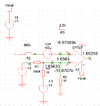
My actual circuit is as below i am sorry that i am going in steps to understand what the circuit does in one go it is quite challenging to analyze
1775716914685.png
The voltage at noninverting input is 3.3V/2 = 1.65V and it is amplified by the factor of 1.65V*(1 + 2.5kOhm/660kOhm) = 1.65V
1775717608955.png
I get around 1.66V which is deviation but my main point to understand is the influence of V1 source, does it have any effect after some voltage or it does not influence the circuit at all?
 

Attachments

  • cktanalyze.asc
    1.8 KB · Views: 0

Electric1

Nov 29, 2025
49
Joined
Nov 29, 2025
Messages
49
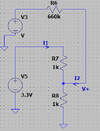
I applied the Kirchoff's rules to the below circuit
1775719345044.png
and derived the below equation of the voltage at the noninverting input
V+ = (1.65V - V/1323).
 

Harald Kapp

Moderator
Moderator
Nov 17, 2011
14,270
Joined
Nov 17, 2011
Messages
14,270
  1. The circuit in post #7 lacks the input bias current of the opamp.
  2. V+ is the voltage at the midpoint between the two 2 k resistors? It is not marked in the schematic.
  3. 1.75 V is correct. V/1323 is not correct, try again considering all resistors.
 

Electric1

Nov 29, 2025
49
Joined
Nov 29, 2025
Messages
49
  1. The circuit in post #7 lacks the input bias current of the opamp.
  2. V+ is the voltage at the midpoint between the two 2 k resistors? It is not marked in the schematic.
  3. 1.75 V is correct. V/1323 is not correct, try again considering all resistors. Looks like this is a kind of homework or assignment, right?
I am trying to solve not really homework problem.

I do not know how to add bias current and analyze the circuit, I have re written the equations last time i have done mistakes, these are the new equations
1775728277647.png
and get entirely new equation and it is not correct as well since when V1 = 0V; V+ = 6546V/1323 = 4.94V. What mistakes i am doing?

1775728475813.png
 

danadak

Feb 19, 2021
1,062
Joined
Feb 19, 2021
Messages
1,062
You are running a transient solution, 10 mS, is the OP747 settled yet given the internal
compensation C and other miller effects of bias generators and the like ? Not sure....

1775730473091.png
 

danadak

Feb 19, 2021
1,062
Joined
Feb 19, 2021
Messages
1,062
Solve your circuit using superposition to make life easier.....?

In your modified circuit I get -

1775731010173.png
 
Last edited:

Electric1

Nov 29, 2025
49
Joined
Nov 29, 2025
Messages
49
Solve your circuit using superposition to make life easier.....?

In your modified circuit I get -
Thank you so i will assume that the voltage at the noninverting input is the voltage sum of the V3 and V4 based on super position theorem, that really makes life very easy.
 

danadak

Feb 19, 2021
1,062
Joined
Feb 19, 2021
Messages
1,062
No not the sum, as shown its 1.65633 volts.

Take a look at videos on how to do superposition, very simple.
 

Electric1

Nov 29, 2025
49
Joined
Nov 29, 2025
Messages
49
No not the sum, as shown its 1.65633 volts.

Take a look at videos on how to do superposition, very simple.
Yes i understand the superposition principle, the voltage at a point is the sum due to the voltage V1 with V2 removed and due to voltage source V2 with V1 removed. I hope my understanding is correct.
 

danadak

Feb 19, 2021
1,062
Joined
Feb 19, 2021
Messages
1,062
Yes, keeping in mind the signs of the two solutions matter and -

  1. Replace all voltage sources with short circuits (wires)
  2. Replace all current sources with open circuits (breaks)
 

Electric1

Nov 29, 2025
49
Joined
Nov 29, 2025
Messages
49
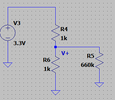
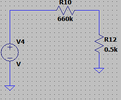
1323: When you consider V3, the voltage divider consists of R7||R8 and R6
Yes used the super position and calculated the values, hopefully it is correct.
1775823051167.png
1775823068327.png
1775823092064.png
But in the circuit i have left out few capacitors, i will add them and update the schematic and post it, i wanted to understand the behavior if i have to create a transfer function or not.
 

Harald Kapp

Moderator
Moderator
Nov 17, 2011
14,270
Joined
Nov 17, 2011
Messages
14,270
Rather confusing. Keep your equations in sync with the schematic. The equation uses V1, but your schemativ shows V4.
Easy to spot in this primitive example circuit, but potentially fatal once your circuit(s) become bigger.

Other than that the result looks o.k.
 
Top