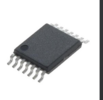
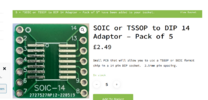
Adapters of this kind are readily available. Enter e.g. "soic dil adapter" in your favorite search engine.
Or buy a through hole opamp, see e.g.
this list.
For this application you can imho use any opamp with sufficient bandwith (> 100 kHz). There's no need for a fany ultra-low-noie or ultra-high-frequency type or anything in that direction.
All you need is rail-to-rail operation if you have a single power supply. Contruction may be easier when using a dual power supply (+-).
To be frank: I think this project - at least in the current state - is beyond your level of understanding (theory of opamps, filters, processors).
By no means do I want to discourage you, but I'd like to suggest you change your line of action and learn on your way:
Instead of trying to build the full project in one giant step - thereby risking loss of all components if it doesn't work (and chances are good it won't work instantly) - use a step-by-step approach.
- build a signal amplifier that picks up the aufio signal from the source you are going to use (microphone, line-i, ...?) and amplifies it to a level the LM3914 can handle. You'll probably have to learn a lot while building tjis circuit. Opamps are deceptively simple when you look at the standard circuits, but opamps can nevertheless be tricky to handle when it comes to the fine details like e.g. stability of the amplifier without ringing or, worse, self-oscillation due to improper feednack circuits.
- Build a single channel VU-meter to display the signal from the amplifier by the LM3914 in a way that pleases your estetics.
- If necessary (very probable) debug these circuits and tweak components until it operates as your expect.
- Build a first single filter e.g. for the bass range. Insert the filter into your signal chain and check that the response displayed by the LM3914 matches your expectations, which in this case should be a display of the bass tones' volume only.
- Once this works go on and build the remaining filters and display circuits for the remaining channels. You may even consider designing a modular PCB with filter and display circuit which is customized to different frequencies by populating the filter with different components. The have 20 or so of these PCBs manufactures (not so expensive nowadays). The simply assemble the PCBs (solder components to them) and combine with power supply and signal amplifier (step 1 from above list) for the full spectrum analyzer.
In my opinion your chances to complete this project to your satisfaction are much better using such (or similar) modular approach.