Speaker output relay

gibon0695

Dec 2, 2015
27
Joined
Dec 2, 2015
Messages
27
Hello,

How can I create a relay that will delay the output to the speakers for around 2 seconds when the circuit is turned on?

The reason I need this is because the chip outputs multiple pops when initialised.

Circuit:
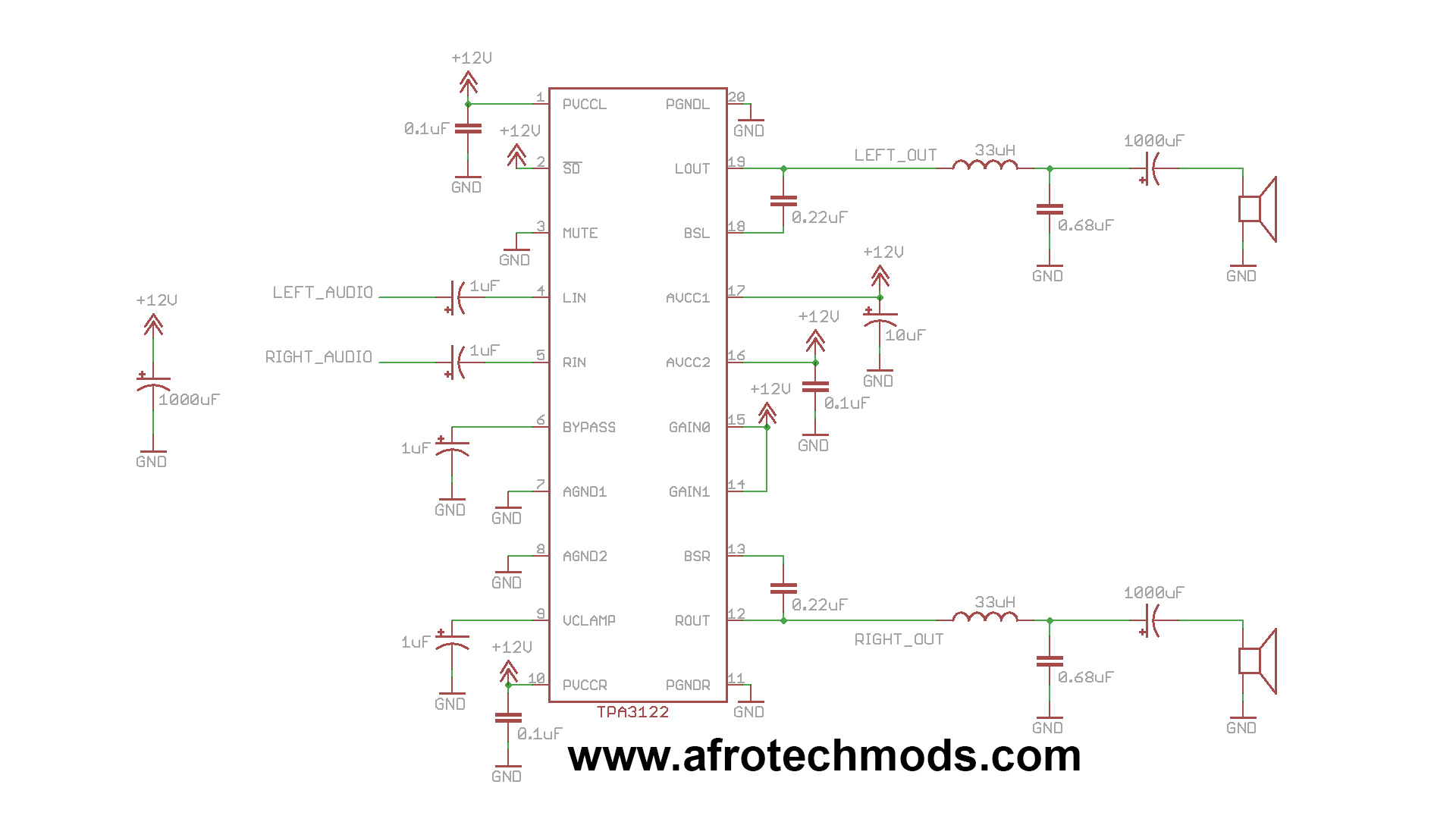
MITAXQ5.jpg


Thanks for your time.
 

Alec_t

Jul 7, 2015
3,817
Joined
Jul 7, 2015
Messages
3,817
I'd try a resistor/capacitor combo on the Mute input of the chip, to provide power-up muting. Or perhaps a similar combo on the Gain0 and Gain1 inputs. Read the datasheet or any Application Note (if available) for advice re those inputs.
 

gibon0695

Dec 2, 2015
27
Joined
Dec 2, 2015
Messages
27
I'd try a resistor/capacitor combo on the Mute input of the chip, to provide power-up muting. Or perhaps a similar combo on the Gain0 and Gain1 inputs. Read the datasheet or any Application Note (if available) for advice re those inputs.

Thanks for the reply. I did try this. Popping still occurs even with mute fully enabled. I didn't try it on the gain pins though, could be an idea
 

Alec_t

Jul 7, 2015
3,817
Joined
Jul 7, 2015
Messages
3,817
Then I guess the pops are due to those fat 1000uF caps charging. Perhaps you could wire a resistor of, say, >1k in series with the speaker so that the cap charges slowly at power-up, then use relay contacts to short out the resistor after ~2 secs. The contacts would have to be rated for the maximum speaker current.
 

AnalogKid

Jun 10, 2015
3,045
Joined
Jun 10, 2015
Messages
3,045
Add a 1 K resistor across each output, from the 1000 uF negative side to GND. This provides a current path to charge up the output capacitor while the speakers are disconnected. Connect each side of a DPST or DPDT relay between the negative side of the output capacitors to the speaker.

To control the relay coil you can use a simple R-C network with a really big C, or a 1-transistor or 555 timer with smaller timing components. We don't know what parts you have or have access to, so pick out a relay and give us the coil specs; they will be part of the decision.

ak
 

cjdelphi

Oct 26, 2011
1,166
Joined
Oct 26, 2011
Messages
1,166
I wonder how the chip would tolerate a slow rising voltage / softstart
 

AnalogKid

Jun 10, 2015
3,045
Joined
Jun 10, 2015
Messages
3,045
My guess is that the internal oscillator ha an undervoltage lockout to protect the output transistors from operating in the linear active region due to insufficient gate drive. When Vcc is high enough, the oscillator kicks in the output DC jumps to Vcc/2.

ak
 

gibon0695

Dec 2, 2015
27
Joined
Dec 2, 2015
Messages
27
Add a 1 K resistor across each output, from the 1000 uF negative side to GND. This provides a current path to charge up the output capacitor while the speakers are disconnected. Connect each side of a DPST or DPDT relay between the negative side of the output capacitors to the speaker.

To control the relay coil you can use a simple R-C network with a really big C, or a 1-transistor or 555 timer with smaller timing components. We don't know what parts you have or have access to, so pick out a relay and give us the coil specs; they will be part of the decision.

ak

Hey, apologies for the delayed response.

Would I need a seperate relay for each speaker? or can I send the two seperate signals through a single relay?

I was thinking of using this relay:
http://uk.farnell.com/panasonic-electric-works/tx2-12v/relay-signal-dpdt-30vdc-2a/dp/1200952

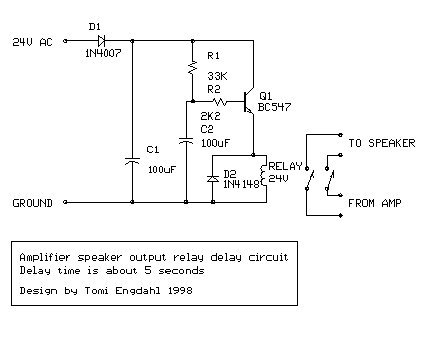
And using it in a similar ciurcuit to this:
ampdelay.gif
 

unnimenon

Apr 17, 2016
1
Joined
Apr 17, 2016
Messages
1

Attachments

  • protector_salidas.pdf
    186.4 KB · Views: 88
Top