Hi Blacksheep,
You don't need collector curves for silicon transistors that are used well within their ratings. The current gain vs current is an absolute straight line!
A curve of a typical base-emitter voltage is usually shown in datasheets, but doesn't mean much since each transistor with the same part number is different.
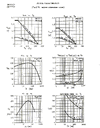
I have Philips' 1968 databook which shows their metal-cased BC107 to BC109 in great detail. Collector curves with the lines separated by exactly the same distance, impedance curves and noise curves. The BC547 to BC549 are the same transistors in a modern plastic package.
Transistors are cheap enough now to add plenty of negative feedback to make them more linear and the same.
What are you making that requires a collector curve for its design?

 I don't know much about it and i think it is very confusing -- i don't know where to start and where to end. I thought about transferring the theory about vacuum tubes to transistor design, because i understand it better. In tube stage designing, the anode curves (collector curves for transistors) is used to get parameters such as amplification, internal resistance and others. I think it is a nice way to design and understand a tube circuit. Why is it so different with transistors? Is it the because of the difference between transistors of the same part number or is it just a totally different way of designing amplifier stages? I could really use a good book about small (audio) signal amplifiers using transistors...