A
Alun
- Jan 1, 1970
- 0
It is a well known fact that a speaker can act as a microphone becase when sound hits the diaphram it generates a small voltage. I've see circuits that use a speaker as a microphone like a wakie talkie. With these circuits you push a button to talk but it normaly acts as a speaker.
My idea is defferent, it is possible to use a speaker as a microphone while at the same time using it as a speaker.
I've done it before, many years a go (when I was about 11) I connected two small 8 ohm speakers togeather with a twisted pair and made a small telephone. You spoke into one speaker and your voice came out of the other speaker. I discovered it worked best when the speakers were the same impedance so I learned about impednace matching without even knowing it. Of course it wasn't very loud besause there was no amplification. If I added an amplifier it would've been great but I didn't know enough about electronics to design one but now I think I could, whether I get round to it or not is a different matter, maybe this summer when I finish college.
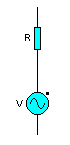
The diagram below shows the model for a speaker:
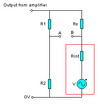
Where R is the resistance of the voice coil and V is the voltage generated when it acts as a microphone.
My idea is defferent, it is possible to use a speaker as a microphone while at the same time using it as a speaker.
I've done it before, many years a go (when I was about 11) I connected two small 8 ohm speakers togeather with a twisted pair and made a small telephone. You spoke into one speaker and your voice came out of the other speaker. I discovered it worked best when the speakers were the same impedance so I learned about impednace matching without even knowing it. Of course it wasn't very loud besause there was no amplification. If I added an amplifier it would've been great but I didn't know enough about electronics to design one but now I think I could, whether I get round to it or not is a different matter, maybe this summer when I finish college.
The diagram below shows the model for a speaker:
Where R is the resistance of the voice coil and V is the voltage generated when it acts as a microphone.
Last edited:

 ,
,


