Wall charger ripple effect reducer

hyudryu

Feb 24, 2010
64
Joined
Feb 24, 2010
Messages
64
Hi, I have a 8.4V wall charger that charges an airsoft battery. I figured since it is from china and is cheap, I don't think they reduced the ripple effect by a lot. Anyways, before I did anything, I measured out around 13VDC with a multimeter.

This is my circuitry
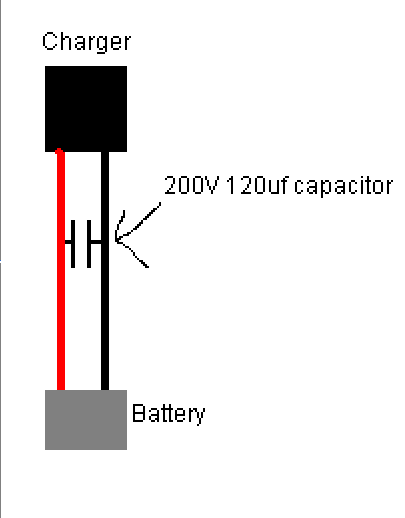
561aac660be422f43f944d7dfdb1a64e.png


And I measured out around 19VDC after I put the capacitor there. It surprised me that there was a voltage gain. The capacitor I used was an electrolyte capacitor and I made sure the polarity was correct. Is there an explanation to this phenomenon?
 
Last edited:

daddles

Jun 10, 2011
443
Joined
Jun 10, 2011
Messages
443
You have to know what you were measuring; this is best done with an oscilloscope. If there was some AC on the DC, then it's possible it affected your DMM's DC measurement, especially if it's a cheap DMM.

What you should do is measure both the AC and DC voltages and combine them in quadrature. This will give you a better measure of the unfiltered waveform. If your meter is an AC-coupled RMS responding meter, then this method gives you the real RMS value of the waveform. If you have the typical average-responding meter, then this method isn't correct unless the ripple is a sine wave.

Here's an example. I set a function generator to a 1 Vrms sine wave at 60 Hz. DC offset was 0.5 V. My HP 3456A voltmeter measured DC = 0.49781 V, AC-coupled RMS = 1.00402, and it measured the AC+DC value (the "real" RMS value of the waveform) as 1.11940 V. If you combine the DC and AC-coupled RMS value in quadrature, you get 1.1207, which is about 0.1% different than what the meter measured (i.e., it's pretty close).

In other words, it's difficult to know exactly what you measured -- and the best way would be to use a scope. But give the method I outlined above a try and let us know what you get. Also say what brand of DMM you have.
 

(*steve*)

¡sǝpodᴉʇuɐ ǝɥʇ ɹɐǝɥd
Moderator
Jan 21, 2010
25,510
Joined
Jan 21, 2010
Messages
25,510
The explanation is that your charger is probably just producing rectified AC. Your multimeter will read either the average or the RMS value of this voltage.

When you add a capacitor, it charges to the peak voltage.

In theory the peak is around 1.4 times the RMS value. 13 * 1.4 is just over 18 volts, so we're definitely in the ballpark.
 

davelectronic

Dec 13, 2010
1,087
Joined
Dec 13, 2010
Messages
1,087
charger filter

your air soft charger is made to charge the battery at the desired correct voltage and current, to add external capacitors that up the peak voltage might damage your battery and charging circuit, crude dc charging is not a problem, most chargers small ones have some ripple, it not critical to have the perfect ripple free regulated charger. there might be a varister in the charger limiting the start up. Dave.
 

davelectronic

Dec 13, 2010
1,087
Joined
Dec 13, 2010
Messages
1,087
Charger

Your chargers voltage will drop when loaded, this is some what normal, the product manufacturer would have allowed for this drop, you probably measured the unloaded charger, i cant see any gain from adding extra capacitors, unless the charger is not the one that came with the air soft battery, in that case do the math to achive the correct charging voltage and current, some ripple is ok. Dave.
 

wannabegeek

Aug 17, 2011
133
Joined
Aug 17, 2011
Messages
133
This is a great thread for me. I've seen this happen too in different situations.

Steve's simple answer is a good reminder to me a beginner, that caps are charging to highest voltage seen and storing an that or an average.

Also, I've been wondering what method my cheapo DMM uses to find RMS. I don't
think it is computing the time averaged integral :) It assumes a sine input if I understand daddles correctly.

I really need a good DMM. My old Tektronix 1975 rack mount unit died. I found on it a junk pile.

wbg
 
Top