
Seriously? I based that schematic and plots on your posted schematic, not additional loads. That power supply is being milked with that circuit alone. If you have additional current sucking circuitry, all bets are off !
You are using an out of date browser. It may not display this or other websites correctly.
You should upgrade or use an alternative browser.
You should upgrade or use an alternative browser.
Scroll to continue with content
Hi all (again)...
I have added the final leg of the circuit after much reverse engineering.
Attached is the circuit diagram to the best of my knowledge.
The NAND gates are part of a 4093B quad 2 input NAND gate with Schmitt trigger inputs.
Unfortunately, I can't run the simulation on my device as I do not have a Schmitt trigger in my virtual parts bucket so I subbed straight NAND gates for the diagram but it doesn't run. The power for the 4093 is directly across the 8.2v zener with a 100nF cap across the power pins of the chip.
The two toggle switches are magnetic reed switches. One indicates an error condition and turns on the RED LED and presumably turns off the pump too. The other closes when it's time for the pump to turn off. ie. the pump is on when the on/off reed switch is OPEN.
Once the on/off reed switch is closed, the circuit has a delay of about 5-10 seconds before the pump turns off.
The two unlabelled diodes are germaniums with a voltage drop of 0.565v.
The original circuit has a 1u cap instead of the 2.2u shown here.
This thing has been bugging me for so long it's become personal now! I really want to understand and solve this.
I look forward to any comments.
Kind regards,
-Paul
I have added the final leg of the circuit after much reverse engineering.
Attached is the circuit diagram to the best of my knowledge.
The NAND gates are part of a 4093B quad 2 input NAND gate with Schmitt trigger inputs.
Unfortunately, I can't run the simulation on my device as I do not have a Schmitt trigger in my virtual parts bucket so I subbed straight NAND gates for the diagram but it doesn't run. The power for the 4093 is directly across the 8.2v zener with a 100nF cap across the power pins of the chip.
The two toggle switches are magnetic reed switches. One indicates an error condition and turns on the RED LED and presumably turns off the pump too. The other closes when it's time for the pump to turn off. ie. the pump is on when the on/off reed switch is OPEN.
Once the on/off reed switch is closed, the circuit has a delay of about 5-10 seconds before the pump turns off.
The two unlabelled diodes are germaniums with a voltage drop of 0.565v.
The original circuit has a 1u cap instead of the 2.2u shown here.
This thing has been bugging me for so long it's become personal now! I really want to understand and solve this.
I look forward to any comments.
Kind regards,
-Paul
Attachments


Last edited:

- Joined
- Nov 28, 2011
- Messages
- 8,393
Hi Paul,
That schematic doesn't make much sense to me. I think you must have made several errors reverse-engineering it. Here are a few specific points, but this may not be a full list of problems.
You should show the power path to 4093. I know you explained it in the comments but it should be shown on the schematic.
Connecting the Error switch in series with a 100k resistor across the supply makes no sense. It won't have any effect.
The four components connected in series across first gate input make no sense. I suspect that the positive power rail actually connects in there somewhere, possibly to the second gate input, and there must be other connections among those components as well.
Where's the fourth gate?
I think there's probably a feedback path somewhere to form a latch. Perhaps that's what the fourth gate does, or perhaps it's implemented through one of the other gates. The button marked "reset" presumably resets this latch. The gate output that goes to the 10k resistor to the relay driver transistor, does it connect anywhere else?
The diodes won't be germanium. Germanium diodes are uncommon these days, and more expensive than silicon. They are only used when they are absolutely needed, which doesn't apply to this circuit. Why do you think they are germanium?
You are now showing a circuit that has three inputs (from two reed switches and a pushbutton) and two outputs (the relay that controls the pump, and one LED). Is that the full list of inputs and outputs? Can you define how the circuit responds to the inputs? You've said that the pump turns off 5~10 seconds after the "on/off" reed switch closes, and the red LED illuminates when the "error" reed switch closes (presumably). Can you be more specific about the circuit's behaviour? Can you post some clear photos of the top and bottom sides of the PCB?
Edit: That last paragraph really only matters if you really want to reverse-engineer the complete circuit, which I don't think is necessary (see later).
Looking back through this thread, the problem you reported was that the relay didn't close positively, and the contacts burnt out. My suggestions were, and still are:
(a) Replace the relay with another 24V type with the same coil resistance.
(b) Leave the LED in series with the coil as-is.
(c) Increase the zener voltage to 27V or perhaps 30V or 33V if necessary to get at least 24VDC average voltage across the relay coil at nominal mains voltage.
(d) Possibly, increase the 220 uF smoothing capacitor, to reduce the ripple on the voltage seen by the relay coil.
(e) Possibly increase the 1 uF capacitor slightly (2.2 uF is too high; the capacitance here is actually fairly critical).
(f) After increasing the zener voltage and/or 1 uF capacitor value, check the zener diode's average power dissipation and operating temperature, and use a part with a higher power rating if necessary.
(g) Use a full-wave rectifier on the input - I've reconsidered this suggestion - there's a lot more circuitry involved, including a CMOS IC, and it's probably better to leave it at neutral potential (assuming the mains connections are wired right and can't be reversed) rather than deliberately introducing a high AC voltage onto the common rail.
I'm not sure why you want to trace out the 4093 part of the circuit. Is it because of the extra load it puts on the power supply? You can calculate the load current from the zener voltage (8.2V) and the series resistor. The series resistor drops the difference between the supply rail voltage and the zener voltage (approximately). Assuming that the average supply rail voltage is, say, 26V (24V for the coil minus 2V for the LED), that's about 18V across the resistor, which is 1.5 kilohms, so from I = V / R the current will be about 12 mA. This is another reason why you need to increase the current available from the power supply, using the suggestions I listed above.
This 12 mA current will be fairly constant, even if parts of the 4093 circuit draw current. The zener sets the 8V rail at that voltage, and if the 4093 circuit doesn't draw much current, all of that 12 mA flows through the zener. As the 4093 circuit draws current, less current flows through the zener, but the rail stays at 8V. Therefore the voltage drop across the 1.5K series resistor remains around 18V and the current remains around 12 mA. So the details of the 4093 circuit probably don't matter much.
At this point, a complete and correct schematic is probably not needed. I (and gorgon) have suggested changes for the power supply to increase its voltage and current capabilities. What other information do you need?
That schematic doesn't make much sense to me. I think you must have made several errors reverse-engineering it. Here are a few specific points, but this may not be a full list of problems.
You should show the power path to 4093. I know you explained it in the comments but it should be shown on the schematic.
Connecting the Error switch in series with a 100k resistor across the supply makes no sense. It won't have any effect.
The four components connected in series across first gate input make no sense. I suspect that the positive power rail actually connects in there somewhere, possibly to the second gate input, and there must be other connections among those components as well.
Where's the fourth gate?
I think there's probably a feedback path somewhere to form a latch. Perhaps that's what the fourth gate does, or perhaps it's implemented through one of the other gates. The button marked "reset" presumably resets this latch. The gate output that goes to the 10k resistor to the relay driver transistor, does it connect anywhere else?
The diodes won't be germanium. Germanium diodes are uncommon these days, and more expensive than silicon. They are only used when they are absolutely needed, which doesn't apply to this circuit. Why do you think they are germanium?
You are now showing a circuit that has three inputs (from two reed switches and a pushbutton) and two outputs (the relay that controls the pump, and one LED). Is that the full list of inputs and outputs? Can you define how the circuit responds to the inputs? You've said that the pump turns off 5~10 seconds after the "on/off" reed switch closes, and the red LED illuminates when the "error" reed switch closes (presumably). Can you be more specific about the circuit's behaviour? Can you post some clear photos of the top and bottom sides of the PCB?
Edit: That last paragraph really only matters if you really want to reverse-engineer the complete circuit, which I don't think is necessary (see later).
Looking back through this thread, the problem you reported was that the relay didn't close positively, and the contacts burnt out. My suggestions were, and still are:
(a) Replace the relay with another 24V type with the same coil resistance.
(b) Leave the LED in series with the coil as-is.
(c) Increase the zener voltage to 27V or perhaps 30V or 33V if necessary to get at least 24VDC average voltage across the relay coil at nominal mains voltage.
(d) Possibly, increase the 220 uF smoothing capacitor, to reduce the ripple on the voltage seen by the relay coil.
(e) Possibly increase the 1 uF capacitor slightly (2.2 uF is too high; the capacitance here is actually fairly critical).
(f) After increasing the zener voltage and/or 1 uF capacitor value, check the zener diode's average power dissipation and operating temperature, and use a part with a higher power rating if necessary.
(g) Use a full-wave rectifier on the input - I've reconsidered this suggestion - there's a lot more circuitry involved, including a CMOS IC, and it's probably better to leave it at neutral potential (assuming the mains connections are wired right and can't be reversed) rather than deliberately introducing a high AC voltage onto the common rail.
I'm not sure why you want to trace out the 4093 part of the circuit. Is it because of the extra load it puts on the power supply? You can calculate the load current from the zener voltage (8.2V) and the series resistor. The series resistor drops the difference between the supply rail voltage and the zener voltage (approximately). Assuming that the average supply rail voltage is, say, 26V (24V for the coil minus 2V for the LED), that's about 18V across the resistor, which is 1.5 kilohms, so from I = V / R the current will be about 12 mA. This is another reason why you need to increase the current available from the power supply, using the suggestions I listed above.
This 12 mA current will be fairly constant, even if parts of the 4093 circuit draw current. The zener sets the 8V rail at that voltage, and if the 4093 circuit doesn't draw much current, all of that 12 mA flows through the zener. As the 4093 circuit draws current, less current flows through the zener, but the rail stays at 8V. Therefore the voltage drop across the 1.5K series resistor remains around 18V and the current remains around 12 mA. So the details of the 4093 circuit probably don't matter much.
At this point, a complete and correct schematic is probably not needed. I (and gorgon) have suggested changes for the power supply to increase its voltage and current capabilities. What other information do you need?
Last edited:
Hi KrisBlueNZ, CDRIVE;
Thank you for taking the time to write such a comprehensive reply.
I'll try and address your comments as best I can.
The circuit makes little sense to me either and I too suspected/believed I have made one or more errors in the reverse engineering process in the extra leg I added. I wanted to show CDRIVE the remaining leg or at least the gist thereof and also see if I could understand better what was going on since I overlooked that when he was making his spice sim. My bad CDRIVE - sorry.
The fourth gate is not used and is tied to one of the rails so I ignored it.
Since the rest of the circuit works fine, I wanted to focus just on the power supply portion since it wasn't driving the relay properly. I should have only included the second zener and resistor in my revised schematic since the rest is largely irrelevant as KrisBlueNZ agrees. Though it does show context even if my actual diagram for that leg is incorrect.
So lets ignore the hows and whys about the IC etc and assume that as long as the correct current is flowing through the second zener/resistor leg (the 8.2v one) and that the zener is not overloaded by increasing the first zener, I'll be good.
Upon closer inspection those diodes are probably just 1n4148 diodes so I retract my comment that they are germaniums. They just *looked* like they might be and I thought since current in this circuit is at a premium, they might be germs to lower their voltage drop. That was my thinking anyway faulty or otherwise.
So:
A) I'm going to replace the relay with a new 24v one.
B) I'll increase the zener which will also mean increasing the resistor in series with the second zener and checking the wattage of the first zener remembering it's only half wave.
I am just unsure how much to increase it by or how much to increase the 1u cap by.
CDRIVE: do you still have the spice circuit you lovingly made? I wonder if you could add just the second zener and resistor to show the full load on the PSU (as per the attached diagram) and then determine which value zener I need to provide close to 20mA on the relay and by how much I ought to increase the 1u cap by (if at all) and by how much I should increase the resistor in series with the 8.2v zener to maintain the same current for the rest of the circuit. My sim does not have zeners over 25v sadly so I can't do it myself *sigh* otherwise that would be easy
I have to order the 1u cap replacement overseas so I can't really just keep subbing them into the circuit until it works. Plus I don't want to kill the circuit entirely
Also, KrisBlueNZ is of the opinion that increasing it too much would be bad. Though with the 24v zener I had to beef it to 2.2u to make the relay close properly. Changing the zener seems to me to be the best suggestion.
EDIT: I've manually edited the zener data to 27v and increasing the 1u cap to 1.8u seems to be a good starting point.
Any disagreements or additional gotchas I've missed?
Thanks again for all your help. Nearly there! I really appreciate all your time and effort guys.
-Paul
Thank you for taking the time to write such a comprehensive reply.
I'll try and address your comments as best I can.
The circuit makes little sense to me either and I too suspected/believed I have made one or more errors in the reverse engineering process in the extra leg I added. I wanted to show CDRIVE the remaining leg or at least the gist thereof and also see if I could understand better what was going on since I overlooked that when he was making his spice sim. My bad CDRIVE - sorry.
The fourth gate is not used and is tied to one of the rails so I ignored it.
Since the rest of the circuit works fine, I wanted to focus just on the power supply portion since it wasn't driving the relay properly. I should have only included the second zener and resistor in my revised schematic since the rest is largely irrelevant as KrisBlueNZ agrees. Though it does show context even if my actual diagram for that leg is incorrect.
So lets ignore the hows and whys about the IC etc and assume that as long as the correct current is flowing through the second zener/resistor leg (the 8.2v one) and that the zener is not overloaded by increasing the first zener, I'll be good.
Upon closer inspection those diodes are probably just 1n4148 diodes so I retract my comment that they are germaniums. They just *looked* like they might be and I thought since current in this circuit is at a premium, they might be germs to lower their voltage drop. That was my thinking anyway faulty or otherwise.
So:
A) I'm going to replace the relay with a new 24v one.
B) I'll increase the zener which will also mean increasing the resistor in series with the second zener and checking the wattage of the first zener remembering it's only half wave.
I am just unsure how much to increase it by or how much to increase the 1u cap by.
CDRIVE: do you still have the spice circuit you lovingly made? I wonder if you could add just the second zener and resistor to show the full load on the PSU (as per the attached diagram) and then determine which value zener I need to provide close to 20mA on the relay and by how much I ought to increase the 1u cap by (if at all) and by how much I should increase the resistor in series with the 8.2v zener to maintain the same current for the rest of the circuit. My sim does not have zeners over 25v sadly so I can't do it myself *sigh* otherwise that would be easy
I have to order the 1u cap replacement overseas so I can't really just keep subbing them into the circuit until it works. Plus I don't want to kill the circuit entirely
Also, KrisBlueNZ is of the opinion that increasing it too much would be bad. Though with the 24v zener I had to beef it to 2.2u to make the relay close properly. Changing the zener seems to me to be the best suggestion.
EDIT: I've manually edited the zener data to 27v and increasing the 1u cap to 1.8u seems to be a good starting point.
Any disagreements or additional gotchas I've missed?
Thanks again for all your help. Nearly there! I really appreciate all your time and effort guys.
-Paul
Attachments

Last edited:
- Joined
- Nov 28, 2011
- Messages
- 8,393
Yes, good.So lets ignore the hows and whys about the IC etc and assume that as long as the correct current is flowing through the second zener/resistor leg (the 8.2v one) and that the zener is not overloaded by increasing the first zener, I'll be good.
The behaviour of the power input circuit is determined by a combination of factors. The mains voltage and frequency can't be changed. Other factors are the input coupling capacitor (the 1 uF one), the zener voltage, the smoothing capacitance, and the load current.A) I'm going to replace the relay with a new 24v one.
B) I'll increase the zener which will also mean increasing the resistor in series with the second zener and checking the wattage of the first zener remembering it's only half wave. I am just unsure how much to increase it by or how much to increase the 1u cap by.
You aren't going to change the load current. It's roughly 40 mA. That's 20 mA for the relay coil, correct? Plus 12 mA for the IC circuitry and 7 mA for the "ON" LED.
Assuming the smoothing capacitor is 220 uF and the period between top-ups from the mains is 20 ms (50 Hz mains, half-wave rectification), the ripple can be calculated from dV / dT = I / C which rearranges to dV = dT I / C which is 0.02 * 0.04 / 0.00022 which is 3.6V peak to peak. That's 15% of the nominal voltage. This would normally be way too much but it's reasonable in this application. There may not physically be room to increase the smoothing capacitor and you rapidly get into diminishing returns. So let's assume you stay with 220 uF.
Since you need a mean rail voltage of about 26V after the drop from the 1N4007, and ripple is about +/- 1.8V, you should be using a zener of 27V or 30V. I would buy one of each and start with the 27V one, measure the DC voltage across the relay coil while the relay is ON, and if it's less than, say, 23V, switch to a 30V zener.
Edit: The following paragraph is wrong. I'm not clear on where I've made the mistake; if anyone can explain it properly, please do. In a later post I show the results of simulation, where it's clear that the input capacitor needs to be at least 2.2 uF.
The last item is the input capacitor. Capacitive reactance (which works like resistance in this application) is calculated as Xc = 1 / (2 pi f C) which is 1 / (6.28 * 50 * 1e-6) which is about 3200 ohms for the original 1 uF value. At 230V RMS, current will be about 72 mA. This is not exact because on positive cycles the capacitor doesn't see the full mains voltage across it, because the power supply is taking roughly 24V for itself, but it's close enough. Half of this current is wasted because of the half-wave rectification, leaving about 36 mA available for the circuit. We want to increase that to 40 mA plus some left over for safety margin and current in the main zener. I would aim for 45~50 mA or an increase of 25~39%. So the capacitor should be between 1.25 and 1.39 uF. So my initial guesses of 1.2 uF or 1.5 uF are probably about right. I will assume you choose 1.5 uF so the current from the capacitor on positive half-cycles is about 54 mA.
Edit: Does what I said in that paragraph, "half of this [72 mA] current is wasted because of the half-wave rectification, leaving about 36 mA available for the circuit", make sense? I don't think it does. (*steve*) perhaps you could comment...? (I will PM Steve and ask him to look at this thread.)
Edit2: I think what I said is valid.
Edit3: There is definitely something wrong with my calculations and my conclusion that the capacitor should be between 1.25 and 1.39 uF. See my later post with the results of simulation, where it's clear that the input capacitor needs to be at least 2.2 uF.
The last parameter is the zener power dissipation. Worst case will be when the relay is not activated, and the 20 mA that it would draw has to be absorbed by the zener. The zener dissipates practically nothing during negative half-cycles of the mains voltage, because at that time, the forward voltage of the zener is only ~0.7V. On positive half-cycles the incoming current will be about 54 mA and the load current will be about 20 mA so the zener will be absorbing about 34 mA half the time. If the zener voltage is 30V (the worst case) this is a power dissipation of about 1W half the time. So you should use a zener rated at 1W at least. A larger part (1.3W or 2W for example) will give a better safety margin and will have better heat dissipation.
Since these changes will beef up the power supply significantly, I would leave the 1k5 series resistor to the IC circuit unchanged.
Can you connect two zeners in series?My sim does not have zeners over 25v sadly so I can't do it myself *sigh* otherwise that would be easy
I would be interested to see the results of a simulation with those changed component values too.
Last edited:

- Joined
- Jan 21, 2010
- Messages
- 25,510
I've been ignoring this thread because I note that CDRIVE and KrisBlueNZ have been contributing (so I was pretty sire it was in safe hands).
I've been asked to poke my head in, so I've had a quick read of a couple of posts on this page.
I understand that the problem is to get a little more power from this power supply.
Kris notes that half the current is "wasted" due to the forward conduction of the zener. Given that the rectifier is only half wave, that power wasn't going anywhere anyway. The zener does perform a service of clamping the negative transients so a low voltage rectifier diode could be used.
If the zener diode were a link, the current through it (in either direction) would be mostly out of phase with the mains voltage and hence little actual power would be dissipated. The series resistances alter this somewhat since current through a resistor always causes loss of power. likewise, the resistor across the capacitor adds to losses. Since the series resistor is low, and the parallel one high, the effect is negligible.
However, it does suggest a way to double the power output. If the existing diode is replaced with a bridge rectifier, and the existing zener is replaces with two similar zeners back to back, the resulting full wave rectification will reduce the sag in voltage at a given current.
This modification is also probably the easiest to reverse engineer since adding a bridge may just require a single track is cut, and changing to a pair of zeners can be done with the connection between them in "mid-air" (i.e. above the board).
An alternative is to place the zener after a bridge rectifier, but this may be harder to accomplish, and will also double the power dissipation in the zener. You can still use a low voltage bridge because the reverse voltage across any one diode in a bridge is far lower, dramatically so in this circuit (around 28V as opposed to close to 400V) with the zener after the rectifier.
).I've been asked to poke my head in, so I've had a quick read of a couple of posts on this page.
I understand that the problem is to get a little more power from this power supply.
Kris notes that half the current is "wasted" due to the forward conduction of the zener. Given that the rectifier is only half wave, that power wasn't going anywhere anyway
. The zener does perform a service of clamping the negative transients so a low voltage rectifier diode could be used. If the zener diode were a link, the current through it (in either direction) would be mostly out of phase with the mains voltage and hence little actual power would be dissipated. The series resistances alter this somewhat since current through a resistor always causes loss of power. likewise, the resistor across the capacitor adds to losses. Since the series resistor is low, and the parallel one high, the effect is negligible.
However, it does suggest a way to double the power output. If the existing diode is replaced with a bridge rectifier, and the existing zener is replaces with two similar zeners back to back, the resulting full wave rectification will reduce the sag in voltage at a given current.
This modification is also probably the easiest to reverse engineer since adding a bridge may just require a single track is cut, and changing to a pair of zeners can be done with the connection between them in "mid-air" (i.e. above the board).
An alternative is to place the zener after a bridge rectifier, but this may be harder to accomplish, and will also double the power dissipation in the zener. You can still use a low voltage bridge because the reverse voltage across any one diode in a bridge is far lower, dramatically so in this circuit (around 28V as opposed to close to 400V) with the zener after the rectifier.
- Joined
- Nov 28, 2011
- Messages
- 8,393
Thanks Steve.
I think my comment about needing to halve the 72 mA current (which I calculated based on the mains voltage and the reactance of the feed capacitor) was right.
Regarding the bridge rectifier idea, I suggested that earlier, and CDRIVE disagreed, because the negative rail of the circuit would no longer be at ground potential, which it currently is (assuming that the mains connection can't be reversed, which is true here in New Zealand where the OP is located, assuming any extension leads are wired correctly, and assuming an isolating transformer isn't used). Since then we've discovered that there's a fair bit of extra circuitry, including a 4093, and I'm tending to agree with CDRIVE that it would be better to leave the circuitry common rail connected to Neutral, rather than have it jump between 0V and -30V relative to Neutral during each mains cycle.
Thanks for your input.
I think my comment about needing to halve the 72 mA current (which I calculated based on the mains voltage and the reactance of the feed capacitor) was right.
Regarding the bridge rectifier idea, I suggested that earlier, and CDRIVE disagreed, because the negative rail of the circuit would no longer be at ground potential, which it currently is (assuming that the mains connection can't be reversed, which is true here in New Zealand where the OP is located, assuming any extension leads are wired correctly, and assuming an isolating transformer isn't used). Since then we've discovered that there's a fair bit of extra circuitry, including a 4093, and I'm tending to agree with CDRIVE that it would be better to leave the circuitry common rail connected to Neutral, rather than have it jump between 0V and -30V relative to Neutral during each mains cycle.
Thanks for your input.
Thanks Steve.
Regarding the bridge rectifier idea, I suggested that earlier, and CDRIVE disagreed, because the negative rail of the circuit would no longer be at ground potential, which it currently is <snip> I'm tending to agree with CDRIVE that it would be better to leave the circuitry common rail connected to Neutral, rather than have it jump between 0V and -30V relative to Neutral during each mains cycle.
Thanks for your input.
Actually, I thought you were referring to connecting a bridge directly to the mains prior to the zener. This would have dictated lifting circuit common off mains neutral and would have placed common 338VP above mains neutral. Placing the bridge after two zeners back to back, (as Steve suggested) is a different animal but still requires lifting the common off neutral. I agree that having it jump between 0V and -30V isn't desirable either.
Bassmo has never completely explained the physical layout of this pump/control. I've repeatedly asked why a dirt cheap wallwart couldn't replace this power supply section. The power demands of the control is very low. Just about any 24V wallwart could replace it.
Chris
- Joined
- Nov 28, 2011
- Messages
- 8,393
Actually I was suggesting putting the bridge between the feed capacitor and the zener. Since the feed capacitor would be in the Phase side, and the combination of the bridge and the zener would limit the voltage across the bridge to 30V, the ground rail of the circuit would only jump between 0V and -30V relative to Neutral, but neither of us realised that at the time, which is why I didn't query your "338V peak" claim at the time.Actually, I thought you were referring to connecting a bridge directly to the mains prior to the zener. This would have dictated lifting circuit common off mains neutral and would have placed common 338VP above mains neutral.
Yes, another case of too little information. I imagine it's a compact sealed unit and there wouldn't be room.Bassmo has never completely explained the physical layout of this pump/control. I've repeatedly asked why a dirt cheap wallwart couldn't replace this power supply section. The power demands of the control is very low. Just about any 24V wallwart could replace it.
Here is a photo of the board. The reason I can't just whack a 24v wall supply in there is that this circuit goes inside the pump unit and when the water level reaches a certain point, a magnetic float trips the reed switch on the back (it's next to the big 1u cap but on the other side). There are no other components on the back.
The relay is still currently the 12v replacement one - it will be exchanged for an original 24v one as discussed. Also the IC is missing from the socket as I wanted to see what was happening underneath the IC.
Hope this adds some more light to the situation.
-Paul
The relay is still currently the 12v replacement one - it will be exchanged for an original 24v one as discussed. Also the IC is missing from the socket as I wanted to see what was happening underneath the IC.
Hope this adds some more light to the situation.
-Paul
Attachments

- Joined
- Nov 28, 2011
- Messages
- 8,393
Paul, I'm sorry, my earlier calculations were wrong. I apologise. I clearly do not fully understand the way power is transferred through the input capacitor to the circuitry.
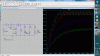
I tried simulating the circuit in LTSpice and found that the value of the input capacitor is far too low. At values below 2.2 uF the input capacitor itself limits the voltage available to the circuit, and in fact the zener doesn't even come into play.

That is a screen capture of a simulation run using a 27V zener made from a 12V and a 15V zener in series, with four values of input coupling capacitor - 1 uF (green), 1.5 uF (blue), 2.2 uF (red) and 2.7 uF (cyan) (these values are shown under the schematic). The trace in the simulation actually shows the coil current, not the rail voltage, but the shapes are almost identical. You can see how the lowest values don't even reach the zener voltage! Values of 2.2 uF and 2.7 uF both reach the zener threshold (eventually) and that's true also at 200VAC input.
I think the clear conclusion here is that you need to use at least 2.2 uF for the input capacitor, perhaps 2.7 uF if you want a safety margin. I hope you have room on that board; it doesn't look like it!
That leaves the issue of the zener diode power rating. With the relay coil OFF, i.e. maximum dissipation in the zener, the average reverse current in the zener is about 24 mA with a 2.2 uF input capacitor, and 32 mA with a 2.7 uF input capacitor. For a 27V zener this corresponds to 650 mW and 870 mW respectively so in either case I would go for at least a 1.3W zener. Personally I would use a 2W zener just to be safer in case of mains disturbances etc.
Again I apologise for putting you wrong.
I tried simulating the circuit in LTSpice and found that the value of the input capacitor is far too low. At values below 2.2 uF the input capacitor itself limits the voltage available to the circuit, and in fact the zener doesn't even come into play.
That is a screen capture of a simulation run using a 27V zener made from a 12V and a 15V zener in series, with four values of input coupling capacitor - 1 uF (green), 1.5 uF (blue), 2.2 uF (red) and 2.7 uF (cyan) (these values are shown under the schematic). The trace in the simulation actually shows the coil current, not the rail voltage, but the shapes are almost identical. You can see how the lowest values don't even reach the zener voltage! Values of 2.2 uF and 2.7 uF both reach the zener threshold (eventually) and that's true also at 200VAC input.
I think the clear conclusion here is that you need to use at least 2.2 uF for the input capacitor, perhaps 2.7 uF if you want a safety margin. I hope you have room on that board; it doesn't look like it!
That leaves the issue of the zener diode power rating. With the relay coil OFF, i.e. maximum dissipation in the zener, the average reverse current in the zener is about 24 mA with a 2.2 uF input capacitor, and 32 mA with a 2.7 uF input capacitor. For a 27V zener this corresponds to 650 mW and 870 mW respectively so in either case I would go for at least a 1.3W zener. Personally I would use a 2W zener just to be safer in case of mains disturbances etc.
Again I apologise for putting you wrong.
Attachments
- Joined
- Nov 28, 2011
- Messages
- 8,393
Not a good idea, there will be slight differences between zeners (even from the same batch) that will cause one to take the majority of the current. You CAN put two or more zeners in SERIES, though.Can one put 2 equal value 1W zeners in parallel to allow 2W dissipation?
- Joined
- Jan 21, 2010
- Messages
- 25,510
It's not recommended.
One zener is likely to have a slightly lower knee voltage than the other. It will conduct slightly earlier and get warmer. What happens next depends on the temperature coefficient of the diode.
In general, below 5.6V the coefficient is negative and the warmer zener will hog the current. Above 5.6V the coefficient is positive and the warmer zener will tend to shed current to the cooler one.
So the answer really depends on how close the knee voltages are to each other, and the voltage.
It is well worth double-checking with the specs for the device, and also checking how close the knee voltages are.
For lower voltage zeners it is imperative that the devices are in close thermal contact if you want to try this, for higher voltages this is less important (and can indeed become counter-productive).
Sorry, no easy answer to this one.
One zener is likely to have a slightly lower knee voltage than the other. It will conduct slightly earlier and get warmer. What happens next depends on the temperature coefficient of the diode.
In general, below 5.6V the coefficient is negative and the warmer zener will hog the current. Above 5.6V the coefficient is positive and the warmer zener will tend to shed current to the cooler one.
So the answer really depends on how close the knee voltages are to each other, and the voltage.
It is well worth double-checking with the specs for the device, and also checking how close the knee voltages are.
For lower voltage zeners it is imperative that the devices are in close thermal contact if you want to try this, for higher voltages this is less important (and can indeed become counter-productive).
Sorry, no easy answer to this one.
Ok, I'll stick to a single zener. I suspected it wouldn't work well with 2 in parallel but wanted to be sure.
I concur in my sim that anything less than 2.2u on the input doesn't help so:
I'll put a 2.2u cap there since space is at a premium and sub in a 27v/2W zener and that should do it. I'll get a 30v zener too just in case.
Thanks KrisBlueNZ for your time to spice these changes for me.
Any last comments before I jump in from anyone?
-P
I concur in my sim that anything less than 2.2u on the input doesn't help so:
I'll put a 2.2u cap there since space is at a premium and sub in a 27v/2W zener and that should do it. I'll get a 30v zener too just in case.
Thanks KrisBlueNZ for your time to spice these changes for me.
Any last comments before I jump in from anyone?
-P
I also just noticed there's a 2.1v p-p ripple on the relay too. is that too much for a 24v DC relay? The one below to be precice
I can't see how this circuit ever worked - yet it did albiet it's failed before and the company charges $400 to have it replaced. What a joke! It must have been pushing the absolute limits and no wonder the relay burned it's contacts out. It's ridiculous really underpowering a relay for such heavy switching loads.
FINDER - 40.61.7.024.0000 - RELAY, PCB, SPCO, 24VDC
Manufacturer:
FINDER
Order Code:
1169167
Manufacturer Part No:
40.61.7.024.0000
Product Information
RELAY, PCB, SPCO, 24VDC
Relay Type: Miniature
Coil Voltage VDC Nom: 24V
Contact Current Max: 30A
Contact Voltage AC Nom: 250V
Coil Resistance: 1.2kohm
Contact Configuration: SPCO
Coil Type: DC, Sensitive
Coil Current: 20mA
Nom Operating Power: 500mW
Relay Mounting: PCB
External Height: 29mm
External Width: 12.4mm
External Depth: 25mm
SVHC: No SVHC (19-Dec-2011)
Approval Bodies: BEAB / CSA / DEMKO / IMQ SEMKO / NF-USE / SETI / SEV / UL / VDE
Approval Category: VDE, BEAB, UL, CSA, SEV, NF-USE, SETI, IMQ SEMKO, DEMKO
Coil Operating Lower Percent Limit: 80%
Coil Operating Upper Percent Limit: 150%
Contact Configuration: SPCO
Contact Current AC Max: 16A
Contact Current DC Max: 16A
Contact Material: Silver Cadmium Oxide
Contact Voltage AC Max: 240V
Contact Voltage DC Max: 30V
DC Coil Power: 500mW
External Length / Height: 29mm
Mounting Type: PCB
No. of Poles: 1
Operating Temperature Max: 70°C
Operating Temperature Min: -20°C
Operating Time: 10ms
PCB Hole Diameter: 1.5mm
Release Time: 7ms
Series: 40
I can't see how this circuit ever worked - yet it did albiet it's failed before and the company charges $400 to have it replaced. What a joke! It must have been pushing the absolute limits and no wonder the relay burned it's contacts out. It's ridiculous really underpowering a relay for such heavy switching loads.
FINDER - 40.61.7.024.0000 - RELAY, PCB, SPCO, 24VDC
Manufacturer:
FINDER
Order Code:
1169167
Manufacturer Part No:
40.61.7.024.0000
Product Information
RELAY, PCB, SPCO, 24VDC
Relay Type: Miniature
Coil Voltage VDC Nom: 24V
Contact Current Max: 30A
Contact Voltage AC Nom: 250V
Coil Resistance: 1.2kohm
Contact Configuration: SPCO
Coil Type: DC, Sensitive
Coil Current: 20mA
Nom Operating Power: 500mW
Relay Mounting: PCB
External Height: 29mm
External Width: 12.4mm
External Depth: 25mm
SVHC: No SVHC (19-Dec-2011)
Approval Bodies: BEAB / CSA / DEMKO / IMQ SEMKO / NF-USE / SETI / SEV / UL / VDE
Approval Category: VDE, BEAB, UL, CSA, SEV, NF-USE, SETI, IMQ SEMKO, DEMKO
Coil Operating Lower Percent Limit: 80%
Coil Operating Upper Percent Limit: 150%
Contact Configuration: SPCO
Contact Current AC Max: 16A
Contact Current DC Max: 16A
Contact Material: Silver Cadmium Oxide
Contact Voltage AC Max: 240V
Contact Voltage DC Max: 30V
DC Coil Power: 500mW
External Length / Height: 29mm
Mounting Type: PCB
No. of Poles: 1
Operating Temperature Max: 70°C
Operating Temperature Min: -20°C
Operating Time: 10ms
PCB Hole Diameter: 1.5mm
Release Time: 7ms
Series: 40
- Joined
- Nov 28, 2011
- Messages
- 8,393
That shouldn't be a problem. The peak and trough voltages are both well within the minimum pull-in voltage and the maximum allowable voltage.I also just noticed there's a 2.1v p-p ripple on the relay too. is that too much for a 24v DC relay? The one below to be precice
The principle is sound, as I said many times, but the component values are clearly not appropriate for that amount of load (about 20 mA with the relay open and 40 mA with the relay closed). No surprise at all that the original relay contacts burned out. I wonder whether the company makes any component value changes when they "fix" the returned units.I can't see how this circuit ever worked - yet it did albiet it's failed before and the company charges $400 to have it replaced. What a joke! It must have been pushing the absolute limits and no wonder the relay burned it's contacts out. It's ridiculous really underpowering a relay for such heavy switching loads.
This has been an interesting thread; I've learned quite a lot from it.
That relay sounds perfect.FINDER - 40.61.7.024.0000 - RELAY, PCB, SPCO, 24VDC [...]
Perhaps it's been long forgotten but I posted a number of schematics, simulations and plots that clearly showed the results of modifying said components. Currently, this part of the thread is a re-hash of what's already been covered waaay back.
Chris
Chris
- Joined
- Nov 28, 2011
- Messages
- 8,393
I can't find any posts from you that show the effect of varying the input capacitor. The ones I can find relate to changing the smoothing capacitor, C2.Perhaps it's been long forgotten but I posted a number of schematics, simulations and plots that clearly showed the results of modifying said components. Currently, this part of the thread is a re-hash of what's already been covered waaay back.
Varying the smoothing capacitor will affect how long the rail takes to reach full voltage when AC power is first applied, and how much ripple is on it. Varying the input capacitor affects the continuous current available from the circuit and whether the rail will ever reach the zener voltage if it's under load.
Last edited:
I've noticed that similar capacitors to the one originally fitted seem to be rated at 400v AC and 250DV. I guess that accounts for the 250v RMS which is about 400v.
Would replacing it with a 630v DC one work ok with 240v AC?
Like this one - it's a 2.7u too...
http://cgi.ebay.com/ws/eBayISAPI.dll?ViewItem&item=150795246646
or even:
http://cgi.ebay.com/ws/eBayISAPI.dll?ViewItem&item=140818355335
Would replacing it with a 630v DC one work ok with 240v AC?
Like this one - it's a 2.7u too...
http://cgi.ebay.com/ws/eBayISAPI.dll?ViewItem&item=150795246646
or even:
http://cgi.ebay.com/ws/eBayISAPI.dll?ViewItem&item=140818355335
Last edited:
Similar threads

- Replies
- 2
- Views
- 907


- Replies
- 0
- Views
- 1K
- Replies
- 5
- Views
- 843
