No problem, this project has had some design creep, LOLSorry for the really slow reply!
That is what I concluded too, there is a short in that diagram that I can not reconcile, so two circuits it is.But with them commoned like that, if he changed the wires round at the electrical panel, he could short out a phase.
Agreed, however, the relay is common to the two circuits - how do I ensure that two loads are not used simultaneously - other than simply remembering not to power two devices at once? Do you see a simple way of accomplishing this or will the circuitry require a lot more components or large switches?I guess the best solution would be to have two independent current detecting circuits on the board. That would require two Allegro chips. The signal from the second Allegro chip could feed into pin 2 of the micro, and R5 could move to pin 6 or pin 7, so the only extra components would be the connector(s), one Allegro chip and two capacitors.
The connectors on my layout are Phoenix Combicon types. I gave links in post #55.
I used imperial on my board as well (ic pin pitch convention). What was the method you used to discern all the common planes between parts on your board? That would really help me redesign my attempts!The board is exactly 4 inches horizontally, and 2 inches vertically, between the mounting holes. My PCB CAD package does both metric and imperial, but it's best to use one or the other, and all of the other components were imperial, so I used imperial spacing for the mounting holes as well.
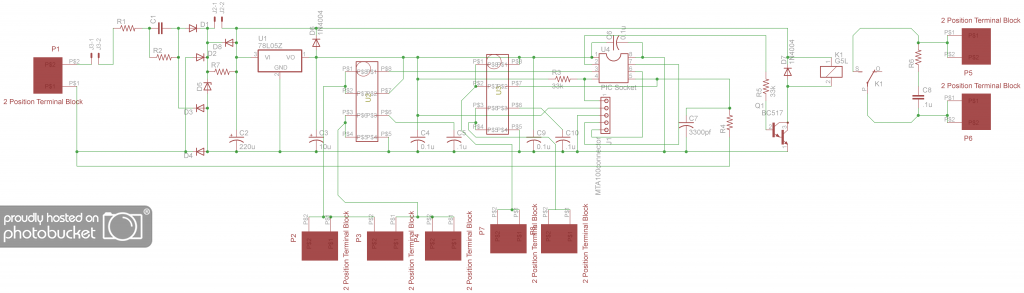
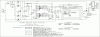
Thank you, that clears it up.C4 is the decoupler for U2. C5 is a filter capacitor for the signal inside U2. C6 is the decoupler for U3. C7 is a filter capacitor for the mains frequency signal that feeds into U3.
I asked because the old PIC was in the schematic again, are we still using the 675 for ease of programming?Either the PIC12F675 or the PIC12F1571 can be used, with a slight change in the firmware.