Designing a Time Delayed Relay

Arouse1973

Adam
Dec 18, 2013
5,178
Joined
Dec 18, 2013
Messages
5,178
Fair enough, I still have to shoehorn it in to the box! ;) So either 16ga or 14ga are acceptable, 14 obviously better than 16.

I was reading about tinned multi-strand conductor wire and thought it would be a good idea until I read that tin only has 15% the conductivity of bare copper. Being humid and hot down here, I wondered how quickly I could count on that bare wire keeping in said condition... Lots of variables in design!

Your thoughts on use of tinned wire vs. bare copper? Anyone feel free to chime in as well!

I think Kris has covered this well. I have done a bit on mains and LVD (low voltage directive). In the UK you need to make sure the wire has the correct current rating for the length you are using to prevent excessive heating and voltage drop.

The fuse needs to be rated with respect to the current handling of the wire to protect it from over heating also. It is also permissible if the wire is less than 1 meter long for you to use a smaller gauge wire even if the wire spec is for a lower current. I'll try and dig out the info for this.

Clearance and creep-age gaps also need to be considered, this depends on the type of equipment being designed. Here is a chart that may help.

8jbVm.png

If you have mains wires soldered to the PCB you also have to have them supported so if they break they stay together. The way we did this which is a really easy fix was to cable tie them together and we passed the test. This is classed as adequate support??

With regard to tinned wires and connectors. I was always told, screw type connector (which uses an actual screw, UK plug as an example) should always bite down on a solid wire or ferrule. I guess tinned would come under this?. And bare multi-strand for the lever clamp type screw terminals. And yes I know nobody does this but I think they should.

Don't know if this is of any help or relevant.

Adam
 

chopnhack

Apr 28, 2014
1,576
Joined
Apr 28, 2014
Messages
1,576
Don't know if this is of any help or relevant.
Adam

Hey Adam! Yes, its quite relevant and helpful - thanks for digging that up!

There are some traces on board that are at 0.45mm spacing, but they are very low power traces, mostly signaling to pic.
And I agree, more people should be aware of the correct wire to terminate under the appropriate connector.

As for length, the smaller leads that I want to use with the connectors to mains would be no more than 30cm (12 in.) long.
I don't know what space I will have in the box for all these wires, but we'll have to make do!
 
Last edited:

KrisBlueNZ

Sadly passed away in 2015
Nov 28, 2011
8,393
Joined
Nov 28, 2011
Messages
8,393
Thanks for the info and advice Adam.

Those connectors are the rising clamp type, so bare stranded wire is appropriate.

I think the tinned copper wire is probably individually tinned strands. Is that right John? But I don't think you're considering that option now, right?

That creepage and clearance table is very helpful, thanks.
 

chopnhack

Apr 28, 2014
1,576
Joined
Apr 28, 2014
Messages
1,576
I think the tinned copper wire is probably individually tinned strands. Is that right John? But I don't think you're considering that option now, right?

That creepage and clearance table is very helpful, thanks.
Correct, I saw that they pre tin the individual strands (something like 29 30ga strands) and then insulate them making them far less likely to corrode. It is probably overkill, the garage is closed most of the times, its humid, but I have learned that even if ambient humidity is high, the surface must be open for the water vapor to condense onto to cause the rust. Sealed by a plate will make it less exposed, so it will probably be ok for a long time.

Kris, hate to beat the layout to death, and my apologies, but post #280 is the latest, when you have time let me know if it is ok. Also, I made a change to the schematic in #277 which I think was ok, but I would like you to check to make sure my logic was sound.

Thanks again :)
 

KrisBlueNZ

Sadly passed away in 2015
Nov 28, 2011
8,393
Joined
Nov 28, 2011
Messages
8,393
Yes, the schematic in post #277 is good.

I would avoid having the top side track from pin 2 of the mains input connector crossing the bottom side track from the positive output of the bridge rectifier to the smoothing caps. Actually I would move those tracks from the bridge to the caps further west, and put both of the tracks from the mains connector to the transformer primary on the bottom layer.

I suggest you add top overlay markings for the connectors saying what they're for, and for the mains one, label E, N and P.

Is there enough creepage distance across the isolation barrier under the Allegro chips?

Everything else looks great! You've saved a LOT of space!
 

chopnhack

Apr 28, 2014
1,576
Joined
Apr 28, 2014
Messages
1,576
Yes, the schematic in post #277 is good.

I would avoid having the top side track from pin 2 of the mains input connector crossing the bottom side track from the positive output of the bridge rectifier to the smoothing caps. Actually I would move those tracks from the bridge to the caps further west, and put both of the tracks from the mains connector to the transformer primary on the bottom layer.

Done, I don't understand why though? Was the clearance not sufficient? I figured the distance and the board between traces should have been isolation enough.

I suggest you add top overlay markings for the connectors saying what they're for, and for the mains one, label E, N and P.
Excellent suggestion, I will add that to the silkscreen once layout is done. Thanks! :)
Is there enough creepage distance across the isolation barrier under the Allegro chips?
Not completely sure - if we consider them to be internal conductors then yes we have ~110 thou or ~2.7mm clearance and that would satisfy the entire range of column B1 of the above.
Everything else looks great! You've saved a LOT of space!
Thanks! :D It will be of great help considering the wires that have to go in as well as outlets!!
I think we are ok to order parts then?
I will post a final after I do cleanup and add vias, silkscreen - print out and check against physical parts when they come in.
I really appreciate your time and efforts Kris, you are the man!

upload_2014-12-2_21-17-51.png
 

KrisBlueNZ

Sadly passed away in 2015
Nov 28, 2011
8,393
Joined
Nov 28, 2011
Messages
8,393
Done, I don't understand why though? Was the clearance not sufficient? I figured the distance and the board between traces should have been isolation enough.
You had a live (or potentially live) track on one side, crossing over a grounded (or nearly grounded) track on the other side, so you were using the board thickness as an isolation barrier. I don't know what the regulations say about it, but I've never seen that done, and I would never do it.
(re clearance across Allegro chips) Not completely sure - if we consider them to be internal conductors then yes we have ~110 thou or ~2.7mm clearance and that would satisfy the entire range of column B1 of the above.
Yes, that table seems to be pretty forgiving in the B1 and B4 columns.
I think we are ok to order parts then?
Barring those unforeseeable errors, sure :)
I will post a final after I do cleanup and add vias, silkscreen - print out and check against physical parts when they come in.
Cool!
I really appreciate your time and efforts Kris, you are the man!
It's my pleasure! I'm surprised by how patient and diligent you are.
 

chopnhack

Apr 28, 2014
1,576
Joined
Apr 28, 2014
Messages
1,576
Good to know. Its probably not likely, but good practice anyway! (re: crossing of traces/potentially grounding through board)
And again, I really appreciate your patience and consistent, nearly instant replies! It has made learning and actually making something so much easier. Thanks for helping, answering my questions (and in some cases more than once on the same issue, LOL) and kicking ideas around with me. :D
 

Arouse1973

Adam
Dec 18, 2013
5,178
Joined
Dec 18, 2013
Messages
5,178
Thanks for the info and advice Adam.

Those connectors are the rising clamp type, so bare stranded wire is appropriate.

I think the tinned copper wire is probably individually tinned strands. Is that right John? But I don't think you're considering that option now, right?

That creepage and clearance table is very helpful, thanks.

No Probs, I have all the relevant standards for the UK. LVD, vehicle directive, machinery directive, generic standards and all the emission and immunity standards and also R&TTI, which you have to purchase for the latest copy,so if you want to know anything then I can easily look it up for you. Some of the info will also be relevant for other countries and even if not will give John a start with good design practices.

Adam
 

chopnhack

Apr 28, 2014
1,576
Joined
Apr 28, 2014
Messages
1,576
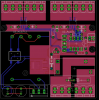
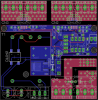
Perhaps the last layout pic we will see? I am sure it can't be soon enough for many! LOL

Changes:
Perforated board with vias (0.019 drill size, 0.035 via size)
Moved Q2 to allow 5v trace to pass between diode and transistor
Verified no clearance under 70 thou between high potential areas
Labelled CN1 with Ground, Neutral and Phase
Added vias near ground pin of U2/3 - not having to rely on the skinny trace between pads and top before isolation area.
Rounded all trace angles

Going to finish the BOM and place order soon.

Been thinking since I couldn't place the holes for mounting where I would have liked to, I have a nylon rod that I intend to take some thin slices off of to use as washers between the board and the screw on both sides. If I have sufficient left I want to cut some lengths of it and hot glue it to the areas under the connectors - I don't foresee having to plug and unplug them much, but you never know... To be safe, I will glue them so that they don't straddle across the connector's gap.

upload_2014-12-5_22-32-53.png
 

Arouse1973

Adam
Dec 18, 2013
5,178
Joined
Dec 18, 2013
Messages
5,178
Perhaps the last layout pic we will see? I am sure it can't be soon enough for many! LOL

Changes:
Perforated board with vias (0.019 drill size, 0.035 via size)
Moved Q2 to allow 5v trace to pass between diode and transistor
Verified no clearance under 70 thou between high potential areas
Labelled CN1 with Ground, Neutral and Phase
Added vias near ground pin of U2/3 - not having to rely on the skinny trace between pads and top before isolation area.
Rounded all trace angles

Going to finish the BOM and place order soon.

Been thinking since I couldn't place the holes for mounting where I would have liked to, I have a nylon rod that I intend to take some thin slices off of to use as washers between the board and the screw on both sides. If I have sufficient left I want to cut some lengths of it and hot glue it to the areas under the connectors - I don't foresee having to plug and unplug them much, but you never know... To be safe, I will glue them so that they don't straddle across the connector's gap.

View attachment 17439

John this looks good, some of the traces I would beef up a bit but thats only my preferance. You have designed this PCB with what I consider advanced PCB layout techniques. Your use of islands is a very good idea this reduces resistances but can cause issues with hand soldering. I realy hope this works out. If it does not dont worry myself and Kris are here to help.
Adam
 

chopnhack

Apr 28, 2014
1,576
Joined
Apr 28, 2014
Messages
1,576
Excellent John! That looks great!
Thanks Kris :)
John this looks good, some of the traces I would beef up a bit but thats only my preferance. You have designed this PCB with what I consider advanced PCB layout techniques. Your use of islands is a very good idea this reduces resistances but can cause issues with hand soldering. I realy hope this works out. If it does not dont worry myself and Kris are here to help.
Adam
Thanks Adam! I read up a bit on PCB construction and relied heavily on Kris for the things I didn't understand or did wrong. Agreed, I am concerned with some of these copper pours, despite having thermals on them will I be able to saturate them with enough heat quick enough to not hurt the component. The things that I have assembled to mitigate the risk: I have a relatively new soldering station (Hakko FX888D), I have a few tubes of flux gel (soldering under the shield of these to make it quicker), solder paste as well as very thin solder. I was thinking of preheating the board in a toaster first too...

Which traces do you think should be wider? The thinnest are 12 thou, the board house can make down to 10 thou. Keep in mind that the copper will be 2 oz. because of the high current area.

I hope the soldering will be a lot easier than the design, LOL - thanks for your continued support, both of you! :):D:)

I wasn't sure that I could hack that one, I had looked at other reasonably priced units like this one, but you would need one for each piece of equipment and a remote!
The other systems that are available are over $600, which I thought was ludicrous!

My total cost maybe close to break even with getting two of the linked units and a remote ~$200, but it was a learning experience I embarked on months ago and don't regret one minute of it - education is dear, but takes time! I paid with time and got back priceless value!! I have a better understanding of electronics, flow in a circuit - I maybe fuzzy on some of the details, but I can muddle my way through. I hope to continue on this path and get better at it.
Thanks for the link :)
 
Last edited:

KrisBlueNZ

Sadly passed away in 2015
Nov 28, 2011
8,393
Joined
Nov 28, 2011
Messages
8,393
John this looks good, some of the traces I would beef up a bit but thats only my preferance.
Yes, it was my gut feeling that some of the tracks could be thicker, but I'm not sure I can justify this.

It used to be common to use wide tracks for all connections to bulky and heavy components, and connectors, to provide extra rigidity to resist copper ripping off the board if the board is subjected to a shock that pushes the pins further through the board.

But this can be avoided by mounting the transformer and connectors very firmly against the board (i.e. no gaps), and in any case is unlikely to be an issue with through-hole-plated boards.

So I think my instinctive feeling that these tracks should be wider is probably no longer valid. If you have other reasoning, please let us know.
 

hevans1944

Hop - AC8NS
Jun 21, 2012
4,968
Joined
Jun 21, 2012
Messages
4,968
@chopnhack : Great job, John!

I recommend that Ian make this thread "sticky" for newbies, as well as for old pros, to see just what this forum is all about!

From Day 1 on April 27, 2014 @chopnhack (who admitted he had very little experience in electronics) posted a clear description of what he wanted to do, accepted suggestions and constructive criticism from forum responders, answered questions that were asked, and proceeded down a path to success, demonstrating initiative and the ability to learn. I wish that everyone who posts for the first time on Electronics Point would read this thread to see what can be accomplished here with due diligence and a willingness to perform their own research.

On PCB traces: I have always followed the philosophy that wider traces for power are preferable to narrow traces, even if the "design rules" allow narrower traces. Some designers take this to extremes, especially for RF designs, by routing only non-conducting paths among "islands" of components, but that clearly is not necessary or even desirable for John's circuit board. Still, if it is "easy" to make artwork changes before committing to a finished board, and time is not a constraint, I like to go back over my artwork to make it "prettier" if not more functional. This has become so much easier since I graduated from taped layouts to CAD layouts!

Go ahead and submit your layout to a PCB house, John. I am anxious to see how this saga turns out. And being also a woodworker (wood butcher, more accurately) I could benefit from your results.
 

chopnhack

Apr 28, 2014
1,576
Joined
Apr 28, 2014
Messages
1,576
@chopnhack : Great job, John!
Thank you hevans! I appreciate the kudos and positive feedback. It has been some time since I started this thread! LOL, but its been a great learning experience. So many have been very informative and guiding along the way that without, I am sure I would have gotten lost or discouraged, many thanks to all!!
Go ahead and submit your layout to a PCB house, John. I am anxious to see how this saga turns out. And being also a woodworker (wood butcher, more accurately) I could benefit from your results.
That's awesome!!! I will certainly keep you up to date with the project. I too like to butcher wood, hence the moniker of chop n hack ;):D
 

Arouse1973

Adam
Dec 18, 2013
5,178
Joined
Dec 18, 2013
Messages
5,178
Hey John
My concern is the power traces to and from the transformer, they might be fine they just look a bit thin. You dont want them going pop before the fuse. I guess they are 0.3mm. What current are you expecting the circiut to use? Let me know and I'll work out the fusing current and temp rise.
Adam
 

chopnhack

Apr 28, 2014
1,576
Joined
Apr 28, 2014
Messages
1,576
Hey John
My concern is the power traces to and from the transformer, they might be fine they just look a bit thin. You dont want them going pop before the fuse. I guess they are 0.3mm. What current are you expecting the circiut to use? Let me know and I'll work out the fusing current and temp rise.
Adam

You're awesome Adam! Good eye too, 0.41mm. The circuit would use a max of 120mA current per Kris's calculations. I get what you are saying - didn't think of that before, if the circuit should experience some type of failure, the trace would act as a fuse - this has happened to me in the past, I had to solder a small wire to jumper the burnt trace. The trace has to survive more than the fuse's ratings. The fuse I will be using is a 160mA rating, slow blow fuse.

Using the circuitcalculator.com's feature for traces, at 160mA, 0.48" length (longest lead to transformer), 2oz. copper, using internal layer category, I get a required trace width of 0.024mm.

We are way over that, but I am interested to see what you come up with as well!

I did find this from another user of that site:

20. Administrator - June 25, 2006
—forwarded message—

Hi Brad.

Thanks for your response. I was interested in sizing tracks from fused supplies. Since I sent you the last email, I have found out that rating the track to 160% of the fuse value (at room temp.) is a good rule of thumb that is recommended by automotive companies.

Cheers
Brendan
 
Last edited:
Top