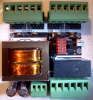
Designing a Time Delayed Relay

Arouse1973

Adam
Dec 18, 2013
5,178
Joined
Dec 18, 2013
Messages
5,178
Hi John

Using 70um copper (2oz) with no plating I get 2.7 Amps will blow the trace in 5 seconds. So if you had a 3 Amp fuse fitted and a fault developed that drew just under 3 Amps as an example the fuse wouldn't blow but your track would. This uses Onderdonk's equation.

Is your base copper 2oz with 1oz plating? or 1oz base and 1oz plate to give you overall 2oz?

Thanks
Adam
 

chopnhack

Apr 28, 2014
1,576
Joined
Apr 28, 2014
Messages
1,576
Hi John

Using 70um copper (2oz) with no plating I get 2.7 Amps will blow the trace in 5 seconds. So if you had a 3 Amp fuse fitted and a fault developed that drew just under 3 Amps as an example the fuse wouldn't blow but your track would. This uses Onderdonk's equation.

Is your base copper 2oz with 1oz plating? or 1oz base and 1oz plate to give you overall 2oz?

Thanks
Adam

Hi Adam, I haven't the slightest clue with regard to the copper question - I had assumed that selecting a 2oz. option gives you a 2oz. copper base. Do you have information to the contrary? Thanks!
 

Arouse1973

Adam
Dec 18, 2013
5,178
Joined
Dec 18, 2013
Messages
5,178
Hi Adam, I haven't the slightest clue with regard to the copper question - I had assumed that selecting a 2oz. option gives you a 2oz. copper base. Do you have information to the contrary? Thanks!

There are lots of options that you can have from the PCB manufacture. Unless you selected other than their standard then I think your going to get 2oz finished copper weight. So that's 1oz base copper and 1oz plate. You need to check with the manufacturers specifications. Who are you using? I'll have a look for you.
Adam
 

chopnhack

Apr 28, 2014
1,576
Joined
Apr 28, 2014
Messages
1,576
There are lots of options that you can have from the PCB manufacture. Unless you selected other than their standard then I think your going to get 2oz finished copper weight. So that's 1oz base copper and 1oz plate. You need to check with the manufacturers specifications. Who are you using? I'll have a look for you.
Adam
Thanks Adam, I was not aware that it was done that way. I was going to use http://smart-prototyping.com/

will this matter much considering the small amount of power being used? (under 200 mA)
 

Arouse1973

Adam
Dec 18, 2013
5,178
Joined
Dec 18, 2013
Messages
5,178
Maximum currents in the mains transformer are a few hundred milliamps. The current is inherently limited by the transformer design; see post #249: https://www.electronicspoint.com/threads/designing-a-time-delayed-relay.268425/page-13#post-1632350

I was thinking more fault currents rather than operational current. So if we had 2oz finished weight and calculated it with the largest fuse someone could fit which could be a 13 Amp fuse (UK) even though we know this is way higher than we will actually use it could never the less happen my mistake. So if we doubled the rating to 26 Amps and said the fuse should blow within a 2 seconds to protect our trace we would need a trace 1.8 mm wide.

This has been an example

Adam
 

KrisBlueNZ

Sadly passed away in 2015
Nov 28, 2011
8,393
Joined
Nov 28, 2011
Messages
8,393
If there's a failure inside the primary of the transformer, something is going to blow, and with relatively thin tracks like you currently have, it will be those tracks, unless there's a primary fuse, which there isn't.

You could thicken the tracks and leave a short section thin, so if that happened, they would blow in a limited area, instead of the whole track vaporising.

AFAIK there is no fuse in that circuit at all; not in the primary, and not in the secondary. The transformer is designed with enough internal resistance that none is needed, as I pointed out most recently in post #302.
 

Arouse1973

Adam
Dec 18, 2013
5,178
Joined
Dec 18, 2013
Messages
5,178
I am assuming maybe incorrectly that what ever plug is used has a fuse? It is this fuse that need to be correctly rated. Fuses are for safety in the event of a failure of the equipment. I wouldn't use a track as a fuse because I wouldn't want to repair my PCB if a failure occurred. At the end of the day it's up to you if you fit a fuse but I strongly recommend it.

Adam
 

KrisBlueNZ

Sadly passed away in 2015
Nov 28, 2011
8,393
Joined
Nov 28, 2011
Messages
8,393
AFAIK fuses inside mains plugs are not normal outside of the UK. They're not a bad idea, because they protect against severe damage to the mains lead, as well as failure of the equipment, whereas fuses in the equipment don't protect the cable; the switchbox fuse will blow if the cable gets crushed and shorts out.

In this case I don't think a fuse is really justified, and the data sheet of the transformer seems to be saying the same. Any other opinions?
 

hevans1944

Hop - AC8NS
Jun 21, 2012
4,968
Joined
Jun 21, 2012
Messages
4,968
Well, I have used a lot of line-powered equipment that omits any sort of fusing. In a few instances this has proven to be "penny wise but pound foolish" when something failed in a rather spectacular fashion. I have a current project in place now that uses an OEM open-frame linear-regulated DC power supply without a fuse in either the primary or the secondary. I have used this particular line of open-frame power supplies for about... um... forty or fifty years? Never had any problems, even with the output DC accidentally shorted. It just shuts down. So, maybe it uses one of those current-limiting transformers, or maybe I've just been lucky.

Given my druthers, I'd druther put a fuse in the primary, or at least a fuse in the secondary, but that's just the "better safe than sorry" part of my brain talking. I think Kris is right: a current-limited transformer is "safe enuf" as he stated in his post #249 and as shown on the datasheet Kris posted in #246. Just make sure you are using the transformer type that is specified there.
 

chopnhack

Apr 28, 2014
1,576
Joined
Apr 28, 2014
Messages
1,576
Ok mates, I think I followed you all, but to be sure - Is the fuse I intend to place inline with the mains to the transformer adequate? It will not be directly on board the pcb for space constraints. It will fuse entering mains before the 3 pin on board header, so technically the entire board is fused.
 

chopnhack

Apr 28, 2014
1,576
Joined
Apr 28, 2014
Messages
1,576
Parts came in today :D - the transistor was a different form factor than expected, I have to redo a small section of the pcb. The transistor came with cranked legs? Basically the three legs are in line with each other, but the outer ones look like they have a ~22.5 deg bend towards the outside.
 

KrisBlueNZ

Sadly passed away in 2015
Nov 28, 2011
8,393
Joined
Nov 28, 2011
Messages
8,393
OK, some manufacturers do that. NXP for example. I don't like it; I always have all three pads, and all three leads, in a straight line. I've seen a few cases where a transistor with staggered legs gets bumped and the middle lead gets crumpled or weakened, or pushes the whole pad off the board. (That's not going to happen on a PTH board though.)
 
Top