charmcaster.engg
- Mar 20, 2014
- 79
- Joined
- Mar 20, 2014
- Messages
- 79
What is the power dissipated by R2, R4, and R6?
Please do the work and tell us how much current is passing through R2, R4, and R6What is the power dissipated by R2, R4, and R6?
![]()
Quote possibly, but he has demonstrated that he can calculate the equivalent resistance of a resistor network, as well as calculate power, current, and voltage drop.Well then that would be easy. I think he needs more help than that![]()
It will take a little work to break down the drawing, but his demonstrated skills in the other posts should easily give him the answer.
I'd like to see what kind of effort has gone in so far. I've seen a lot of questions pop up recently.
That method will certainly give a correct answer. However, what is commonly done in this type of situation is to iteratively combine parallel resistances to ultimately find the total source current, then iteratively use current division to find the current in each branch. But if you have a symbolic algebra engine, then just write the node equations and let the computer solve it.To calculate the currents using KVL,KCL.
Can you explain in detail how to perform iterative current division?I got total resistance as 6.26K n thus total current as 17.73mA.That method will certainly give a correct answer. However, what is commonly done in this type of situation is to iteratively combine parallel resistances to ultimately find the total source current, then iteratively use current division to find the current in each branch. But if you have a symbolic algebra engine, then just write the node equations and let the computer solve it.
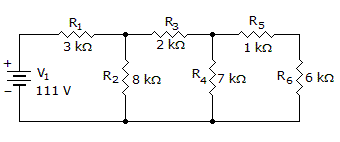
This is correct. This is the current flowing through R1. From that you can calculate the voltage drop across R1 to get the voltage across R2. From the voltage across R2 you can calculate the current through R2 and thus the power dissipated by R2.I got total resistance as 6.26K n thus total current as 17.73mA
Thanks!This is correct. This is the current flowing through R1. From that you can calculate the voltage drop across R1 to get the voltage across R2. From the voltage across R2 you can calculate the current through R2 and thus the power dissipated by R2.
Apply Kirchhoff's laws to get the current through R3 (you know currents through R1 and R2 by now). Move forward repeating the same calculations as above for the other resistors (calculate voltage drops, calculate currents etc.)