Voltage from rotation

Gryd3

Jun 25, 2014
4,098
Joined
Jun 25, 2014
Messages
4,098
I dont see how thinner wire can help only the fact you can wind more on the bobbin but this reduces the Q. You need to do the math and see what magnets and coils you need. Trial annd error will take a while.
Adam
I think it's time for example math :p
The formulas are a little above me at the moment.
 

wdariusw

Nov 10, 2014
149
Joined
Nov 10, 2014
Messages
149
Maybe anyone know how to work with comsol , maxwell, quickfield etc. and do simulations of that system?
 

Arouse1973

Adam
Dec 18, 2013
5,178
Joined
Dec 18, 2013
Messages
5,178
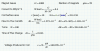
Ok here is a rough stab at it. The reason it's rough is we don't know the actual magnetic flux of the magnet at that distance, I took the Gauss figure from first for magnets. I also made up the coil size and turns, maybe @wdariusw can tell me the size and number of turns. Looking at this again I can see another problem which could be the magnets are too close.

What this will do is reduce the difference between flux 1 and flux 2, this is the 80% in the formula I have used. What this means is for maximum voltage you want the flux to change the most in a certain time. So to go from max flux to zero flux would give the best results.

So if the flux doesn't go to zero because of the proximity of the other magnet then you would either have to increase the turns, increase the speed of revolutions or the strength of the magnets. You could obviously do all.

Adam

Coil and Magnet voltage.PNG
 

wdariusw

Nov 10, 2014
149
Joined
Nov 10, 2014
Messages
149
Hi Adam, thanks for helping ! Here I found calculator for Gauss at certain distance https://www.kjmagnetics.com/calculator.asp . Can you give me link where you found fi1*80% formulla ? Do not understand what it means, why 80 % ? Another thing, i think that there should be formulla with coil wire thickness, not only with turns. Here at my matlab calculations using your formulas.


image hoster


here I have "induced voltage 1.1V ". What it means ? AC voltage peak to peak amplitude? In my code you can see all coil dimensions. Thanks !
 

Arouse1973

Adam
Dec 18, 2013
5,178
Joined
Dec 18, 2013
Messages
5,178
Hi
The 80% I used was an example to show you how the flux works. It would be quite involved to work it out in reality. It means you only loose 20% of the flux each time which limits the amount of voltage.
Adam
 

Arouse1973

Adam
Dec 18, 2013
5,178
Joined
Dec 18, 2013
Messages
5,178
Hi Adam, thanks for helping ! Here I found calculator for Gauss at certain distance https://www.kjmagnetics.com/calculator.asp . Can you give me link where you found fi1*80% formulla ? Do not understand what it means, why 80 % ? Another thing, i think that there should be formulla with coil wire thickness, not only with turns. Here at my matlab calculations using your formulas.


image hoster


here I have "induced voltage 1.1V ". What it means ? AC voltage peak to peak amplitude? In my code you can see all coil dimensions. Thanks !
Yes I get 1.1 V, if I reduce the loss of flux to only 10% I get 558 mV. One thing to try is to take out every other magnet and see what happens. This will allow for a greater difference in flux loss. You may have to spin it faster though.
Adam
 

wdariusw

Nov 10, 2014
149
Joined
Nov 10, 2014
Messages
149
Adam, i need achieve best result for 1 rotation per second, so increasing speed will give better results, but they would almost never achieved in real life system. There are more programs, like QuickField student edition, there are limetid mesh size to 255, program is free. But i can't work it out how to simulate my system. So 80% means 20% loss (flux do not reach zero) ?
 

Arouse1973

Adam
Dec 18, 2013
5,178
Joined
Dec 18, 2013
Messages
5,178
Yes. Just try and take out every other magnet. You might find the gain is greater so you won't have to turn faster. You must try these different things to learn don't keep relying on simulation. Practice makes perfect!
Adam
 

wdariusw

Nov 10, 2014
149
Joined
Nov 10, 2014
Messages
149
Just tried. Not good. Maybe magnets now are too far each other. Need to find perfect position between them. And there i think software like quickfield should help..
 

Arouse1973

Adam
Dec 18, 2013
5,178
Joined
Dec 18, 2013
Messages
5,178
Yes maybe they are too far apart now. But hope you can use the formula to now see what makes the most difference. Magnetic flux and number of turns plays a big part in all this.
Adam
 

Merlin3189

Aug 4, 2011
250
Joined
Aug 4, 2011
Messages
250
Would slightly disagree with Arouse here. You've done the trial, so now the calculations are much simpler than they would have been had you not done them.

Yes, thinner wire lets you get more turns in a given space and the voltage you get out is proportional to the number of turns. So if now know you are getting 1.5 V with say 1000 turns, then to get 3V you need 2000 turns.* To get 3.4 V you need 2267 turns. A lot easier than calculating from an estimated magnetic flux.
*(Putting aside the other changes you could make, like a stronger magnet or, dare I say it again, improving the magnetic circuit.)

As you say, there is a downside with smaller wire, which is increased resistance. If you half the size of the wire you double the resistance and when you also double the number of turns you double the resistance again. Whether this matters depends on how much current you draw.

Say you are drawing 1mA at 1.5 V and the coil resistance is about 10 Ohm. Then you are losing 1mA x 10 Ohm = 10 mV to resistance. (wire D= 0.2mm, 1000 turns, say 2cm per turn)
Now you double the turns with wire of half the size, so you quadruple the resistance to 40 Ohm. Now, for 1 mA current you loose 40mV to resistance. But you have doubled your Voltage to 3V. The 40 mV loss is still probably negligible.
(wire half the area, D=0.14mm, 2000 turns at 2cm per turn)

As you try to draw more current, the loss might be significant, but it sounds to me that your're still ok here. Even at 10 mA, you'd still lose only 0.4 V. ( So about 2300 turns should give you 10mA at 3.4V - 0.4V = 3V out.)

Other changes you might make do become a bit more complex and, as Arouse says, the maths helps.
If you increase the area of the coil, the length of the wire will increase and so the resistance will increase. But also as you increase the area, the amount of flux going through the coil will increase, which means you could use less turns or get more voltage for the same number of turns.
The difficulty is estimating how much the flux increases with area - so trials again may be the simplest way!
If the coil is smaller in area than the magnet, the flux may go up proportionally with area. But there is less increase after that. (Very rough pointers.) Up to this point the benefit (more voltage) is greater than the loss (more resistance), because the voltage increases with the area of the coil but the resistance increases only with the circumference. ( Area is proportional to the square of the circumference.)

Once you put an iron core in the coil (or similar material), you get a big increase in flux because magnetic flux passes so much more easily through iron than air. After that, look at the air it still has to pass through. If you can replace 3cm through air with 2.7cm through even a thin sheet of iron and only 3mm of air, then you can get a tenfold increase in flux and therefore in voltage. You get more return on investment when you replace air with iron than you do adding more turns of wire. Halving your air path can double your voltage with no increase in resistance: doubling your turns will double your voltage but quadruple your resistance.
 

BobK

Jan 5, 2010
7,682
Joined
Jan 5, 2010
Messages
7,682
If you really want to generate the maximum power, you should wind the coil on a ferromagnetic core that is a torus with a gap, and the magnet should pass through the gap as close as possible to the core. This will concentrate all the magnetic flux through the coil.

Bob
 

wdariusw

Nov 10, 2014
149
Joined
Nov 10, 2014
Messages
149
I do not want to use materials that magnets can attract. For cyclist it is negative force. Now resistance of coil with 0.2mm wire and 600 turn is 10 Ohm.
 

wdariusw

Nov 10, 2014
149
Joined
Nov 10, 2014
Messages
149
I do not want to use materials that magnets can attract. For cyclist it is negative force. Now resistance of coil with 0.2mm wire and 600 turn is 10 Ohm.
Just found very interesting film
. Have bought it from ebay, next week hope to get it.
 

Merlin3189

Aug 4, 2011
250
Joined
Aug 4, 2011
Messages
250
I do not want to use materials that magnets can attract. For cyclist it is negative force.
I don't think you need to worry about this. The magnets are pulled into the gap as they approach (helping the cyclist!) and cause drag as they leave. The two will cancel out, except for the small amount of energy being extracted by the circuitry (and eddy current losses.)
 

wdariusw

Nov 10, 2014
149
Joined
Nov 10, 2014
Messages
149
The more coil inductance the more induced voltage in the coil ? And how about the current ? If i connected in series 4 coils with 10 Ohm resistance, and after rectification i have 400mV, so there is 10mA current (no load) ?
 
Top