It's really hard to argue against a neat layout that flows with the schematic, voltage rails on opposite sides, silk-screened component identification, tin-plated copper traces, plated-through holes and all the other nice amenities a factory-made board provides. But I wouldn't characterize
@chopnhack 's board as useless if the circuitry is correct and it achieves its goal of providing a stable bread-board platform for experimentation and learning.
I sure wish we had laser printers back in the day to do "toner resist" transfers, plus the (free) software for schematic capture and board layout available today to make an image of the traces to be etched. Instead, we did layout at 1X on a Mylar sheet using Bishop Graphics crepe tape (of various widths) for conductors and stick-on Mylar pads (called puppets) for through-hole components. Some of the IC pads had traces between the pads, which made layout a little easier, and a tiny hole for spot drilling the pad later after the board was etched.
After the artwork was done, we used it to contact-expose Kodak Kodalith photolithography film in our makeshift darkroom, flicking on the overhead room light for a few seconds of exposure. The film was then developed in Kodak AB developer, fixed, washed, and hung up to dry for a few hours. Usually there were a few pin-holes on the developed negative that we filled in with Koh-I-Noor Rapidograph technical pens filled with India ink. We then used the developed film to contact-expose photosensitive resist on boards purchased from Kepro.
It took about ten minutes of board exposure under a photography photoflood lamp, mounted about eighteen inches above the board inside a box with mirror-finish aluminum walls and forced-air cooling to keep the board from overheating. The board was sandwiched in a carrier over a piece of foam rubber with a plate glass cover. The sandwich slid on rails into the exposure box. There were alignment pins on the board carrier, so theoretically we could do a double-sided board with two negatives and two exposures, but without through-hole plating of the vias of course.
Board exposure was followed by development in trichlorethylene solvent. Etching followed almost immediately afterward in a heated solution of ferric chloride, also purchased from Kepro. Total turnaround time from schematic to board production was usually a day or two, depending on how long the tape-up task required. I did some digital boards that required more than a week for tape-up, but once that was done the boards could be turned out in less than a day, with perhaps a few hours for drilling on a small drill press with carbide drill bits. I never attempted double-sided boards but some of the techs in the lab did. I found a few judiciously placed jumpers would eliminate the need for a double-sided layout, although it became increasingly difficult to do with digital circuitry.
After drilling the boards, we sometimes placed graphic lettering on one side to identify components and jumper wire locations, using rub-on transfer letters and numbers or sometimes just hand-drawn with a technical pen and India ink. Then we sprayed the board with clear Krylon to keep the graphics from rubbing off. We also tried dipping the boards in an electroless tin-plating solution sold by Kepro, but that gave less than satisfactory results: not shiny and very thin. Sometimes I tried fluxing the board and used a soldering iron and 60/40 solder to "tin" the traces. That worked okay, but was very labor intensive. Most of the time we just left the copper traces bare, mounted components, cleaned off the solder flux residue and sprayed it with clear Krylon.
The most difficult task was coming up with a replacement for board-edge "finger" contacts. Factory-made boards lay down a layer of nickel followed by a few hundred microns of pure gold using an electrolytic process. We tried using an "electrolytic brush pen" and had terrible results. Our gold was always too thin (as determined by Auger surface analysis) to be effective, so we had to come up with a replacement for "finger" contacts. Turns out other people of that era had the same problem, so someone invented fork-contacts you could purchase in strips, cut them off to the correct number of contacts, and solder them to the top side of the board. Fortunately, mating edge-connectors designed for rack-mounting the boards were also available.
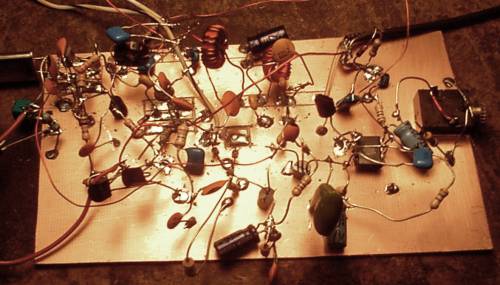
It was always our goal in this lab to turn out prototypes as quickly and as inexpensively as possible. The jobs were almost always "one offs" never to be seen again after a project ended. Sometimes we even resorted to Manhattan construction as well as "dead bug" construction or a combination of both just to get the thing up and running:
This image was copied from the Web at
http://kd1jv.qrpradio.com/ap80/AP_80_ugly.jpg
Pretty and professional-looking were happy accidents more than intentions, but no one went out of their way to build ugly... well, maybe one or two grouchy old techs would do that, just to show us young whippersnappers that "done" is usually better than "perfect" if the project is completed on time, within budget, and working.
So, I guess my point is not that things are easier today, but that they are different. If what you build suits your purpose at the time, kudos to you for getting it "done" rather than getting it "perfect".
I have on-loan a board manufactured this year on a CNC milling machine for the purpose of mounting a few SMD (surface-mount devices) components. It is on loan while I attempt to make it work. Rather than risk damaging the components already mounted on this board, I ordered a SMT-to-DIP converter kit with five or six tiny μP chips and corresponding DIP headers. Each chip has to be hand-soldered to its DIP header. I then attempted to breadboard the original circuit on a common DIP breadboard (the kind most folks here use for LEDs, 555 timers and such).
So far, I have gone through three of the chips (one, at least, expiring with visible release of "magic smoke") without much to show for my efforts. So I ordered ten of the μP chips in an 8-pin PDIP package. They are really cheap! So far, so good. I have been able to "read" the programmable memory contents, and no smoke yet. Next step is to download a small program to test the I/O ports to verify I understand how the hardware works. If I had a board like the one that
@chopnhack designed and built, I would be using it now instead of trying to see where all those jumper wires go on the breadboard, and making sure they all connect to the right holes on the breadboard. Even with my magical magnifying headset this is a difficult task for this old(er) man...
Keep on truckin'
@chopnhack ! You may have inspired me to repair my ancient black-and-white HP Laserjet printer to make some "toner resist" circuit boards. How come nobody sells inkjet cartridges with resist ink for the el-cheapo inkjet printers? I thought the whole idea of cheap inkjet printers was to suck you into buying ink cartridges! With a straight-through paper handler you could print the resist right on the circuit board. I bet the Xerox wax-ink printer would do this, but their paper path is not straight, IIRC. Plus they cost a fortune.
73
de AC8NS
Hop



 But wait until you move up to one of the big guys with a zillion more pins. We are starting to talk about some serious computing horse power! But I bet they Microchip engineers still try to multiplex everything on as many pins as possible. It seems to be their culture:
