Does electron die?

Status
Not open for further replies.

RRITESH

Oct 10, 2010
85
Joined
Oct 10, 2010
Messages
85
[edited ... you were given incorrect info]

Because man is not made to deal with high voltages. The nerves operate at millivol levels, not tens of volts or more.
How nervous system operate at mV?
Can we check with multimeters?
 
Last edited by a moderator:

davenn

Moderator
Sep 5, 2009
14,470
Joined
Sep 5, 2009
Messages
14,470
The Electron are sitting between copper wire let say wire strands.
and it depends on type of cable.

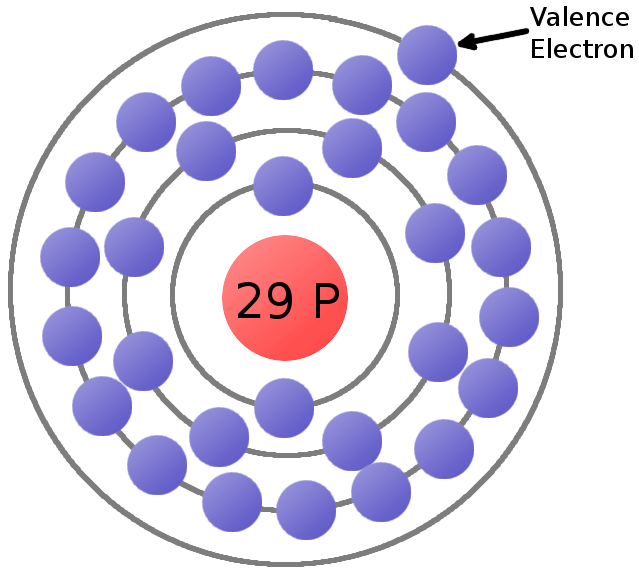
no, the electrons are in the wire, and as per your pic, they are part of every atom
each copper atom has 29 electrons. 11 of those are what are called Valence electrons. That means they are free to move between
atoms. ALL conductors have valence electrons that are free to move around.
These electrons are moving randomly in all directions around inside the conductor
When a voltage is applied to the conductor, altho the random movement is still there, there also becomes an overall drift in one direction.
This is the electron drift that dorke spoke of. and it is this drift that constitutes a current flow or more precisely a flow of charges.


yes, but an electron doesn't need to decay to produce photons. Photons are emitted every time a charge ( electron) is accelerated
and hence is the source of electromagnetic radiation

It is independent from voltage or current, only from physical parameters of the wire.

no, that is incorrect ... electron drift velocity is directly related to voltage and current

http://hyperphysics.phy-astr.gsu.edu/hbase/electric/ohmmic.html#c2


Dave
 
Last edited:

RRITESH

Oct 10, 2010
85
Joined
Oct 10, 2010
Messages
85
no, the electrons are in the wire, and as per your pic, they are part of every atom
each copper atom has 29 electrons. 11 of those are what are called Valence electrons. That means they are free to move between
atoms.
here is 1 only.

51a67853ce395fa26b000000.png
 

RRITESH

Oct 10, 2010
85
Joined
Oct 10, 2010
Messages
85
yes, but an electron doesn't need to decay to produce photons. Photons are emitted every time a charge ( electron) is accelerated

How photon are made how they become useful in generation electricity photo voltaic cell
 

CDRIVE

Hauling 10' pipe on a Trek Shift3
May 8, 2012
4,960
Joined
May 8, 2012
Messages
4,960
I think I love this thread!

Chris
 

davenn

Moderator
Sep 5, 2009
14,470
Joined
Sep 5, 2009
Messages
14,470
How photon are made

I should expand on this a bit .....

Don't get too tied up with the image you posted earlier .... the idea of electrons orbiting the atom nucleus like planets orbiting the sun or satellites orbiting the earth
is very outdated and not really correct. Electrons are in specific energy level positions around the nucleus of an atom in a "cloud" structure. The Heisenberg Uncertainty Principle tells us that we don't know the exact locations of any of the electrons at any given time.

If you energize atoms, say by putting a voltage across the ends of a wire, you can move its electrons to higher energy state. A photon is produced whenever an electron in a higher-than-normal energy state(level) falls back to its normal energy level. During the fall from high energy to normal energy, the electron emits a photon -- a packet of energy -- with very specific characteristics. The photon has a frequency and colour, that exactly matches the distance the electron falls and how much energy the electron looses in that process. Photons are also emitted from a wire etc when electrons are accelerated eg by the application of an alternating voltage to the circuit. First the electrons are accelerated in in one direction ( one half of the cycle) the get accelerated in the other direction, in a repeating cycle.

This is one way to produce photons, there are several others that include bombarding an atom with
other particles ... like in an X-ray tube where a metal target is hit with a stream of high energy electrons. This causes hi energy photons to be emitted by the electrons in the target metal
Gamma radiation ( still photons, just higher energy and shorter wavelength) is usually produced when the nucleus of the atom emits photons when bombarded with hi energy electrons.
It's a difficult differentiation as X-rays can also be produced by this method, so measuring the
frequency/wavelength and the energy level of the photons being produced

So, each photon is a little packet of energy. It is NOT like a little bullet shooting out as old physics text books and still some high schools teach.
Once university physics education is started, the true properties of the photon are taught.
Light and other electromagnetic radiation is neither a wave nor a particle. Depending on the experiment used, it can be seen to be one or the other at that time

cheers
Dave
 
Last edited:

Harald Kapp

Moderator
Moderator
Nov 17, 2011
14,272
Joined
Nov 17, 2011
Messages
14,272
yes, but an electron doesn't need to decay to produce photons. Photons are emitted every time a charge ( electron) is accelerated
and hence is the source of electromagnetic radiation
You're right. My answer was in response to "does electron die?".
 

RRITESH

Oct 10, 2010
85
Joined
Oct 10, 2010
Messages
85
If you energize atoms, say by putting a voltage across the ends of a wire, you can move its electrons to higher energy state.

The wire get burn at at higher current.
If voltage increase that mean pressure increase?
and current increase mean electron increase?
 

hevans1944

Hop - AC8NS
Jun 21, 2012
4,968
Joined
Jun 21, 2012
Messages
4,968
My wife feeds her kefir with the milk in the back of the Fridge. They grow like crazy! Every day she has to strain off the excess. Her culture has been handed down from generation to generation. Those little buggers could be hundreds of thousands of years old! We make vegetable smoothies out of 'em so we can live longer too! Here is a representative photo of them:

upload_2016-5-20_19-32-34.jpeg

I have tried, but have never successfully executed an electron. However, I have often inconvenienced a large number of electrons by typing long missives on my computer and spewing them out on the Ethernet, where they are eagerly devoured by the hungry masses expecting pearls of wisdom... or perhaps just pearls. Which explains why the masses are often underfed and mostly unappreciative of my humble efforts. Hmmph.
 

Attachments

  • upload_2016-5-20_19-39-54.jpeg
    upload_2016-5-20_19-39-54.jpeg
    5.6 KB · Views: 74

Ratch

Mar 10, 2013
1,102
Joined
Mar 10, 2013
Messages
1,102
So, we have lots of electron near us?
Of course, every atom contains one or more electrons.
The electron move from negative to positive side.
The electron has a negative charge which is attracted to a positive voltage.
Why we say current in positive to negative?
That is a mathematical convention which assumes that positive charge carriers exit the positive terminal of the voltage source and enter the negative terminal. If the charge carrier is negative, the true direction of the charge carrier is reversed.
So, why we say crisis of electricity if there is lot of present electrons?
Unless the charge carriers are crowed together, they do not possess a energy density. For instance two charge carriers far apart have an infinitesimal amount of energy/charge. But to move them close together, energy is needed. So two or more electrons crowded together have a energy density ( joules/coulomb or volts). Electrons repel each other, so they will flow to where the energy density/charge (voltage) is lower provided a conduction path exists. The 'crisis of electricity" occurs when there is no way to generate a voltage to move the electrons, not because the electrons are not available.

In DC circuit the voltage is low so pressure is low they move slowly in AC they move very fastly due to high voltage pressure?
Pressure is for hydraulics, voltage is for electricity
And in ac the oscillation is 50/60hz?
Sometimes yes, and sometimes no.

Ratch
 

Ratch

Mar 10, 2013
1,102
Joined
Mar 10, 2013
Messages
1,102
Is there alternator like we have in vehicles in aeroplane also?
why it is rated at 400hz they build AC
new term 787 li-ion battery in it from google.
what electrical engineer has to do job with aeroplane in it?
In AC the electron oscillates what happen at different current.
It would sure help if you capitalized the beginning of your sentences and put a period at the end of your sentences. Also, a little more proofreading to catch missing words would make your writing more clear.

Ratch
 

Ratch

Mar 10, 2013
1,102
Joined
Mar 10, 2013
Messages
1,102
Hello,
new term drift velocity OK,
The average speed of the charge carriers along the conductor.
i have studied about in class but was not sure with meaning at that time.
You understand it now?
the higher the current ,the higher the velocity
That stands to reason, doesn't it?
higher voltage or current?
Can't you reason that out?
A calculation shows that the electron is traveling at about 2,200 kilometers per second. That's less than 1% of the speed of light, but it's fast enough to get it around the Earth in just over 18 seconds. Read up on what happens when nothing can go faster than the speed of light.
source
Irrelevant observation. It doesn't matter how fast the charge carriers travel in all directions. Only the drift velocity brings the charge carriers around the circuit to where they expend their energy.

Ratch
 
Status
Not open for further replies.
Top