Looking for 60A 60V mosfet

asaf123098

May 23, 2017
12
Joined
May 23, 2017
Messages
12
Hello, im looking to buy a mosfet/mosfets to hook on parallel that can serve as an on/off switch for my electric skateboard.
I already ordered some from ebay but they didn't work, im trying to find something better, can anyone recommend a specific model?
The gs voltage needs to be 12v
Thanks!
 

Harald Kapp

Moderator
Moderator
Nov 17, 2011
14,272
Joined
Nov 17, 2011
Messages
14,272
Try one of the many parametric search pages, e.g.this one. You enter all the parameters relevant to you and get a list of suitable components.
 

bertus

Moderator
Nov 8, 2019
3,837
Joined
Nov 8, 2019
Messages
3,837
Hello,

Does this list help?

I wanted to upload a spreadsheet, but the forum does not allow it.
I have attached the spreadsheet by adding.txt
Remove the .txt to reveal the spreadsheet, that can be opened in office.

Bertus
 

Attachments

  • irProducts_N_gate_fets_Vds 60 Idd 60.pdf
    41.8 KB · Views: 1
  • irProducts_N_gate_fets_Vds 60 Idd 60.xls.txt
    41.5 KB · Views: 2
Last edited:

Nanren888

Nov 8, 2015
622
Joined
Nov 8, 2015
Messages
622
Or to put the same question another way: in what way did the previous FETs not work?
 

asaf123098

May 23, 2017
12
Joined
May 23, 2017
Messages
12
In what way?

As already asked but not answered, why...?

Or to put the same question another way: in what way did the previous FETs not work?

Drain and source were not "divided" when applying voltage from drain to source, it worked regardless of the gate source voltage

Try one of the many parametric search pages, e.g.this one. You enter all the parameters relevant to you and get a list of suitable components.

Thanks, i i could find only this one:
https://eu.mouser.com/ProductDetail/Infineon-IR/IRF3708PBF?qs=2r01AXMCG3P2FLBF0Ge6xA==

But the drain source breakdown voltage is 30v, i i need 60v, is it possible to wire 2 of those in series in order to "raise" the breakdown voltage?
Hello,

Does this list help?

I wanted to upload a spreadsheet, but the forum does not allow it.
I have attached the spreadsheet by adding.txt
Remove the .txt to reveal the spreadsheet, that can be opened in office.

Bertus

Thanks, ill have a look when im in front of a computer :)
 
Last edited:

duke37

Jan 9, 2011
5,364
Joined
Jan 9, 2011
Messages
5,364
You can get mosfets with voltage capabilty in the hundreds so why use a specialised 30V transistor? You can only use two in series with extra circuitry and should only be necessary above 500V.

If the mosfets are conducting all the time, have you got the base connected to the source properly or have you popped them with excess voltage?

Show us the schematic.
 

Fish4Fun

So long, and Thanks for all the Fish!
Aug 27, 2013
481
Joined
Aug 27, 2013
Messages
481
asaf123098,

It is probably a bad time to ask, but are you trying to switch:

1) The High Side

2) The Low Side

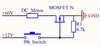
Assuming you are using an N-Channel mosfet to switch the Low Side (as you probably should be), the basic schematic will look like this:
N Channel Mosfet.jpg
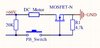
With an N-Channel Mosfet the control signal = "ON" is typically 3V - 15V (referenced to ground) and "OFF" is ground (or close to ground). If you only have 60Vdc then you could create a voltage divider like this:
VD N Channel Mosfet.jpg
If you are using a voltage other than 60Vdc, you would want to adjust the resistor values to insure that you meet the mosfet's gate voltage requirements.

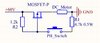
If you are using a P-Channel mosfet to switch the High Side (you probably Should NOT do this) the basic schematic will look like this:

P Channel Mosfet.jpg

With a P-Channel Mosfet the control signal is referenced to Vcc (in this case 60Vdc), to turn this P-Channel Mosfet "ON" the gate voltage needs to be ~12V LESS than 60V. To turn a P-Channel Mosfet "OFF" the Gate Voltage = Vcc (in this case 60Vdc).

These schematics assume that the control signal is coming from a simple push-button switch and therefore the "Turn-On" and "Turn-Off" times are trivial compared to typical "ON" & "OFF" periods. If a PWM source is used for speed control in place of a simple PB Switch then careful attention to the switching characteristics of the actual mosfet being used would be critical.

Hope this helps!

FIsh
 

bertus

Moderator
Nov 8, 2019
3,837
Joined
Nov 8, 2019
Messages
3,837
Hello,

@Fish4Fun , I would place zener diodes of 12 Volts accross the gate/source connections for protection of the mosfet, in the 2nd and 3rd schematic.

Bertus
 

asaf123098

May 23, 2017
12
Joined
May 23, 2017
Messages
12
You can get mosfets with voltage capabilty in the hundreds so why use a specialised 30V transistor? You can only use two in series with extra circuitry and should only be necessary above 500V.

If the mosfets are conducting all the time, have you got the base connected to the source properly or have you popped them with excess voltage?

Show us the schematic.

My main problem is that i couldn't find a transostor matchingy needs, my preference would be to use only one transistor.

asaf123098,

It is probably a bad time to ask, but are you trying to switch:

1) The High Side

2) The Low Side

Assuming you are using an N-Channel mosfet to switch the Low Side (as you probably should be), the basic schematic will look like this:
View attachment 46818
With an N-Channel Mosfet the control signal = "ON" is typically 3V - 15V (referenced to ground) and "OFF" is ground (or close to ground). If you only have 60Vdc then you could create a voltage divider like this:
View attachment 46819
If you are using a voltage other than 60Vdc, you would want to adjust the resistor values to insure that you meet the mosfet's gate voltage requirements.

If you are using a P-Channel mosfet to switch the High Side (you probably Should NOT do this) the basic schematic will look like this:

View attachment 46821

With a P-Channel Mosfet the control signal is referenced to Vcc (in this case 60Vdc), to turn this P-Channel Mosfet "ON" the gate voltage needs to be ~12V LESS than 60V. To turn a P-Channel Mosfet "OFF" the Gate Voltage = Vcc (in this case 60Vdc).

These schematics assume that the control signal is coming from a simple push-button switch and therefore the "Turn-On" and "Turn-Off" times are trivial compared to typical "ON" & "OFF" periods. If a PWM source is used for speed control in place of a simple PB Switch then careful attention to the switching characteristics of the actual mosfet being used would be critical.

Hope this helps!

FIsh

Thanks!!
My plan is to implement the first schmatic in you comment.
 

Harald Kapp

Moderator
Moderator
Nov 17, 2011
14,272
Joined
Nov 17, 2011
Messages
14,272
Thanks, i i could find only this one:
What were your parameters? There are definitely MOSFETs available with higher voltage ratings. You do not look for Vds = 60 V but for Vds > 60 V.
You should never operate a component at the limits of its datasheet values. Always include some safety margin. For a 60 V power supply I would use approx. 20 % safety margin which results in a MOSFET with Vds >= 72 V.
What current do you need?

My plan is to implement the first schmatic in you comment.
That's good. However, how did you test in the first place? Show us a diagram of your circuit.

Be aware that you very likely will have to use a heatsink to drain excess heat from the MOSfet away. Otherwise it may easily die from overheating.
 

Alec_t

Jul 7, 2015
3,817
Joined
Jul 7, 2015
Messages
3,817
One thing you MUST add is a reverse-biased diode across the motor, otherwise the back-emf generated when the FET switches off will kill the FET.
 

Fish4Fun

So long, and Thanks for all the Fish!
Aug 27, 2013
481
Joined
Aug 27, 2013
Messages
481
@ bertus & Alec_t

Yes, there are several refinements I would make to the posted schematic(s) prior to implementation ... not the least of which would be some type of **speed regulation** ... 60V @ 60A = 3.6kW .... on a "skateboard" no less ... but I thought it prudent to test if the OP was at least connecting the proper type Mosfet in the proper configuration before working out the nuances ;-)

It is possible that the OP is designing a constant speed, variable torque drive ... a skateboard that only moves 3mph but is capable of pulling a wagon load of friends up a steep hill .... ? Though I suspect that inquiring into ways to switch 3.6kW on/off (on a skateboard) might be more indicative of a person with a bit more need for speed.

I think a Mosfet blown from over-stress, back-emf or even a damaged gate might be the situational equivalent of an air-bag ;-)

Cheers!

Fish
 

Fish4Fun

So long, and Thanks for all the Fish!
Aug 27, 2013
481
Joined
Aug 27, 2013
Messages
481
@asaf123098

Actually, thinking about the parameters you have given, I have to ask ...

Are you attempting to control the motor (presumably a permanent magnet motor with a conventional armature) with your circuit ??

Or

Are you simply wanting to turn the power on/off to an existing DC motor speed control?

The answer really makes a lot of difference ...

Fish
 

BobK

Jan 5, 2010
7,682
Joined
Jan 5, 2010
Messages
7,682
I get 740 matching results on Mouser when I search for N-charnnel MOSFETs with >= 60V Vds and >= 60A Id.

It seems to me that one of these might be OK for you.

Bob
 

asaf123098

May 23, 2017
12
Joined
May 23, 2017
Messages
12
What were your parameters? There are definitely MOSFETs available with higher voltage ratings. You do not look for Vds = 60 V but for Vds > 60 V.
You should never operate a component at the limits of its datasheet values. Always include some safety margin. For a 60 V power supply I would use approx. 20 % safety margin which results in a MOSFET with Vds >= 72 V.
What current do you need?


That's good. However, how did you test in the first place? Show us a diagram of your circuit.

Be aware that you very likely will have to use a heatsink to drain excess heat from the MOSfet away. Otherwise it may easily die from overheating.

Hi, my parameters are:
- 20a continues and 30+- at peaks
- 50v on drain
- 12v on gate

For that i was looking for a 60a60v drain transistor, with gate that operates at 12v

I didn't test it, i don't have any transistors laying around, i did try the schematic same as mentioned (only without a resistor for the button) with a relay and it worked.

For the amount of current im planning to use continuesly i was hoping the transistor won't get really got.

One thing you MUST add is a reverse-biased diode across the motor, otherwise the back-emf generated when the FET switches off will kill the FET.

Im using an electronic speed controller to operate the motor, the transistor is just to operate is a kill switch for the entire system.

@asaf123098

Actually, thinking about the parameters you have given, I have to ask ...

Are you attempting to control the motor (presumably a permanent magnet motor with a conventional armature) with your circuit ??

Or

Are you simply wanting to turn the power on/off to an existing DC motor speed control?

The answer really makes a lot of difference ...

Fish

It seems i failed to mention that as you are not the only one who thought about that :)

As mentioned above, i already have an electronic speed controller, im just trying to make an on off switch :)
 
Last edited:

Bluejets

Oct 5, 2014
7,374
Joined
Oct 5, 2014
Messages
7,374
Rather difficult trying to decipher just what it is exactly that you need.
Best approach is sketch up a diagram and others can go from there.
 

bertus

Moderator
Nov 8, 2019
3,837
Joined
Nov 8, 2019
Messages
3,837
Hello,

What speed controller are you using?
Does it have an enable input?
If so, that can likely be used as kill switch.

Bertus
 
Top