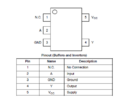
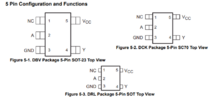
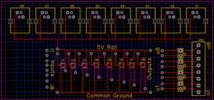
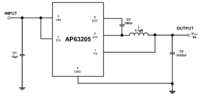
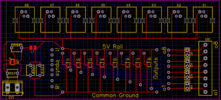
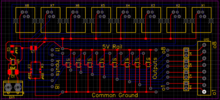
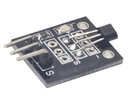
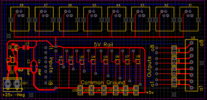
What you want is not a Hall Effect (HE) sensor, but a Proximity Switch. Just type Proximity Switch into your favorite online crap store. Or, you could devise a system whereby your CNC gantry pushes a magnet away from the HE sensor.
Fyi, the nature of the Hall Effect is that a magnetic field disturbs the flow of electrons moving in a straight conductor, keywords MOVING and STRAIGHT. Thus, I am not sure how but they can stop current, with said current being restored by taking away the magnetic field. But magnetic fields cannot be used to impart electron movement to static electrons in a straight conductor to make them jump a barrier to continue their journey and produce current and the 5v we need, per se. You could build an inductive sensor yourself with coils and op-amps and transistors and such to detect the current generated by a magnet attached to your CNC gantry. It would look very cool and steam-punky but such sensors are an entire field of study and whole careers are spent by "top minds" producing proximity switches for us to play with, so I would recommend just getting Proximity Switches.
Software solution:
If you would like to save five dollars on proximity switches by spending a week or two fighting with software then a change in the GRBL code for your CNC machine could fix the problem and eliminate the need for additional circuitry altogether, and you could use your Hall Effect sensors. "Stop switches" are usually normally open and connected to digital pins on the microcontroller. The pins will read LOW when open and HIGH when closed (contacts pushed together). Somewhere in the code there will be a line like "if(mypin==HIGH) then stopdammit();". Just change the HIGH to LOW in whatever programming IDE your system uses. My CNC machine uses Arduino and GRBL. GRBL software for CNC machines is open source and I would be surprised if there was not already a flag you could set to indicate whether high or low means a stop has been reached. My CNC machine does not use any hardware stops. The software is "supposed to" handle that function. Keyword "supposed to"...
FYI2: My application was for an on-off switch for an underwater device where I wanted to be able to wave a magnet over a Hall Effect sensor inside the enclosure with the magnetic field passing through the ABS and turning the device on. I encountered the same conundrum you encountered with your CNC machine so I devised a system where I remove the magnet to turn it on, and place the magnet back on to turn it off. Magnet is attached to the enclosure with a velcro pad at the moment but might build some manner of slide mechanism in the future.