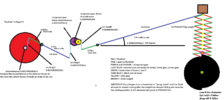
I want to know all of the maths concerning this scissor mechanism!

Maglatron

Jul 12, 2023
2,025
Joined
Jul 12, 2023
Messages
2,025
so imagine a truck thats moving 5mph and you got in the way of it and pushed against it, it would definately move you although your feet would be slipping on the floor it would be constant velocity and there would be no acceleration or should i say a minor decceleration of the truck but you would still be forced along, so the question is can I make the cam movement like this so that it moves the scissor up with ease but with no acceleration,? thanks so my laptop charger has broke so might not be on for a few days after the battery has died
 
Last edited:

Maglatron

Jul 12, 2023
2,025
Joined
Jul 12, 2023
Messages
2,025
so I'm back for a bit managed to charge laptop, it's not the cable it's the charging port on the laptop have to balance the laptop and charger in some special way for it to charge or the port gets hot and doesn't charge!! have to deal with like this for a bit in limp mode till I can afford a new one! any way
Don't see why not, except that would result in the load rising at a constant velocity, whereas you want it to rise at an accelerating rate under constant force unless you accelerate the cam rotation rate.

its not really a problem if it moves with constant velocity or not but I thought that if I put an unbalanced force that there would have to be acceleration also if the cam is moving 1 turn a second or 2pi then it would'nt be accelerating any way the slope would just lift up the weight at a constant with the slope all I know is that the cam needs to overcome the 2.7N to lift the weight and oh yeah it would take 0.5 second for each lift of the weight twice/revolution

so imagine a truck thats moving 5mph and you got in the way of it and pushed against it, it would definately move you although your feet would be slipping on the floor it would be constant velocity and there would be no acceleration or should i say a minor decceleration of the truck but you would still be forced along, so the question is can I make the cam movement like this so that it moves the scissor up with ease but with no acceleration,? thanks so my laptop charger has broke so might not be on for a few days after the battery has died
thanks
 

Alec_t

Jul 7, 2015
3,817
Joined
Jul 7, 2015
Messages
3,817
"can I make the cam movement like this so that it moves the scissor up with ease but with no acceleration,?"
The laws of physics dictate that you have to accelerate the load if you want it to move from rest to a desired height in a desired time.
 

Maglatron

Jul 12, 2023
2,025
Joined
Jul 12, 2023
Messages
2,025
"can I make the cam movement like this so that it moves the scissor up with ease but with no acceleration,?"
The laws of physics dictate that you have to accelerate the load if you want it to move from rest to a desired height in a desired time.
yeah thats what I was getting at but you said about constant velocity somewhere!
 

Maglatron

Jul 12, 2023
2,025
Joined
Jul 12, 2023
Messages
2,025
Don't see why not, except that would result in the load rising at a constant velocity, whereas you want it to rise at an accelerating rate under constant force unless you accelerate the cam rotation rate.
this is what has confused me! thanks
 

Maglatron

Jul 12, 2023
2,025
Joined
Jul 12, 2023
Messages
2,025
also thought what about a hydraulic press the press with tons of force but they move at a constant speed with no acceleration?
 
Last edited:

Alec_t

Jul 7, 2015
3,817
Joined
Jul 7, 2015
Messages
3,817
So how do they get to that constant speed? Any thing which is initially static and then starts moving MUST accelerate. The acceleration may not be noticeable to a human, or may start off at a finite value and then quickly reduce to zero.
 

Maglatron

Jul 12, 2023
2,025
Joined
Jul 12, 2023
Messages
2,025
so can you clarify what you meant by this please?
Don't see why not, except that would result in the load rising at a constant velocity, whereas you want it to rise at an accelerating rate under constant force unless you accelerate the cam rotation rate.
 

Alec_t

Jul 7, 2015
3,817
Joined
Jul 7, 2015
Messages
3,817
If you want the load to start from stationary and reach a certain height in 0.25 sec it must accelerate.
The acceleration will be constant if the force moving the load is constant, or will vary if the force varies.
If you want the cam-follower to stay in contact with the cam then the cam profile, and/or the cam rotation rate (your choice), must match the cam's rate of change of radius to the instantaneous velocity of the cam-follower. That velocity is dictated by the load's required acceleration and the number of scissor stages.
 

Maglatron

Jul 12, 2023
2,025
Joined
Jul 12, 2023
Messages
2,025
I'm going for 0.5 seconds now, the cam will rotate at 2pi rad/s constant rate - and have a constant slope for each half of the cam going from radii 0.324m to 0.45m (difference 0.126m), in pi radains (half a turn). I want this to move the 0.275kg weight up to the desired 1.26m in height in the half a second. How much force will this need and how much torque will this require at the tip of the 0.45m radius? thanks andd what are the units for slope, m/radian?? and 10 stages I want it to move up at near constant rate!!
 

Attachments

  • 2lobe.png
    2lobe.png
    9.6 KB · Views: 0
Last edited:

Alec_t

Jul 7, 2015
3,817
Joined
Jul 7, 2015
Messages
3,817
For a near-constant rate the acceleration a will be >1g initially then near 1g.
Force=effective-mass*a. Don't forget to take into account the scissor mass and the effect of the inertia of the flywheel (via the gearing) when calculating the effective mass. Force will also be affected by friction.
Slope is dimensionless.
 
Last edited:

Maglatron

Jul 12, 2023
2,025
Joined
Jul 12, 2023
Messages
2,025
my thinking is that if you put a ball in your hand or anything for that matter and move up with constant velocity you are still using effort to move it upwards but not so much that it will leave your hand when you stop moving your hand, okay I get it now
 

Maglatron

Jul 12, 2023
2,025
Joined
Jul 12, 2023
Messages
2,025
I need to modify this
need to modify this because I don't want it accelerating the entire 1.26m. Say I want it to accelerate to 2.52m/s very quickly, and then have it move up at that speed untill reaching 1.26m approx 0.5 sec

Find acceleration

To move the block upwards 1.256637061meters in 0.5 seconds, you need to counteract gravity's downward acceleration of 9.80665m/s² and provide an additional upward acceleration

a = 2 * d / s², 2 * 1.256637061 / 0.5² = 10.05309649m/s² to achieve the desired movement. Since both accelerations are in the same direction (upwards), the total required acceleration is the sum of these two, resulting in 19.85974649m/s².

do you know what I'm talking about?
 
Last edited:

Maglatron

Jul 12, 2023
2,025
Joined
Jul 12, 2023
Messages
2,025
the cam will start to move the peg on the level 1 of the scissor as soon as it drops off of the end of the highest point of the cam. the cam is turning 1revolution/second so will lift the 275gram weight 2ce per rotation of the cam how much torque will be needed to lift the weight if the rotational slope is constant and the movement of the scissor peg moves up at a constant rate. I'm a bit stuck I appreciate that you have explained already in a fassion but am not quite getting something the radii of the cam in 1 half turn is 0.324m to 0.45m, can you explain for me in idiot proof terms, thanks
 

Attachments

  • proggress.png
    proggress.png
    297.8 KB · Views: 4

Maglatron

Jul 12, 2023
2,025
Joined
Jul 12, 2023
Messages
2,025
the inertia of the flywheel dosen't come into it because it's allowed to freewheel after the drop of the weight but I do need to take into account the lever masses and there associated inertia's and the mass of the scissors and then the 0.275kg weight itself could you explain for me again because I'm not yet clear thanks
For a near-constant rate the acceleration a will be >1g initially then near 1g.
Force=effective-mass*a. Don't forget to take into account the scissor mass and the effect of the inertia of the flywheel (via the gearing) when calculating the effective mass. Force will also be affected by friction.
Slope is dimensionless.

the cam will start to move the peg on the level 1 of the scissor as soon as it drops off of the end of the highest point of the cam. the cam is turning 1revolution/second so will lift the 275gram weight 2ce per rotation of the cam how much torque will be needed to lift the weight if the rotational slope is constant and the movement of the scissor peg moves up at a constant rate. I'm a bit stuck I appreciate that you have explained already in a fassion but am not quite getting something the radii of the cam in 1 half turn is 0.324m to 0.45m, can you explain for me in idiot proof terms, thanks
 

Alec_t

Jul 7, 2015
3,817
Joined
Jul 7, 2015
Messages
3,817
If your cam profile and constant rotation rate cause the weight to move vertically at a constant speed then the upward force needed = the weight Wt. The lateral force, Lf, to follow the profile = Wt x slope, so the torque T = Lf x radius. Taking the mean slope at the mean radius should give an approximate value for T.
 

Maglatron

Jul 12, 2023
2,025
Joined
Jul 12, 2023
Messages
2,025
thanks, what does Wt and Lf mean? okay Lf = lateral force and that will be Wt * slope, whereas Wt is the weight * gravitational constant 9.81 ie weight force I guess?
 
Last edited:
Top