I want to know all of the maths concerning this scissor mechanism!

Maglatron

Jul 12, 2023
2,025
Joined
Jul 12, 2023
Messages
2,025
i assumed you needed to add it because thatl take care of gravity
and even when I do the calculation 2.5132755 / 0.0625 = 40.213
 

Maglatron

Jul 12, 2023
2,025
Joined
Jul 12, 2023
Messages
2,025
its a casio fx CG50 definatly not binning it!!#
do I not need the gravity constant 9.80665m/s^2?
is 36.032 the acceleration solved?
found the problem
1.256637061 * 2 is = 2.513274122(and not 2.252) and that / 0.0625 = 40.21238595
solved
now need to know if I add the gravity in
need to get it out the bin
 
Last edited:

Maglatron

Jul 12, 2023
2,025
Joined
Jul 12, 2023
Messages
2,025
is this correct

To move the block upwards 1.256637061meters in 0.25 seconds, you need to counteract gravity's downward acceleration of 9.80665m/s² and provide an additional upward acceleration of 40.21238595m/s² to achieve the desired movement. Since both accelerations are in the same direction (upwards), the total required acceleration is the sum of these two, resulting in 50.01903595m/s².
 

Alec_t

Jul 7, 2015
3,817
Joined
Jul 7, 2015
Messages
3,817
The post #124 figures look good (apart from all those decimal places!).
I see how the discrepancy arose. In post #109 you have typed 1.125.... as the distance s, but instead used 1.25.... in the calculation.
 

Maglatron

Jul 12, 2023
2,025
Joined
Jul 12, 2023
Messages
2,025
t^2 = 0.25^2 = 0.0625.
2*s = 2*1.126 = 2.252.
2.252/0.0625 = 36.032.
If your calculator says otherwise, treat it to a new battery or bin it :).
How did you get the 9.80665 figure?
the actual distance to move is 1.256637061m
The post #124 figures look good (apart from all those decimal places!).
I see how the discrepancy arose. In post #109 you have typed 1.125.... as the distance s, but instead used 1.25.... in the calculation.
thanks
 

Maglatron

Jul 12, 2023
2,025
Joined
Jul 12, 2023
Messages
2,025
I made this file for those interested there are a couple of anomalies such as why the lifting of the block takes out 2.7 joules and I'd like to know how to change this value thanks I hope its correct!!
 

Attachments

  • MAGLATRON3.0.pdf
    243.2 KB · Views: 6
Last edited:

Alec_t

Jul 7, 2015
3,817
Joined
Jul 7, 2015
Messages
3,817
The calculations so far have assumed the cam presents a constant slope to the cam follower. In reality that won't be the case (at least for the usual spiral forms), so your refinements need to take actual slope into account in calculating force, torque and acceleration. Sorry, but I don't have the time or stamina to delve into that.:(
 

Maglatron

Jul 12, 2023
2,025
Joined
Jul 12, 2023
Messages
2,025
The calculations so far have assumed the cam presents a constant slope to the cam follower. In reality that won't be the case (at least for the usual spiral forms), so your refinements need to take actual slope into account in calculating force, torque and acceleration. Sorry, but I don't have the time or stamina to delve into that.:(
ok thanks anyway dood but the calculations were correct?
 

Maglatron

Jul 12, 2023
2,025
Joined
Jul 12, 2023
Messages
2,025
ok so where you got the value 0.137 the value i get is The correct value for the constant slope m is 0.02005 meters per radian Multiplying by 2π again would not be necessary since m already represents the change over the entire 2π radians. Therefore, the slope is correctly calculated as 0.02005 meters per radian.
was you digits over 0.137m/rad
  • The total change in radius is 0.126 meters.
  • The total angular displacement for one full rotation is 2π radians.
  • 0.126/2pi =
  • Therefore, the slope m is approximately 0.02005 meters per radian.
 
Last edited:

Maglatron

Jul 12, 2023
2,025
Joined
Jul 12, 2023
Messages
2,025
so I come up with a solution: make a spiral shape with a constant slope from 0.05 to whatever the the length gets to when it reaches 2 pi and adjust the levels in the scissor accordingly! or this idea is good make the cam much larger and the slope will get shallower dramatically!!
 
Last edited:

Alec_t

Jul 7, 2015
3,817
Joined
Jul 7, 2015
Messages
3,817
That would help to give a constant slope, if that is indeed what you want. However, as the load is accelerating you will also then need to accelerate the rotation speed of the cam to keep the cam follower in contact with it. Have you considered that?
A further point. Up to now you have not said what is supposed to happen when the load has moved up by 1.26 metres. At that point it will have a velocity given by acceleration x time = ~40m/s^2 x 0.25s = ~10m/s and considerable kinetic energy.
 

Maglatron

Jul 12, 2023
2,025
Joined
Jul 12, 2023
Messages
2,025
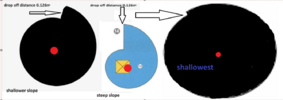
yes considered that I'll try do a drawing in paint the acceleration is also this would only need to rotate 2pi rad and will still make the scisso move up in 0.25sec, I want the radius to be 0.45m diameter 0.90m (from the top the top snail to the bottom of the botton snail) can you help me calculate the slope s on the 4 segments of the cam please also need to torque required and the acceleration need to be 50.01903595m/s². there will be a flywheel action of the cam too which will make it easier to keep its momentum on in put

1717072111545.png
 
Last edited:

Alec_t

Jul 7, 2015
3,817
Joined
Jul 7, 2015
Messages
3,817
Without knowing what is supposed to happen after 1.26m vertical movement its hard to advise on the cam profile. For example, if the cam suddenly stops, the load (and cam-follower) will carry on moving up until slowed to a halt by gravity and friction. Is that the intention? Or is the cam supposed to control descent too?
Why does your cam now have four lobes? Is the load supposed to drop down to minimum after each maximum? If so, it can't do that instantly.
 

Maglatron

Jul 12, 2023
2,025
Joined
Jul 12, 2023
Messages
2,025
still have to design the mechanism just getting a skelington - bare bones of the machine, but it's lifting a weight of 0.275kg it takes 0.25s to move up and then it's free to drop again the weight drops and takes 0.17s to drop at wheel speed 12pi rad/s 0.0257 second is free fall. the four "lobes" are to that if the cam is rotatind 2pi rad/s then each lob will accelerate the box up through the scissor and the sharp drop off is so that the weight can fall rotating the flywheel of inertia 0.05ra/s^2 and put its energy in to the flywheel then the wheel
 
Last edited:
Top