Speaker output ohmage without information.

Status
Not open for further replies.

Martaine2005

May 12, 2015
5,276
Joined
May 12, 2015
Messages
5,276
That means the speaker terminals on the device do not amplify the signal, and it requires a set of speakers that maintain their own power, and amp. It would seem to me, that output, would be considered line voltage, and I don't know what the line voltage is on an output for a set of terminals, designed to be used with externally powered loudspeakers.
Line level or audio line signal is about 1 Volt.
Computers have a line out for external speakers and so do audio mixers (amongst other devices).
The most common available speakers today are 8 Ohms.
But what has the ‘line out’ signal got to do with speaker impedance?.
 

poormystic

Jul 23, 2023
187
Joined
Jul 23, 2023
Messages
187
Wow
Just suck and see :)
1) Connect a signal and a speaker.
2) Start the volume at zero. Turn volume up gradually.

If speaker and amp survive, you won.

:)
 

poormystic

Jul 23, 2023
187
Joined
Jul 23, 2023
Messages
187
Any dedication can get kudos for trying... What I really need are some focused responses that solve my problems.... (Unknown haplo group)
When a manufacturer specifies a loudspeaker impedance, what they're really doing is making sure you dont put too big a load on the amp.
An amplifier made to supply an 8 Ohm speaker won't be happy supplying a 4 Ohm speaker, because twice as much current will be taken by the load - and that often means goodbye amp.
Most modern amps are made for an 8 Ohm load.
If you think your amp might be special, take a photo and post it here :)
 

Delta Prime

Jul 29, 2020
2,987
Joined
Jul 29, 2020
Messages
2,987
Now days 8Ω seems to be the sweet spot, but some are 4Ω to get more power from a fixed low supply voltage, such as a vehicle battery.
I found this interesting a little snippet.. :)
The following is a plausible explanation of the origin of “8 ohms” in audio systems, but it’s not likely the whole story.
The power grid, as we know it, began in the 1880s
Why 8 Ohms?
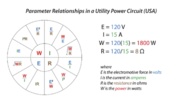
The use of 8 ohms as the minimum load in a utility power circuit accomplishes the following: 1. About 1800 W of continuous power, 2) About 15 A of current, and 3) Acceptable voltage drop (line loss) from AWG12 copper wire up to 120 feet.
Given that audio amplifiers were coming onto the scene after these values were established, it made perfect sense to stick with the basic operating parameters of utility power circuits. Why reinvent the wheel? What “works” for utility power would “work” for audio circuits.
IMG_0495.png
The Ohm’s Law wheel shows the relationship between voltage, current, and resistance for a DC circuit. This is the simplest representation of an AC circuit for which the impedance is resistive. Note the 8 ohm minimum load
resistance.
https://www.prosoundweb.com/why-8-ohms-where-did-it-come-from-and-what-does-it-mean/
 

crutschow

May 7, 2021
984
Joined
May 7, 2021
Messages
984
I found this interesting a little snippet..
Interesting, but I think that's just a coincidence.

The speaker impedance is selected to get the maximum power from typical amplifier designs, along with the limitations of speaker voice-coil design.

Tube amps typically had a tapped output transformer for 4, 8, and 16 ohm speakers.

Solid-state amps with a direct output, seem to generally have an optimum value, for their voltage and current sweep spot, of around 8 ohms.
 

poormystic

Jul 23, 2023
187
Joined
Jul 23, 2023
Messages
187
Interesting, but I think that's just a coincidence.

The speaker impedance is selected to get the maximum power from typical amplifier designs, along with the limitations of speaker voice-coil design.

Tube amps typically had a tapped output transformer for 4, 8, and 16 ohm speakers.

Solid-state amps with a direct output, seem to generally have an optimum value, for their voltage and current sweep spot, of around 8 ohms.
Is that a maximum power transfer sweet spot?
 

crutschow

May 7, 2021
984
Joined
May 7, 2021
Messages
984
Is that a maximum power transfer sweet spot?
It may be for tube amps where the tube has a very high impedance compared to the speaker, but not for solid state amps.
Solid-state amps have a low output impedance, well below the speaker impedance, to maximize efficiency not power output.

The maximum power transfer "sweet spot" gives a 50% efficiency, so half the power would be dissipated in the amp, and that's not desirable for an audio amp, although it may be ok for an RF transmitter amp where you want maximum power output to the antenna at the expense of efficiency.
 

poormystic

Jul 23, 2023
187
Joined
Jul 23, 2023
Messages
187
It may be for tube amps where the tube has a very high impedance compared to the speaker, but not for solid state amps.
Solid-state amps have a low output impedance, well below the speaker impedance, to maximize efficiency not power output.

The maximum power transfer "sweet spot" gives a 50% efficiency, so half the power would be dissipated in the amp, and that's not desirable for an audio amp, although it may be ok for an RF transmitter amp where you want maximum power output to the antenna at the expense of efficiency.
Thanks :)
 

crutschow

May 7, 2021
984
Joined
May 7, 2021
Messages
984
As an added note, solid-state amps are designed to deliver the maximum power to the speakers that the amp power supply can deliver, so trying to maximize the power by matching output and load impedances would overload the supply.
 

Delta Prime

Jul 29, 2020
2,987
Joined
Jul 29, 2020
Messages
2,987
As an added note, solid-state amps are designed to deliver the maximum power to the speakers that the amp power supply can deliver, so trying to maximize the power by matching output and load impedances would overload the supply
Let’s keep the cards straight shall we?
As a supplement!

Damping factor is a specification most commonly associated with amplifiers, but since it concerns the amplifier/speaker relationship,
Damping Factor is the ratio of nominal loudspeaker impedance (the impedance the loudspeaker is rated at) to total output impedance of the system driving the loudspeaker, including the amplifier cables.
 

poormystic

Jul 23, 2023
187
Joined
Jul 23, 2023
Messages
187
As an added note, solid-state amps are designed to deliver the maximum power to the speakers that the amp power supply can deliver, so trying to maximize the power by matching output and load impedances would overload the supply.
:)
If both impedances were 8 Ohms I can't see that there'd be trouble - it's not as if uncontrolled currents could develop?
 

crutschow

May 7, 2021
984
Joined
May 7, 2021
Messages
984
:)
If both impedances were 8 Ohms I can't see that there'd be trouble - it's not as if uncontrolled currents could develop?
Yes.
But as I stated, the output impedance of a typical solid-state audio amp is very low (<1 ohm).
For an audio amp, being rated for an 8 ohm load doesn't mean its output impedance is 8 ohms.
 

Delta Prime

Jul 29, 2020
2,987
Joined
Jul 29, 2020
Messages
2,987
Always enjoy our little trip down the rabbit hole in Wonderland. :rolleyes:
I acknowledge the enjoyment your contributions bring.
I incorporate your brilliant circuits to enhance my own designs.
Giving credit & referencing your circuit designs.
Thank You. :)
 
Status
Not open for further replies.
Top