Not Understanding Arduino useage versus traditional Electronics useage in Devices.

Status
Not open for further replies.

John R Retired

Mar 13, 2022
155
Joined
Mar 13, 2022
Messages
155
Many people are using Arduino (& Rasberry Pi ?) to make functioning electronics devices naowadays using code & programming.

I know Arduino & microcontroller ARE electronics devices, but a lot of makers avoid electronics and instead use the software
capability of Arduino to make what used to be "electronics only" devices. Maybe discreet ICs were the transition, I'm not sure.

I even seen a "Software Radio"

Where is the dividing line between using electronics components to make an electronics device and Arduino (i.e. microcontroller)
to make an electronics device? One is software oriented, the other is component oriented.

This seems to be why a lot of Arduino uses don't know much about electronics, as they use Arduinos instead to make what used
to be just electronics devices.
 
Last edited:

davenn

Moderator
Sep 5, 2009
14,471
Joined
Sep 5, 2009
Messages
14,471
Where is the dividing line between using electronics components to make an electronics device and Arduino (i.e. microcontroller)
to make an electronics device? One is software oriented, the other is component oriented.

because the microcontroller based devices are so much more compact - less discrete components
they are also so much more versatile in what can be done with them, particularly in that smaller space.

It all boils down to the complexity of the circuit and its requirements .... why make the job so much harder
by using dozens of discrete components, when just a microcontroller and a few discrete components
will accomplish the same result ?!

Dave
 
Last edited:

Minder

Apr 24, 2015
3,561
Joined
Apr 24, 2015
Messages
3,561
Many people are using Arduino (& Rasberry Pi ?) to make functioning electronics devices naowadays using code & programming.
An example, When I started out in the tube era, projects were Rather bulky ! To say the least.
Transisters came along and reduced the size drastically, then IC's replaced a bunch of transistors, even more compact. !
Subsequent to that along came the micr-processor, now I can find a whole load of different possible functions and operations in a 8pin micro.
I often look back at circuits I built that were so huge by comparison . :cool:
 

John R Retired

Mar 13, 2022
155
Joined
Mar 13, 2022
Messages
155
To

davenn

and​

Minder


So then, for time efficiency (how to use daily time) really it is sort of a waste of time nowadays to build circuits with discreet electronics components (including ICs) and a better use of time to focus on how to substitute an Arduino (or Rasberry Pi) for a circuit that used
to be built with discreet electronics? I'm talking about modern electronics projects NOT fixing or tinkering with old & vintage devices?

Thanks
 

danadak

Feb 19, 2021
1,064
Joined
Feb 19, 2021
Messages
1,064
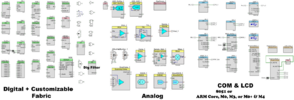
There are micros now not only with standard peripherals but also gate
level fabric in which one can design ones own logic specific parts and
state machine to interface on one chip with each other. Done with schematic
capture (GUI tool) and/or Verilog. On top of that its got a lot of basic
analog f()'s, like OpAmps, PGA, Comparator, DAC, A/D, mixer, reference....

Its like have a lab on a chip, you drag and drop its standard components
on schematic, wire up to each other and out to pins, and code with its
extensive lib of control APIs. Folks have done oscilloscope on a chip
with it, I used it in creating a complex f() generation to burst complex
waveforms, sweep......

An example of the "normal" HW on it, multiple copies in most cases -

1752017853314.png

There are sites/user groups, hundreds of projects, and lib development like DDS, 74HC logic, Cordic
that cand be added to the HW onchip catalog for use....


Last edited:

John R Retired

Mar 13, 2022
155
Joined
Mar 13, 2022
Messages
155
There are micros now not only with standard peripherals but also gate
level fabric in which one can design ones own logic specific parts and
state machine to interface on one chip with each other. Done with schematic
capture (GUI tool) and/or Verilog. On top of that its got a lot of basic
analog f()'s, like OpAmps, PGA, Comparator, DAC, A/D, mixer, reference....

Its like have a lab on a chip, you drag and drop its standard components
on schematic, wire up to each other and out to pins, and code with its
extensive lib of control APIs. Folks have done oscilloscope on a chip
with it, I used it in creating a complex f() generation to burst complex
waveforms, sweep......

An example of the "normal" HW on it, multiple copies in most cases -

View attachment 66095

There are sites/user groups, hundreds of projects, and lib development like DDS, 74HC logic, Cordic
that cand be added to the HW onchip catalog for use....


Correct me if I'm wrong:

With electronics circuits, you are using the flow of electricity as in "electrons" moving through a conductor and those electrons are being manipulated by various components, (resistors, caps, inductors, transistors etc) to achieve some end result like audio amplifier driving a loudspeaker, emitting radio waves, switches (electrical & mechanical) and so on. THAT is electronics.
With something like a microcontroller, you are using code-programming text to achieve some result, so that is NOT electronics at all.
At best it is "simulated" & "virtual" imitations of what REAL electronics using "electricity" (Coulombs law of atomic electron quantity charge).
So the conclusion is that programming a microcontroller with text code, is an entirely different process and has really no
root in electronics as far as the text is concerned. Or is themicrocontroller the same as a microprocessor with microscopic transistors
and components driven by electricity fulfilling the function of traditional electronics circuits, the only difference being that the
microcontroller circuits are just super miniaturized? In a nutshell, is the microcontroller just "Text & Code" and Faking electronics
or are the microcontroller functions REAL electricity at work completing tiny circuits?

Thanks
 

crutschow

May 7, 2021
984
Joined
May 7, 2021
Messages
984
you are using code-programming text to achieve some result, so that is NOT electronics at all.
It's not analog electronics, but it is digital electronics. It still uses electrons and transistors to generate the result.
The difference is that digital electronics can use digital words to represent analog values and perform analog type functions on those digital values.
The digitized analog value can then be manipulated in any manner desired, using functions that would be difficult or impossible to do with analog electronics.
And the digital result can be indefinitely stored without degradation, which an analog voltage cannot be.

But there still has to be some analog electronics to go from our analog world to the digital world, and then back to our analog world when needed.
Thus, for example, a digital camera has an analog-to-digital converter (ADC) to convert the analog signal from the light sensor array to the digital words the digital processor uses to process the signal. The signal can then be stored or sent without degradation, but can be converted back to analog form using some form of a DAC circuit, such as for a TV visual display and audio.
 

John R Retired

Mar 13, 2022
155
Joined
Mar 13, 2022
Messages
155
It's not analog electronics, but it is digital electronics. It still uses electrons and transistors to generate the result.
The difference is that digital electronics can use digital words to represent analog values and perform analog type functions on those digital values.
The digitized analog value can then be manipulated in any manner desired, using functions that would be difficult or impossible to do with analog electronics.
And the digital result can be indefinitely stored without degradation, which an analog voltage cannot be.

But there still has to be some analog electronics to go from our analog world to the digital world, and then back to our analog world when needed.
Thus, for example, a digital camera has an analog-to-digital converter (ADC) to convert the analog signal from the light sensor array to the digital words the digital processor uses to process the signal. The signal can then be stored or sent without degradation, but can be converted back to analog form using some form of a DAC circuit, such as for a TV visual display and audio.
Thanks for that info.

Excuse me if I am behind and not up on the newer electronics like microcontroller. I did take a course in basic microprocessor using
the Heathkit microprocessor trainer kit in college. I lost the kit while moving and wish I had it now, just for refreshing my memory.

I did some research and found that a Microcontroller is simply a CPU with additional peripheral divices built inside and is a computer
complete within itself. In contrast a microprocessor is only a CPU and peripheral devices are external but can be used for any application
especially complete large computers. Also that a microprocessor is more powerful and faster where a microcontroller is slower but more specific to an application. In both devices we are dealing with millions of microscopic transistors in a package--"I get it"..

So basically I found out, a microcontroller is sort of "microprocessor lite" with added peripherals. Evidently the programming of a microcontroller is similar to using Basic programming but uses Python and C++ instead. So it is a complete but limited small computer system.
I am enthusiastically looking forward to learning more about its use and applications. I don't particularly like programming however,
but I guess you can't escape it nowadays in electronics. I used to program industrial machines using UNIX code and it was a pain remembering when to use parenthesis, periods, semicolons etc so I am familiar with that aspect. Never wanted to learn C++, don't
know much about Python.

My main interest to tackle electronics once again in my life has been the "electronics" part of it, not software or code.
I have some knowledge and it kind of haunts me to finish what I started learning decades ago. I have some equipment and books
and I don't relish just donating it or trying to sell it. I have been exploring ways I could eventually make some extra money working
(in retirement) sort of like TV repairman or consumer electronics repair OR SOMETHING but those days are long gone evidently.
How "Arduino" (or other microcontrollers) fit into that scenario, if at all, I don't know. I know that ways to make side income in the
past are now obsolete, and with AI everywhere, ways to make some extra cash are even more slim, but I'm still looking.
Getting a company "JOB" in electronics is not really on my "want to do" list but with so much of that aspect having gone to India, and China I am not sure where that scenario stands today anyway, especiallyin the U.S.. Also as "Delta Prime" as siad, you need a degree
(AS or BS) to even get an entry electronics job so the gatekeepers in HR have raised the bar, or maybe the technology has raised the bar.
Like I said, I'm not sure where "Arduino" (or microcontrollers) fits into all this.
 
Last edited:

bertus

Moderator
Nov 8, 2019
3,837
Joined
Nov 8, 2019
Messages
3,837
Hello,

I assume so, as they are stated as open source.

Bertus
 

Zilliquister

Jan 4, 2024
1
Joined
Jan 4, 2024
Messages
1
Many people are using Arduino (& Rasberry Pi ?) to make functioning electronics devices naowadays using code & programming.

I know Arduino & microcontroller ARE electronics devices, but a lot of makers avoid electronics and instead use the software
capability of Arduino to make what used to be "electronics only" devices. Maybe discreet ICs were the transition, I'm not sure.

I even seen a "Software Radio"

Where is the dividing line between using electronics components to make an electronics device and Arduino (i.e. microcontroller)
to make an electronics device? One is software oriented, the other is component oriented.

This seems to be why a lot of Arduino uses don't know much about electronics, as they use Arduinos instead to make what used
to be just electronics devices.
John, Most Makers have a very good grasp of 'Hardware' as they incorporate Software to control many devices. There are many "Modules" called libraries that make using them with the Arduino IDE and ways to make them compact as with the Atmel 85 chips. Making component based projects like LED Flashers can be done with simple timers(555), resistors, batteries(coin Cells) and LED's . Adding transistors to create logic circuits you can add Capacitors to make the delay longer or shorter to preform other tasks. But this becomes difficult when you try to prototype a larger project. This is where a micro controller comes in handy. Using the Atmel AT Mega 328PU chip it already has most of these built in. Things like PWM (Pulse Width Modulation) Drive motors and other devices with ease. I2C built in to run multiple devices like Temperature sensors , switches , Keypads, LCD(Liquid Crystal Displays) , OLED's etc. Making it a package that is easier for most Beginner electronics enthusiasts to make interesting projects. So in conclusion, why reinvent the wheel when someone already has that part down pat. BTW Arduino Libraries are contributed by the users. So when you add a library. The user made a C script to make everything for the specific device readily available to the end User. You. The code is 'Open Source' with MIT License0 So anyone can use it.
 
Last edited:

danadak

Feb 19, 2021
1,064
Joined
Feb 19, 2021
Messages
1,064
Thanks for that info.

Excuse me if I am behind and not up on the newer electronics like microcontroller. I did take a course in basic microprocessor using
the Heathkit microprocessor trainer kit in college. I lost the kit while moving and wish I had it now, just for refreshing my memory.

I did some research and found that a Microcontroller is simply a CPU with additional peripheral divices built inside and is a computer
complete within itself. In contrast a microprocessor is only a CPU and peripheral devices are external but can be used for any application
especially complete large computers. Also that a microprocessor is more powerful and faster where a microcontroller is slower but more specific to an application. In both devices we are dealing with millions of microscopic transistors in a package--"I get it"..

So basically I found out, a microcontroller is sort of "microprocessor lite" with added peripherals. Evidently the programming of a microcontroller is similar to using Basic programming but uses Python and C++ instead. So it is a complete but limited small computer system.
I am enthusiastically looking forward to learning more about its use and applications. I don't particularly like programming however,
but I guess you can't escape it nowadays in electronics. I used to program industrial machines using UNIX code and it was a pain remembering when to use parenthesis, periods, semicolons etc so I am familiar with that aspect. Never wanted to learn C++, don't
know much about Python.

My main interest to tackle electronics once again in my life has been the "electronics" part of it, not software or code.
I have some knowledge and it kind of haunts me to finish what I started learning decades ago. I have some equipment and books
and I don't relish just donating it or trying to sell it. I have been exploring ways I could eventually make some extra money working
(in retirement) sort of like TV repairman or consumer electronics repair OR SOMETHING but those days are long gone evidently.
How "Arduino" (or other microcontrollers) fit into that scenario, if at all, I don't know. I know that ways to make side income in the
past are now obsolete, and with AI everywhere, ways to make some extra cash are even more slim, but I'm still looking.
Getting a company "JOB" in electronics is not really on my "want to do" list but with so much of that aspect having gone to India, and China I am not sure where that scenario stands today anyway, especiallyin the U.S.. Also as "Delta Prime" as siad, you need a degree
(AS or BS) to even get an entry electronics job so the gatekeepers in HR have raised the bar, or maybe the technology has raised the bar.
Like I said, I'm not sure where "Arduino" (or microcontrollers) fits into all this.
If you dont like programming because of the strict typing of instructions there is a very fun alternative,
block gui programming, where you drag and drop blocks onto design canvas, configure, like setting their
paramters, and hit the compile/program button. The tool generates Arduino code or Python, and you program
part. See post # 5 -


I use this and C. I use block programming now often, its simple, avoids all the strong typing C C++
demands, and fast to create projects. C when I am way into the weeds on a part, or upo against
parts storage limits, or speed issues in algorithims and hardware.
 

ahsrabrifat

Jan 18, 2025
76
Joined
Jan 18, 2025
Messages
76
Many people are using Arduino (& Rasberry Pi ?) to make functioning electronics devices naowadays using code & programming.

I know Arduino & microcontroller ARE electronics devices, but a lot of makers avoid electronics and instead use the software
capability of Arduino to make what used to be "electronics only" devices. Maybe discreet ICs were the transition, I'm not sure.

I even seen a "Software Radio"

Where is the dividing line between using electronics components to make an electronics device and Arduino (i.e. microcontroller)
to make an electronics device? One is software oriented, the other is component oriented.

This seems to be why a lot of Arduino uses don't know much about electronics, as they use Arduinos instead to make what used
to be just electronics devices.
Arduino and similar microcontroller platforms have dramatically shifted how makers and engineers approach hardware projects. What once required deep knowledge of analog components and discrete ICs can now often be achieved through clever use of software and high-level libraries.
The "dividing line" you mention isn't so much a hard boundary as it is a continuum. In many modern projects, the emphasis has moved from raw electronic design to system-level thinking. Platforms like Arduino make these projects easier. This doesn’t diminish the value of electronics knowledge, but it does mean you can now build impressive devices with minimal circuit design experience. Your observation aligns with trends showcased in collections like the Top 10 Arduino Projects, where software-centric innovation often takes center stage. These projects demonstrate how far you can go with microcontrollers, sensors, and prebuilt modules—no deep electronics background required.
 

John R Retired

Mar 13, 2022
155
Joined
Mar 13, 2022
Messages
155
Arduino and similar microcontroller platforms have dramatically shifted how makers and engineers approach hardware projects. What once required deep knowledge of analog components and discrete ICs can now often be achieved through clever use of software and high-level libraries.
The "dividing line" you mention isn't so much a hard boundary as it is a continuum. In many modern projects, the emphasis has moved from raw electronic design to system-level thinking. Platforms like Arduino make these projects easier. This doesn’t diminish the value of electronics knowledge, but it does mean you can now build impressive devices with minimal circuit design experience. Your observation aligns with trends showcased in collections like the Top 10 Arduino Projects, where software-centric innovation often takes center stage. These projects demonstrate how far you can go with microcontrollers, sensors, and prebuilt modules—no deep electronics background required.
Great explanation.

So where does that leave the need for understanding discreet electronics circuits and components as it has been?
Has it come down to where electronics (per se') will no longer be required in the future or near future manufacturing
except for hobbyists, nostalgia tinkerers and techs who maintain old dinosaur electronics devices?
 

Minder

Apr 24, 2015
3,561
Joined
Apr 24, 2015
Messages
3,561
An indicator is the inability to repair and maintain many electronics devices now, due to the proprietary nature of the type of control, i.e. not only processor centred but modular electronics in general.
As I mentioned, I was fortunate in a way, to progress through the era's, from early tube/valve electronics right through to the Micro-processor.
I enjoy programming in assembly, ( So Call me a masochist) !!
 
Status
Not open for further replies.
Top