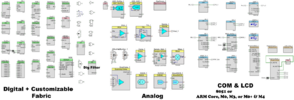
It's not analog electronics, but it is digital electronics. It still uses electrons and transistors to generate the result.
The difference is that digital electronics can use digital words to represent analog values and perform analog type functions on those digital values.
The digitized analog value can then be manipulated in any manner desired, using functions that would be difficult or impossible to do with analog electronics.
And the digital result can be indefinitely stored without degradation, which an analog voltage cannot be.
But there still has to be some analog electronics to go from our analog world to the digital world, and then back to our analog world when needed.
Thus, for example, a digital camera has an analog-to-digital converter (ADC) to convert the analog signal from the light sensor array to the digital words the digital processor uses to process the signal. The signal can then be stored or sent without degradation, but can be converted back to analog form using some form of a DAC circuit, such as for a TV visual display and audio.
Thanks for that info.
Excuse me if I am behind and not up on the newer electronics like microcontroller. I did take a course in basic microprocessor using
the Heathkit microprocessor trainer kit in college. I lost the kit while moving and wish I had it now, just for refreshing my memory.
I did some research and found that a Microcontroller is simply a CPU with additional peripheral divices built inside and is a computer
complete within itself. In contrast a microprocessor is only a CPU and peripheral devices are external but can be used for any application
especially complete large computers. Also that a microprocessor is more powerful and faster where a microcontroller is slower but more specific to an application. In both devices we are dealing with millions of microscopic transistors in a package--"I get it"..
So basically I found out, a microcontroller is sort of "
microprocessor lite" with added peripherals. Evidently the programming of a microcontroller is similar to using Basic programming but uses Python and C++ instead. So it is a complete but limited small computer system.
I am enthusiastically looking forward to learning more about its use and applications. I don't particularly like programming however,
but I guess you can't escape it nowadays in electronics. I used to program industrial machines using UNIX code and it was a pain remembering when to use parenthesis, periods, semicolons etc so I am familiar with that aspect. Never wanted to learn C++, don't
know much about Python.
My main interest to tackle electronics once again in my life has been the "electronics" part of it, not software or code.
I have some knowledge and it kind of haunts me to finish what I started learning decades ago. I have some equipment and books
and I don't relish just donating it or trying to sell it. I have been exploring ways I could eventually make some extra money working
(in retirement) sort of like TV repairman or consumer electronics repair OR SOMETHING but those days are long gone evidently.
How "Arduino" (or other microcontrollers) fit into that scenario, if at all, I don't know. I know that ways to make side income in the
past are now obsolete, and with AI everywhere, ways to make some extra cash are even more slim, but I'm still looking.
Getting a company "JOB" in electronics is not really on my "want to do" list but with so much of that aspect having gone to India, and China I am not sure where that scenario stands today anyway, especiallyin the U.S.. Also as "Delta Prime" as siad, you need a degree
(AS or BS) to even get an entry electronics job so the gatekeepers in HR have raised the bar, or maybe the technology has raised the bar.
Like I said, I'm not sure where "Arduino" (or microcontrollers) fits into all this.