High current, 40 A to 100 A, current limiting devices other than a resistor

HANKMARS

Jul 28, 2019
517
Joined
Jul 28, 2019
Messages
517
I am using 10 Peltier devices connected in parallel. Each device is rated 12 VDC, 15 Amps. My concern is with initial power up. In prior experiments, at the instant of power on, the Peltier device appears as almost a dead short. Once the diode junctions begin to heat up, the device will limit current, usually well below the device's rated maximum current. It is my assumption that if all heat generated could be drawn off the device, then the device will be in a state to allow maximum current flow or even over maximum flow resulting in destruction of the device. In my current experiment, I will be powering the 10 devices with a 24 VDC to 12 VDC, 40 A voltage converter. At the instant of power on, I fear the devices will appear as a short circuit and that the high current demand will fry my converter. Somewhere in my parts heap, I had 4 high power (maybe 1 kW) resisters. I recall their resistive value to be around 0.392 ohms. I could put one in series with my circuit and that would alleviate my worries. I can't find the resister right now, though. Two 12 V lead/acid glass mat batteries, each rated 100 AH, in series, will be used as the power supply. How do I limit my current flow at initial power on?
 

crutschow

May 7, 2021
984
Joined
May 7, 2021
Messages
984
How do I limit my current flow at initial power on?
What's the problem with using one or more of those power resistors?
Why does your title say "other than a resistor"?
 
Last edited:

Harald Kapp

Moderator
Moderator
Nov 17, 2011
14,272
Joined
Nov 17, 2011
Messages
14,272
You're looking for an inrush current limiter.
A fixed resistor will dissipate power during "normal" operation.
An NTC will provide initial resistance which drops during operation to reduce losses, but losses there are.
You could insert an electronic current limiter using e.g. bipolar transistors or MOSFETs
Alternatively turn on the Peltiers sequentially one after the other.
 

Harald Kapp

Moderator
Moderator
Nov 17, 2011
14,272
Joined
Nov 17, 2011
Messages
14,272
Over simplification but classic inductor/choke
Plus, possibly, a voltage limiter (VDR, suppressor diode or similar) to suppress the high voltage spike from the coil when the power is turned off hard via a switch.
 

danadak

Feb 19, 2021
1,064
Joined
Feb 19, 2021
Messages
1,064
HANKMARS replied to a thread you are watching at Electronics Forums.

High current, 40 A to 100 A, current limiting devices other than a resistor


danadak said:
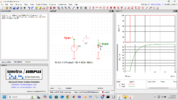
Over simplification but classic inductor/choke :

View attachment 66144


You can online get spice models to do a real sim as TEC is not a simple device due to thermal mass
and other time dependent repsonse it has.
I believe a series inductor may be the way to go. If as in the case where I desire to do testing with batteries that will deliver high current, an inductor of the proper value should work just fine. What I can add to the circuit is a make before break switch which will eliminate the inductor from the circuit. That would provide full power to the circuit after start up and avoid an over current demand on the converter during start up. There is a problem, with testing with batteries, that I failed to mention. The batteries that I would be using in testing will be able to deliver current that exceeds the Peltier ratings. As I understand a Peltier device, it is merely an array of p/n junctions. Therefore, if I do not limit the current, the result would be the same as if I put a 15 amp diode between the posts of a hundred amp battery and expected the diode to limit the current, which it won't, until it burns open. Also, I do not believe my 24 V to 12 V converter will limit current flow to its 40 amp rating. My guess is that the converter will try to match whatever current the circuit calls for and the converter will self-destruct. My initial design has the output of 4 PV panels, each 250 watts, hooked in parallel, directly hooked to the input of the 24 to 12V converter. The converter has an input V range of 19-35 volts. PV panel, no load voltage is 36 volts. Short circuit amperage is around 8 amps. My charge controllers have read as high as 39 amps at their inputs, which I do not fully understand but run with anyway. Voltage input to charge controllers consistantly reads right around 13,1 volts. I'm still learning about PV actions.

**************************************************************************************************
Some interesting I-V info here - https://www.labcenter.com/blog/sim-peltier-models/

A handbook - https://www.dropbox.com/scl/fi/jfbo...ey=mtf9bz4skp9vmmukmowpkk01m&st=6iposdt0&dl=0

Regards, Dana.
 
Last edited by a moderator:

HANKMARS

Jul 28, 2019
517
Joined
Jul 28, 2019
Messages
517
HANKMARS replied to a thread you are watching at Electronics Forums.

High current, 40 A to 100 A, current limiting devices other than a resistor


danadak said:
Over simplification but classic inductor/choke :

View attachment 66144


You can online get spice models to do a real sim as TEC is not a simple device due to thermal mass
and other time dependent repsonse it has.
I believe a series inductor may be the way to go. If as in the case where I desire to do testing with batteries that will deliver high current, an inductor of the proper value should work just fine. What I can add to the circuit is a make before break switch which will eliminate the inductor from the circuit. That would provide full power to the circuit after start up and avoid an over current demand on the converter during start up. There is a problem, with testing with batteries, that I failed to mention. The batteries that I would be using in testing will be able to deliver current that exceeds the Peltier ratings. As I understand a Peltier device, it is merely an array of p/n junctions. Therefore, if I do not limit the current, the result would be the same as if I put a 15 amp diode between the posts of a hundred amp battery and expected the diode to limit the current, which it won't, until it burns open. Also, I do not believe my 24 V to 12 V converter will limit current flow to its 40 amp rating. My guess is that the converter will try to match whatever current the circuit calls for and the converter will self-destruct. My initial design has the output of 4 PV panels, each 250 watts, hooked in parallel, directly hooked to the input of the 24 to 12V converter. The converter has an input V range of 19-35 volts. PV panel, no load voltage is 36 volts. Short circuit amperage is around 8 amps. My charge controllers have read as high as 39 amps at their inputs, which I do not fully understand but run with anyway. Voltage input to charge controllers consistantly reads right around 13,1 volts. I'm still learning about PV actions.

**************************************************************************************************
Some interesting I-V info here - https://www.labcenter.com/blog/sim-peltier-models/

A handbook - https://www.dropbox.com/scl/fi/jfbo...ey=mtf9bz4skp9vmmukmowpkk01m&st=6iposdt0&dl=0

Regards, Dana.
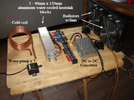
The Poteous site is a good read. CRC of course contains enough data for a 4 year college course. Do you have to have a membership or pay a fee to get CRC data? It seems that the hard copy book was around 500 dollars, about 30 years ago. I will keep both links. Thanks. Current state of test fixture.
 

Attachments

  • A_C TEST FIXTURE 1.png
    A_C TEST FIXTURE 1.png
    1 MB · Views: 1

danadak

Feb 19, 2021
1,064
Joined
Feb 19, 2021
Messages
1,064
I think they aggravate the problem as their cold R quite low then rises
as they heat up ?

See attached.
 

Attachments

  • Tungsten_Light_Bulb_Non-standard_Uses-2016_pdf -- 0db39b009bc18c6f89091a22fee2262a -- Anna’s A...pdf
    233.7 KB · Views: 0

poor mystic

Apr 8, 2011
1,106
Joined
Apr 8, 2011
Messages
1,106
I think they aggravate the problem as their cold R quite low then rises
as they heat up ?

See attached.
yeh ... nice of you to put it that way danadak:)
I saw I'd offered a no-go idea... but couldn't find the delete button
mm well.
Tungsten is of course PTC, and NTC is wanted, as mentioned earlier in the thread.
 

hevans1944

Hop - AC8NS
Jun 21, 2012
4,968
Joined
Jun 21, 2012
Messages
4,968
I think @Harald Kapp in his post #3 mentioned electronic current limiting with either bipolar junction transistors (BJTs) or MOSFETs. This is the ideal, minimal to no power lost, way to go: use a variable duty cycle, with current sensing, to control a pulse-width modulated power source. Start from zero current (0% duty cycle) and ramp up to maximum Peltier current, measuring the current as it increases to keep it below the maximum value that would burn out the devices. Stop at whatever duty cycle yields the desired current.

You might want to throw in a microprocessor to help with this. It could store the final duty cycle percentage for repeated use and "time out" if it takes too long to reach operating current because, say, if one or more of the paralleled Peltier junctions has opened. Or it could do other things, to be defined. Adding even a little "smarts" to electronics projects is super easy to do today... and the components are dirt cheap. Even nicer: if the program doesn't work right, all you have to do is re-write it. Nothing to unsolder, no components to change, just write new code.
 

danadak

Feb 19, 2021
1,064
Joined
Feb 19, 2021
Messages
1,064
The Poteous site is a good read. CRC of course contains enough data for a 4 year college course. Do you have to have a membership or pay a fee to get CRC data? It seems that the hard copy book was around 500 dollars, about 30 years ago. I will keep both links. Thanks. Current state of test fixture.

CRC data - Your inquiring about books ?


archive.org

bitsavers.org


Above all for papers, books, catalogs, ap notes, etcc..
 
Top