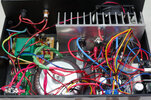
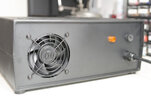
0-30 Vdc Stabilized Power Supply

Tintin

Mar 7, 2018
15
Joined
Mar 7, 2018
Messages
15
Ok, finally I replace R1et R1-1 (1K+1K2) by two 2k2 1W in // and it's works very well. The first test are pretty good.
If you want I made a final review when I will finish my Power supply ;) .
The odd things is the fact that the transformer need a small charge (not too small - 30mA) on PCB to works well and on Protoboard it not need a charge at all to make 36VDC...
Thanks audioguru for your answer !


admin2

Administrator
Administrator
Mar 13, 2015
184
Joined
Mar 13, 2015
Messages
184
I would be perfect if you share your review building this PSU with other members on the community.


audioguru2

Apr 6, 2004
12,026
Joined
Apr 6, 2004
Messages
12,026
Hi Tintin,

Now you say you measured 27VAC from your 24V transformer when its load current is low. Then it is cheap and has a high resistance so they made its voltage 27VAC instead of if it had low resistance and an output closer to 24VAC. Or maybe the voltage of your AC electricity is higher than normal. The peak of 27VAC is 27V x 1.414= 38.2V and the full wave rectifier drops it to about 36.8VDC, not 44VDC. 


Tintin

Mar 7, 2018
15
Joined
Mar 7, 2018
Messages
15
Hi audioguru,

You are right with the fact with 27VAV =>  44VDC after bridge rectifier is not normal, even without a charge.
My hypothesis is on my PCB :
-we see the wrong side of the things : maybe it is not the V+ who go up to 44VDC but the V- who go down to -8VDC when there is no charge (or <20mA) between + and - of the bridge rectifier
-and so, if my hypothesis was good, we have to find why and where is the new "zero point"
-Maybe the rôle of the section D5-D6-C2-C3 is important : on simulation on LTspice, whe have a sinusoïdal voltage between -4V and -12V (so the mean is -8V !) between D6 and C3 on normal situation...

My point of view is, even it's working well with a charge >25mA, I would want to know (because of my scientist brain) the cause of this fealure, in order to not make the same error the next time !


audioguru2

Apr 6, 2004
12,026
Joined
Apr 6, 2004
Messages
12,026
Which schematic are you using? Years ago when I replaced the low voltage TL081 opamps with higher voltage MC34071 or TLE2141 I replaced the D7 zener diode with  two diodes so that the negative supply is only -1.3V. The 0V reference (zero point) for making measurements has always been the negative wire of C1, the main filter capacitor. 


Tintin

Mar 7, 2018
15
Joined
Mar 7, 2018
Messages
15
Hi,
I made a lot of test yesterday and it's works fine, i.e it could deliver 3A <20V, 2.5A<24V and 1A to 30V. It's ok for me, I thinks what did you say and maybe I will buy a 28VAC 160VA toroïdal transformer.
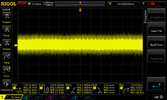
So I test for ripple  voltage for 5V 1-2-3A, and it was pretty good. I test start and my "disable output" and the results were good, particularly the limitation of current peak.

Well finally I test de current limit function, and, after adjusting trimmer RV3 for 1.41V (max 3A), when I make a short-circuit with the Potentiometer 10K at full the current go up to 6A and it blows up my primary fuse (630mA).

1)Ok, I replace the fuse, and I wonder why the max current is 6A !
2)So I test to 5V with a 10R Power Resistor, and, instead of having 5V500mA on my Chineese Multimeter like this : https://fr.aliexpress.com/item/Digital-DC-200V-0-10A-Red-Blue-LED-Dual-Display-Voltage-Current-Meter-Voltmeter-Ammeter-Power/32605098792.html?spm=a2g0s.9042311.0.0.L5o1rg

I have this : 5V with 0.390mA...

3) I test with my multimeter and it is not 5V but 3.90V with 0.390mA !

4)So I have 3 problems :

a) Why with the pot2 to max and with RV3 for 1.41V or even to make it at fully (100K), the current limiter is over 6A !

b)Why now the voltage regulation go down with a small charge, go 5V=>3.90V with only a 10R Power resistor. It's the same with 10V=>7.5V and 8V=>6.90V for example.

c)Why the chineese digital multimeter see 5V and not 3.90V ? I test with other and it was the same things. Or yesterday when i make test, when I put a 2A load on 30VDC the chineese meter saw the same fall than my Multimeter, so why now it did not see the voltage fall ?

I Checked AOPs, Transistors and voltage on AOP, main capacitor, and all is fine.

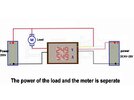
I give you my schematic and how the digital meter is plugged.

Thanks
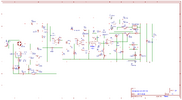
Alimentation_0_30V-afa1cff4a81a4e6380fbe4d075b36b12.png

multimeter.jpg


audioguru2

Apr 6, 2004
12,026
Joined
Apr 6, 2004
Messages
12,026
The Chinese meter is messing up the voltage and current of the power supply project.

Try the power supply project without the Chinese meter. Measure the voltage across R7 then calculate the current in it.

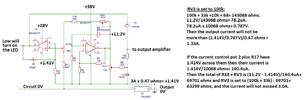
The voltage across R7 will never be more than 1.414V when the current in it is 3.0A or less.

Here are my calculations for the current calibration trimpot RV3: 

current control calibration.png


Tintin

Mar 7, 2018
15
Joined
Mar 7, 2018
Messages
15
Ok thanks Audioguru for your explanation, I wil take measure but I have one questions :

When you write on shematic +1.41V above R21, it is between Circuit OV, not the output ? I wonder if the ground have to be before or after R7 ? Is there any importance ?


Tintin

Mar 7, 2018
15
Joined
Mar 7, 2018
Messages
15
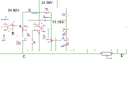
So I make my measure and this is result :

1) If a have no load (D is my ground) :
-UR7 (U_CD )= -12.6mV

-U_AC= 0.745V with RV3 set  to 100K
-U_AC=2.47V with RV3 set to 0K

-U_BD=11.7mV

-U_BC= 24.8mV (11.7-(-12.6))


If I put a 10R load for 5V to output :

-UR7=-115mV, so I=0.115/0.47=245mA

-U_AC = 0.635V with RV3 set to 100K

-U_BD = 11.7mV
-U_BD= 128mV

ex.png


Tintin

Mar 7, 2018
15
Joined
Mar 7, 2018
Messages
15
Oh I measure without my my chineese multimeter and so I have 3.90V on the 10R charge load.
I decided to measure voltage directly on the output of the PCB and surprise I have 5V !

So I think It was the cable between the negative output and the banana-plug who make this voltage fall !

Sorry for this disturbance, I will say you if this is it or not !


audioguru2

Apr 6, 2004
12,026
Joined
Apr 6, 2004
Messages
12,026
5V on 10 ohms produces a current of 500mA (0.5A). Then the voltage across R7 is 0.235V.

On your schematic, C is the ground for the current regulator. The output ground is its input signal and the 11.2V is its reference voltage.


Tintin

Mar 7, 2018
15
Joined
Mar 7, 2018
Messages
15
If my theory is good, the wire between output and banana plug have a resistance of 2.82R.
How to calcul it :
R1=U*R2/U2 - R2

R1=5V*10R/3.90V-10R=2.82R.

That explain :
a) why the chinese voltemeter "see" 5V and not 3.90V after bananaplug

B) why with 10R load
for 5V =>3.90V at output
for 8V = >6.90V output

for 10V =>7.50V output

c) why, when i test with my electronic load, with 100mA on my electronic load I have a current of 282mA !

This evening I try to measure the resistor of the wire, I will change it tomorrow.

prob.png


Tintin

Mar 7, 2018
15
Joined
Mar 7, 2018
Messages
15
I find the problem of the fallen voltage, it is due to a Fucking wire like this who have a 2.8 ohms resistor :mellow: :
So I can test now the current limiter function correctly !
cable-1m-reliant-fiche-banane-et-pince-crocodile-pour-multimetre.jpg


Tintin

Mar 7, 2018
15
Joined
Mar 7, 2018
Messages
15
Ok finally I test limited current and the voltage above R7  with 500mA is 165mV and 313.8mV with 1A. I measure with milliohmeter and I have 430mR for R7. I don't understand why the voltage drop is not 0.43*0.5=215mV and 0.43*1=430mV ?
So I make some test :

a) For max 3A output with Pot2 max I have to put 1.304V on U3+
b)It's works fine, if a put a 3.01A load (with my electronic load) the Led bright and the current limiter est working.
c) But I test to make a short-circuit I blow up my primary fuse (630mA T, maybe to low).

Why do you think about the voltage drop about R7 and for my 1.3V for 3A max ?


audioguru2

Apr 6, 2004
12,026
Joined
Apr 6, 2004
Messages
12,026
Ok finally I test limited current and the voltage above R7  with 500mA is 165mV and 313.8mV with 1A. I measure with milliohmeter and I have 430mR for R7. I don't understand why the voltage drop is not 0.43*0.5=215mV and 0.43*1=430mV ?

165mV/500mA= 0.33 ohms that is wrong. 215mV/1A= 0.215 ohms that is also wrong.

So I make some test :

a) For max 3A output with Pot2 max I have to put 1.304V on U3+

1.304V/3A= 0.435 ohms which is close to your measurement of R7. Then trimpot RV3 is set for a max current of 3A or less.

b)It works fine, if a put a 3.01A load (with my electronic load) the Led bright and the current limiter is working.

c) But I test to make a short-circuit I blow up my primary fuse (630mA T, maybe to low).

When the output current is higher than the setting of P2 then the output of U3 goes low which turns on the LED and reduces the voltage at the output amplifier. Then the shorted output should have a current of 3.0A maximum.

The opamp used for U3 and the negative supply voltage must be allow the output of U3 to go low enough so that the input to the output amplifier is shorted to 0V when the output of the project is shorted. Then R7 is the load.


Tintin

Mar 7, 2018
15
Joined
Mar 7, 2018
Messages
15
Hi Audioguru,

Sorry I do not understand your last phrase
" The opamp used for U3 and the negative supply voltage must be allow the output of U3 to go low enough so that the input to the output amplifier is shorted to 0V when the output of the project is shorted. Then R7 is the load. "

If my memories are good, if I make a short-circuit when the POT2 is set to zéro, the Voltage output do not go down to 0V, and when I turn clockwise the POT2 the current go up.
But I remember with this method, I have 3 A maximum wioth POT2 set to the middle, or if I put a load for 3A the POT 3 need to be max for 3A max.

This is this difference who make me perplexed !

PS : I buy a new toroïdal 28VAC 160VA !

https://www.tme.eu/fr/details/tst150w_28v/transformateurs-toroidaux/indel/tst160013/


audioguru2

Apr 6, 2004
12,026
Joined
Apr 6, 2004
Messages
12,026
When you turn down P2 to zero then the project's output current should be no more than a few mA. The circuit reduces the output voltage with U3 and D9 to reduce the current. When the current is limited to a few mA then the anode of D9 is 0V and its cathode which is driven from the output of U3 must be about -0.65V. That is why U3 is an opamp that has its input and output able to go close to its negative supply and why it has a negative supply.

When you turn up P2 then the current does not go up, the voltage and the load resistance set the current. The maximum current goes up.

The circuit is designed for a maximum current of 3A so you should set the current calibration trimpot RV3 so that with P2 at maximum and with the output of the project shorted then the current is 3.0A. If RV3 is set to its maximum of 100k then the maximum output current will be 1.33A as I showed in post #?.  


Tintin

Mar 7, 2018
15
Joined
Mar 7, 2018
Messages
15
Hi,
I just finish my power supply ;) !
I made a PDF document (with a lot of picture and explanation) who resume all the story about this adventure, and made a lot of measurment !
It is in French but I will translate in English soon.

I thank all this community, who made a great job !

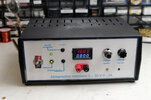
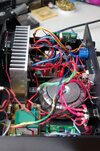
I join you some photos and my work on  a PDF format.


stab5v.jpg

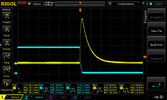
ripple5v3.jpg

IMGP8160_DxO.jpg

IMGP8156_DxO.jpg

IMGP8148_DxO.jpg

IMGP8146_DxO.jpg

IMGP8119_DxO.jpg

View attachment Alimentation0_30V.pdf


admin2

Administrator
Administrator
Mar 13, 2015
184
Joined
Mar 13, 2015
Messages
184
Hi Tintin,

You have done excellent work building this power supply and your experience is valuable for all other members. I encourage you to translate the PDF in English so anyone can benefit from it. Looking forward seeing your measurements and thoughts building this PSU.

 
Top