0-30 Vdc Stabilized Power Supply

admin2

Administrator
Administrator
Mar 13, 2015
184
Joined
Mar 13, 2015
Messages
184
Excellent measurements! Thanks for sharing. :)


detonatorinf

Sep 24, 2017
16
Joined
Sep 24, 2017
Messages
16
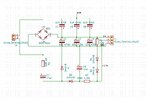
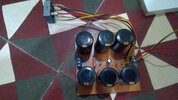
Hello. I have a question about the rectifier part of this project.

I recently made a transformer and a rectifier board that outputs the GND, 30VDC and -1,4VDC lines. Since the winding was made by hand, the output voltage got a little off. Instead of a 28AC output, i got something around 30,5AC. The problem starts when i connect the transformer to my rectifier board. The positive output gets to 45VDC and begins to slowly rise until it hits 49VDC. The negative line stays at -1,6V. I'm more worried about the positive supply since the OPAMP can only take 44Volts.

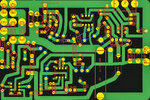
RECTIFIER.jpg

IMG_20180506_110156.jpg

IMG_20180506_110142.jpg


audioguru2

Apr 6, 2004
12,026
Joined
Apr 6, 2004
Messages
12,026
The peak of 30.5VAC is 30.5V x 1.414= 43.13V. The bridge rectifier has diode voltage drops of 1.4V when there is no load so the positive supply will be 43.13V - 1.4V= 41.73V. If your mains electricity voltage rises then the opamps might be destroyed.

I do not know why your voltage measurements are wrong.

A 28VAC transformer is about 29VAC with no load. Then its peak is 41.0V and the bridge rectifier reduces it to 39.6V with no load which is fine for the 44V opamps.   


detonatorinf

Sep 24, 2017
16
Joined
Sep 24, 2017
Messages
16
Then i should assume that my 30.5VAC transformer has a number of widings for a 29.5VAC. The widings are at a ratio of 2,44 turns per volt. So i need to remove 2 or 3 turns to get something near the ideal 28AVC.


Tintin

Mar 7, 2018
15
Joined
Mar 7, 2018
Messages
15
Hello. I have a question about the rectifier part of this project.

I recently made a transformer and a rectifier board that outputs the GND, 30VDC and -1,4VDC lines. Since the winding was made by hand, the output voltage got a little off. Instead of a 28AC output, i got something around 30,5AC. The problem starts when i connect the transformer to my rectifier board. The positive output gets to 45VDC and begins to slowly rise until it hits 49VDC. The negative line stays at -1,6V. I'm more worried about the positive supply since the OPAMP can only take 44Volts.
I, I had the same problem of you. To fix it, make a minimum load with resistor. For me a 25mA load was the minimum to decrease this.
See there :


detonatorinf

Sep 24, 2017
16
Joined
Sep 24, 2017
Messages
16
Thank you, Tintin. Adding another 2k2 resistor in parallel solves the problem. Now the rectified voltage is 40,5 VDC and will not rise.

 
Last edited by a moderator:

detonatorinf

Sep 24, 2017
16
Joined
Sep 24, 2017
Messages
16
Wow! After long 4 months of waiting, my package with five TLE2141CP finally arrived from China. And for my "surprise" none of them worked. Both U1 and U3 got extremely hot and began to smell. Turns out two resistor got burned!!

Just minutes ago i found a store in my country that sells the original MC34071. God... so much time wasted. I'm ordering them tomorrow ASAP.

Just a advice for Brazillians interested in building this project. The online store Proesi is selling the SMD version of the MC34071.


audioguru2

Apr 6, 2004
12,026
Joined
Apr 6, 2004
Messages
12,026
I did not calculate it but I think a tiny surface mounted opamp for position U2 will get too hot if the hFE of the driver and/or output transistors is low.


detonatorinf

Sep 24, 2017
16
Joined
Sep 24, 2017
Messages
16
I did not calculate it but I think a tiny surface mounted opamp for position U2 will get too hot if the hFE of the driver and/or output transistors is low.
U3 only outputs 0,640 volts. When the voltage control pot is rotated to the left or right, the variation in the readings are minimal. The voltage only raises to 10v when U3 gets too hot. U1 outputs 33v and also gets hot. RV2 has no effect on the readings.


audioguru2

Apr 6, 2004
12,026
Joined
Apr 6, 2004
Messages
12,026
My Rev 6 July, 2014 schematic shows that opamp U1 makes the 11.2V reference, U2 is for the voltage control and drives the output driver transistor with 0V to about +32V and U3 is for the current control and has an output from -1.0V to about +27V.

If the output has a low voltage (or is shorted) and a high current then the NPN output transistor in U2 will get hot. A tiny little surface mount package cannot dissipate much heat. 


detonatorinf

Sep 24, 2017
16
Joined
Sep 24, 2017
Messages
16
My Rev 6 July, 2014 schematic shows that opamp U1 makes the 11.2V reference, U2 is for the voltage control and drives the output driver transistor with 0V to about +32V and U3 is for the current control and has an output from -1.0V to about +27V.

If the output has a low voltage (or is shorted) and a high current then the NPN output transistor in U2 will get hot. A tiny little surface mount package cannot dissipate much heat. 
Sorry. You're right. I confused the order of the ICs. U1 (reference voltage) outputs 33v and U2 (voltage control) outputs 0,640V to the base of the BD139.


audioguru2

Apr 6, 2004
12,026
Joined
Apr 6, 2004
Messages
12,026
U1 (reference voltage) outputs 33V and U2 (voltage control) outputs 0,640V to the base of the BD139.

No  and No.

U1 has a gain of 2 times and a 5.6V Zener diode. Therefore its output is 11.2V, not 33V. A 5.6V Zener diode does not change its voltage when its temperature changes but an 11.2V Zener diode increases its voltage if it gets warmer.

The BD139 and the output transistors are emitter-followers. Their emitter voltage follows their base voltage but at high current, their base voltage is 1V to 1.5V higher than their emitter voltage. Then when the output voltage is 30V the output of U2 must be 32V to 32.5V. 

 
Last edited by a moderator:

detonatorinf

Sep 24, 2017
16
Joined
Sep 24, 2017
Messages
16
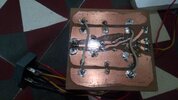
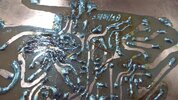
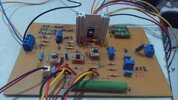
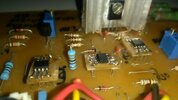
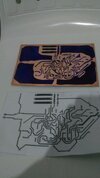
Sorry, audioguru. My post sounded like i was describing how the circuit should work but i was just explaining the behavior of the opamps. None of the 3 opamps were working as intended. The problem was caused by my lack of atention while copying the schematic to Kicad. The opamp footprint for U2 was printed with the negative and positive inputs inverted. Two jumpers solved the problem and now i have a working power supply.  I attached some images.

Really ugly, ain't it? But it was my first time learning how to make one.

R7 resistance is 0R22. I couldn't find the 0R25 resistor recommended for a 5A power supply. Also, three 2sc5200 in parallel are used as output transistors.

IMG_20180622_004441.jpg

IMG_20180622_004409.jpg

IMG_20180622_004359.jpg

IMG_20180419_224656.jpg


audioguru2

Apr 6, 2004
12,026
Joined
Apr 6, 2004
Messages
12,026
Surface mount ICs on adapters? Solder that was dripped on from up high and heated with a blow torch?

All I can say after seeing your project is "EEK!".


Realbird

Feb 12, 2018
1
Joined
Feb 12, 2018
Messages
1
Hi,

Just build this power supply.

Works Ok but will blow output transistor instantly if output is shorted !

Any suggestion


audioguru2

Apr 6, 2004
12,026
Joined
Apr 6, 2004
Messages
12,026
The original defective circuit had many overloaded parts that will blow up. The improved version fixes it.

Opamp U3 senses the output current in R7 and reduces the output voltage and output current to match the current set with P2. The maximum output current is 3.0A in the improved circuit and the two output transistors have a total maximum current rating of 30A so they will not blow up with only 3.0A. 


Jeff A.

Jul 29, 2018
7
Joined
Jul 29, 2018
Messages
7
Dear Sirs,

I followed the discussions on the topic of the power supply project and during the last few years I set up different boards, all with the suggestions and improvements that you have suggested. In all the tests and prototypes that I made happens a small drop in voltage every time a load is turned on. This voltage drop goes from 0.02V up to 0.08V at the most different voltage and current. That is, at lighter loads it is at 0.02V, but at heavier loads it can reach at 0.08V. Is it possible to correct this little problem? What do you think about it?

Thank you for your attention and I sincerely apologize for my English because I am from Brazil and I am using Google translator.

Algot.

 
Top