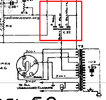
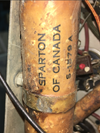
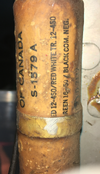
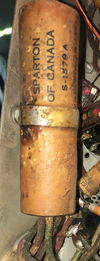
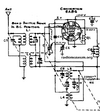
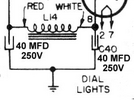
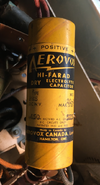
If there is no interaction between each one, i figure that 3 in paralllel may work.
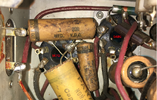
But these values are not available in electrolythics, what is the modern version of these parafin wrapped condenser ?
It doesn't look polarised...
No, you need
three capacitors with a
common connection on one end of each capacitor.
The other lead of each capacitor replaces each of the three leads on the original capacitor. I would suggest using three polarized, axial-lead, electrolytic capacitors. One of these (16 uF @ 50 wvdc) will be quite small compared to the other two (12 uF @ 450 wvdc).
The higher voltage electrolytic capacitors may be (will be) difficult to find, but don't skimp on their voltage rating, and please avoid the temptation to try to use two capacitors of lower voltage rating, in series, when you fail to find a single one rated at 450 working volts direct current (wvdc) or greater.
Hams used to do that, adding a voltage-leveling resistor (about 10 Kohms to 100 Kohms) in parallel with each capacitor, when their transmitters NEEDED high voltage (often 1000 vdc or more) to operate their "final" amplifier power tubes. I've even done it myself, but I cannot recommend it.
It does have the "advantage" that the voltage stored on the capacitors "bleeds off" through the added resistors when power is removed, a "safety" feature. A disadvantage is the resistor in parallel with the capacitor causes wasteful power dissipation and concomitant buildup of heat, constantly while the radio is powered up. This heat can lead to overly rapid failure of other nearby components if not accommodated, like with auxiliary fans.
Find capacitors with the proper voltage rating, or give up trying to restore this radio. Good luck with your restoration efforts. It's a fascinating and emotionally rewarding hobby that allows modern folks to see and hear vintage radios sounding their voices again! I and others especially appreciate if the original vacuum tube technology is preserved, instead of being unobtrusively replaced with modern electronics.
This practice of "spoofing" vintage electronics is common, but IMHO it is borders on the fraudulent to sell a "vintage" radio with modern electronics inside... unless it is made clear, at the point of sale, that the "vintage" product isn't really vintage. The practice is in fact an impediment to those who would preserve our electronic history by restoring operation to our obsolete, but historically important, technology.
Kudos to
@JP-Stereo for your restoration efforts! You should get an inexpensive digital oscilloscope to help you determine when a power supply capacitor needs to be replaced. Defective capacitors show themselves by increased ripple in the power supply output they are supposed to be filtering.