Strange old capacitor

JP-Stereo

Feb 13, 2025
15
Joined
Feb 13, 2025
Messages
15
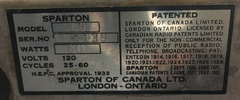
Hi, i am trying to recondition an old tube radio from 1938...

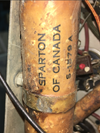
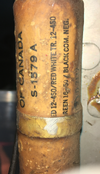
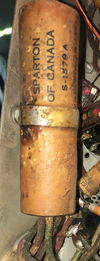
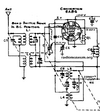
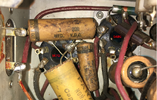
There is this strange 4 leads capacitor wich i dont know how to verify and/or replace...

1754065406372.png1754065563073.png 1754065605359.png

1754065669101.png
It's operating at a pretty high voltage.

Any idea ?

Thanks.
 

bertus

Moderator
Nov 8, 2019
3,837
Joined
Nov 8, 2019
Messages
3,837
Hello,

It looks like a triple capacitor.
It consists of 2 capacitors of 12 uF 450 volts and one capacitor of 16 uF 50 volts.

Bertus
 

JP-Stereo

Feb 13, 2025
15
Joined
Feb 13, 2025
Messages
15
If there is no interaction between each one, i figure that 3 in paralllel may work.
But these values are not available in electrolythics, what is the modern version of these parafin wrapped condenser ?
It doesn't look polarised...
 

JP-Stereo

Feb 13, 2025
15
Joined
Feb 13, 2025
Messages
15
Hi thank you very much for the lead as they also have tubes...

I am not aware if such 1938 capacitor can still be OK or if i have to replace them all ?

I figure that if i want to test them, i need to desolder at least one leg.
 

bertus

Moderator
Nov 8, 2019
3,837
Joined
Nov 8, 2019
Messages
3,837
Hello,

Electectrolitic capacitors may dry out over time and loose a lot of their capacity.
It is hard to tell what type of capacitor you have on the pictures.
The capsite can tell you more about capacitors:

Bertus
 

hevans1944

Hop - AC8NS
Jun 21, 2012
4,968
Joined
Jun 21, 2012
Messages
4,968
If there is no interaction between each one, i figure that 3 in paralllel may work.
But these values are not available in electrolythics, what is the modern version of these parafin wrapped condenser ?
It doesn't look polarised...
No, you need three capacitors with a common connection on one end of each capacitor.

The other lead of each capacitor replaces each of the three leads on the original capacitor. I would suggest using three polarized, axial-lead, electrolytic capacitors. One of these (16 uF @ 50 wvdc) will be quite small compared to the other two (12 uF @ 450 wvdc).

The higher voltage electrolytic capacitors may be (will be) difficult to find, but don't skimp on their voltage rating, and please avoid the temptation to try to use two capacitors of lower voltage rating, in series, when you fail to find a single one rated at 450 working volts direct current (wvdc) or greater.

Hams used to do that, adding a voltage-leveling resistor (about 10 Kohms to 100 Kohms) in parallel with each capacitor, when their transmitters NEEDED high voltage (often 1000 vdc or more) to operate their "final" amplifier power tubes. I've even done it myself, but I cannot recommend it.

It does have the "advantage" that the voltage stored on the capacitors "bleeds off" through the added resistors when power is removed, a "safety" feature. A disadvantage is the resistor in parallel with the capacitor causes wasteful power dissipation and concomitant buildup of heat, constantly while the radio is powered up. This heat can lead to overly rapid failure of other nearby components if not accommodated, like with auxiliary fans.

Find capacitors with the proper voltage rating, or give up trying to restore this radio. Good luck with your restoration efforts. It's a fascinating and emotionally rewarding hobby that allows modern folks to see and hear vintage radios sounding their voices again! I and others especially appreciate if the original vacuum tube technology is preserved, instead of being unobtrusively replaced with modern electronics.

This practice of "spoofing" vintage electronics is common, but IMHO it is borders on the fraudulent to sell a "vintage" radio with modern electronics inside... unless it is made clear, at the point of sale, that the "vintage" product isn't really vintage. The practice is in fact an impediment to those who would preserve our electronic history by restoring operation to our obsolete, but historically important, technology.

Kudos to @JP-Stereo for your restoration efforts! You should get an inexpensive digital oscilloscope to help you determine when a power supply capacitor needs to be replaced. Defective capacitors show themselves by increased ripple in the power supply output they are supposed to be filtering.
 
Last edited:

JP-Stereo

Feb 13, 2025
15
Joined
Feb 13, 2025
Messages
15
Thank you very much for the info.
So let's say the negative leads of the 3 electrolytics replacement caps will be common from the transformer and the positives will supply the 3 individual circuits.
As long as these values are available, this is not a problem.
Are they really electrolytics ?

Replacing old passive components with modern ones is not a modification.
In fact these old components are no longer doing the intended job.
As long as the tubes stay alive, new components are bringing us closer to the truth...

Is someone ever have done a restoration on one of these 30's radio while keeping some of these old caps ?
This is a lot older than 70's stuff...
 

bertus

Moderator
Nov 8, 2019
3,837
Joined
Nov 8, 2019
Messages
3,837
Hello,

As tollerances of electrolitic capacitors can be quite large, you could take 16 uF capacitors for all three the capacitors.
Watch the voltage, as two are 450 volts and one is 50 volts.

Bertus
 

Martaine2005

May 12, 2015
5,277
Joined
May 12, 2015
Messages
5,277
Also, for fanatics, they try and hide the new caps inside the original cap shell. Trying to keep the look original. Whether that’s possible in your case, I don’t know.
 

hevans1944

Hop - AC8NS
Jun 21, 2012
4,968
Joined
Jun 21, 2012
Messages
4,968
I don't have much of a problem replacing passive components, such as resistors, capacitors, and inductors with their modern equivalents. Hiding modern components in the
"shell" of older components is okay by me, too. But some of the "restored" stuff simply retains the original cabinet and replaces the "innards" with semiconductor circuits and modern circuit boards. If all a "vintage" collector is interested in is "looks" and "functionality" that is also okay with me... just as long as it isn't presented as a "restored" antique with a concomitant exorbitant price. That would be fraud IMHO.

As for electrolytics, these shine when the capacitance exceeds a microfarad or so and the voltage it must operate within is as much as (about) 500 volts. It's hard to tell what your triple capacitor is. It is possible that it is a paper/oil insulated, non-polarized, capacitor. There is a way to test for this if the capacitor is new: electrolytics are polarized and will conduct direct current if the wrong polarity is applied. All other (non-electrolytic) capacitors would show no conductivity for direct current, regardless of the polarity of the applied voltage. Your sixteen microfarad capacitor is sitting on the fence. The lower voltage part of it won't take much volume, but to hold off 450 wvdc (working volts direct current) requires a thicker dielectric. It could be a non-polarized capacitor, but since it appears that is is being used as a "bypass" capacitor to filter ripple on the DC power supply (and perhaps other places, such as a screen-grid potential applied to tetrode and pentode vacuum tubes, substituting three electrolytic capacitors of appropriate voltage rating for your original equipment capacitor is probably the "best" restoration you can do.

I would unsolder the un-grounded ends of the triple capacitor and test it for (1) capacitance, (2) leakage current, and (3) voltage breakdown (use a resistor to limit the current, just in case it is shorted) before ordering replacement electrolytics. You might not have to replace all three sections of the triple capacitor, but now you have the problem of where to put the electrolytic capacitors. You probably will NOT be able to easily find 450 wvdc electrolytic capacitors. Beware of "used old stock" offered on eBay and by surplus dealers: anything more than ten years old is suspect until verified to meet its specifications.

With that said, it is pretty easy to perform a go/no-go test on an electrolytic you might want to purchase. All that is required is a voltage source and an high input-impedance voltmeter. You temporarily apply the voltage across the capacitor terminals to "charge" the capacitor. Then you remove the voltage and observe, using your voltmeter connected to the capacitor terminals, how fast the voltage on the capacitor decays. Use the RC circuit formula to determine how fast you should expect the voltage to decay through the input impedance of the voltmeter.

Of course this assumes that you know the input impedance of your voltmeter. Most will be around ten meghoms, but use a stop-watch, a capacitor of known value, and a known test voltage to measure the input impedance based on the how fast the test voltage decays.
 

JP-Stereo

Feb 13, 2025
15
Joined
Feb 13, 2025
Messages
15
Hi, while i was beginning the grocery list, i ran into a problem.
There must be several version of the model 59...
1754431133922.png

Because the schematic is not reflecting the circuit...
1754431277013.png 1754431802571.png
There is no capacitor directly on the antenna connector on the schematic.
But in the radio, there is a 0.1 uF 200 vdc capacitor from one antenna lead to the pin
4 of the 6A8G...

Do i skip something ?

I don't know if i will proceed if i do not have the exact schematic..?
 

Neal

Dec 23, 2009
34
Joined
Dec 23, 2009
Messages
34
Hi, while i was beginning the grocery list, i ran into a problem.
There must be several version of the model 59...
View attachment 69183

Because the schematic is not reflecting the circuit...
View attachment 69184 View attachment 69185
There is no capacitor directly on the antenna connector on the schematic.
But in the radio, there is a 0.1 uF 200 vdc capacitor from one antenna lead to the pin
4 of the 6A8G...

Do i skip something ?

I don't know if i will proceed if i do not have the exact schematic..?
Is that the antenna connection that goes to ground?
 

JP-Stereo

Feb 13, 2025
15
Joined
Feb 13, 2025
Messages
15
Yes, helped by a night of sleep and a morning coffe, i just understand.
This cap is not related to the antenna, it's just physicaly tapping ground there for C12 capacitor.
C12 is a 0.1 uf 200v cap from 6A8G pin 4 to the ground.
So this schematic is OK !
 

Neal

Dec 23, 2009
34
Joined
Dec 23, 2009
Messages
34
Yes, helped by a night of sleep and a morning coffe, i just understand.
This cap is not related to the antenna, it's just physicaly tapping ground there for C12 capacitor.
C12 is a 0.1 uf 200v cap from 6A8G pin 4 to the ground.
So this schematic is OK !
Yes, you got it.
 

JP-Stereo

Feb 13, 2025
15
Joined
Feb 13, 2025
Messages
15
Fine, i just complete the localisation of all capacitors and resistors and their possible replacements.

I've seen a few instances of capacitors labelled as "non inductive"...
Where and when this is mandatory ?

From what i've read, about anything will replace and be better that a "paper" capacitor...
But when it's an electrolitic, is there something to avoid, because in some cases i found only Alu Foil, Millar and Poly Metal as replacement in the rights values.

Also, since some component need to be "non inductive" is "wire wound" resistor to avoid for replacement ?
 

hevans1944

Hop - AC8NS
Jun 21, 2012
4,968
Joined
Jun 21, 2012
Messages
4,968
Almost all wire-wound resistors are slightly inductive. This is more of a concern at radio frequencies than at audio frequencies. The typical wire-wound resistor is a power resistor and is used in circuits where it must dissipate a significant amount of power in a smallish amount of space. Most of these applications don't care about a little side-order of inductance.

It is also possible to manufacture wire-wound non-inductive resistors: just take the length of wire needed to achieve the desired resistance, double it over so now you have a "U-shaped" piece of wire with two long legs on the "U". Now wrap this pair of wires around a ceramic core. The result is the inductance in one leg of the "U" is negated by mutual coupling to the inductance in the other leg because the AC component of the current flows in opposite directions in the two wires, the result being almost zero inductance.

The DC component of the current also flows in opposite directions in the two wires, but this is of no concern except during fast changes in current when inductance may play a role in how a circuit responds.

This type of wire-wound non-inductive resistor can be replaced by technology that allows the same amount of power to be dissipated with the same thermal resistance and physical size, but without using resistance wire, Such resistors are a bit pricey... especially if you don't mind a little bit of inductance served up with your resistance.

Hmmm. According to Trek canon, resistance is futile anyway. Just kidding: futile is something the Chinese export to tile bath rooms, kitchens, and tiled floors. Made and sold by Fu Wung Hung Lo through a trading company in Shenzhen, near Hong Kong. Your mileage or kilometers may vary.
 

JP-Stereo

Feb 13, 2025
15
Joined
Feb 13, 2025
Messages
15
I will proceed with the replacement of all the capacitors and the out of specs resistor.
Some have burning signs.
May take a few weeks...
 

JP-Stereo

Feb 13, 2025
15
Joined
Feb 13, 2025
Messages
15
I've just encounter another 3 lead capacitor.
This time it's in a Phillips CM50A from 1948 this time.
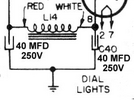
The shematic show two discrete capacitors C39 & C40.

1755117350564.png

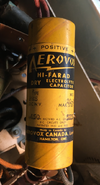
But this is the cap really in place an Aerovox Hi-Farad Dry Electrolytic Capacitor type PRS.
20 - 20 uF 450v Polarised.

1755117419880.png
Someone change the value from 40 uF on the schematic to 20 uF for the real cap.
This should be replacable with 2 electrolytics, i suppose...

Why using such odd symbol on the schematic as there all other caps has the standard symbol..?
 
Top