0-30 Vdc Stabilized Power Supply

eggy1

Dec 4, 2006
14
Joined
Dec 4, 2006
Messages
14
subodhthok said:
I building this circuit on a multi-purpose board. Kinda confused about RV1. The middle pin of RV1 is connected to R1. Other 2 pins to which pins of U2??? I think one is connected to pin 6 (o/p of U2) but the other????
End pins of RV1 are connected to pins 1 and 5.
 

MP1

Dec 7, 2003
3,399
Joined
Dec 7, 2003
Messages
3,399
Subodhthok,
You are correct. The schematic does not show the pin numbers and the text in the project is not clear in using the terms "Offset Null" to describe this connection.
To understand more about what RV1 is doing, you can perform an Internet  search for "op-amp and Offset Null". You will find some pretty descriptive pages.
Hope that helps.

MP


subodhthok

Mar 4, 2007
11
Joined
Mar 4, 2007
Messages
11
I admit I was wrong... :-[. But I'm a newbie...& sometimes confused :-*. But I'm very much keen in electronics....and hope that one day I understand all.

Please tell me what are the functions of R7 & Power Transistor Q4.


The Kolonel

Apr 17, 2007
3
Joined
Apr 17, 2007
Messages
3
Hello subodhthok,

I've been building this circuit last week, I can tell you that it works perfect. But, there are some thinks that I have changed in the original circuit. In stead of using three TL081 IC's, I've been using one LT081 IC,U1 in the scematic, and an LT082 IS for U3 and U2 (same supply voltages...). The TL082 is an Dual JFET Input Operational Amplifier. This works great, and you don't need to add RV1 and R10 to the circuit, these are unnecessary if you use the TL082.

There also a little note you need to keep in mind... The maximum supply voltage of an TL081/TL0872 is about a 36Volts (+/-18V). In the circuit, the supply voltage of these IC's is around a 38Vots (positive maximum of the tranfo= 24V*1.41, neg voltage =-5.6V).
Further... there is a 2N3055 transistor used as power transistor. The worst case powwer dissipation of this transistor =90W (30V*3A). When you check the thermal design, you will see that the junction temperature can rise to 250


audioguru2

Apr 6, 2004
12,026
Joined
Apr 6, 2004
Messages
12,026
Hi Kolonel,
I agree that Q4 gets too hot in this project.
When a 30VAC transformer is used so that the output can reach 30VDC at 3A then the Q4 gets much hotter. Then high voltage opamps must be used.

Does your project exceed an output voltage of only 25VDC at 3A?

Did you use the original little 2N2219 for Q2? It will melt if the gain of the output transistors is low, with a 3A low voltage load.

RV1 is used to adjust the output for exactly 0V. The opamp could have an input offset voltage of up to 6mV which is amplified to plus or minus 18mV at the output. RV1 can reduce it to zero.


The Kolonel

Apr 17, 2007
3
Joined
Apr 17, 2007
Messages
3
Hello Audioguru,

The high voltage opamps aren't really needed, the supply works perfect...no problems untill now.

For Q2 I use a BD137 beceause I hadn't a 2N2219 in my stock. I've mounted a little heatsink at the transisto and it works good,doesn't get too heat at all...

I'l check one of these days if I can measure the 18mV noise at the output with my scope...

BTW, is there someone who has built the LCD panel meter for this supply? Witch are the results?

Greetings

T.K.


eggy1

Dec 4, 2006
14
Joined
Dec 4, 2006
Messages
14
I tried to build it, but...ha some troubles with programming atmega8 ( dil28 package) and finally voltage regulator 78L05 fried to short circuit...result? Atmega8 had 13V between Vcc and GND...it fried...haven't got new one yet. By the way....is it me, or the ISCP part of DIP package Atmega ( on the original page) has serious bugs in it...there are'nt all the pins needed for programming present in LCD connector... 


subodhthok

Mar 4, 2007
11
Joined
Mar 4, 2007
Messages
11
subodhthok said:
I admit I was wrong... :-[. But I'm a newbie...& sometimes confused :-*. But I'm very much keen in electronics....and hope that one day I understand all.

Please tell me what are the functions of R7 & Power Transistor Q4.
Pls Somebody why is Q4 & R7 used?
 

audioguru2

Apr 6, 2004
12,026
Joined
Apr 6, 2004
Messages
12,026
The Kolonel said:
I'l check one of these days if I can measure the 18mV noise at the output with my scope.
It is not noise, it is a DC voltage that is up to positive or negative 18mV at the output of the project when the voltage control is all the way down. It is caused by the opamp U2's input offset voltage which could be from -6mV to +6mV and it is amplified 3 times by the circuit. The output voltage is supposed to be zero which is adjusted with RV1.
 

audioguru2

Apr 6, 2004
12,026
Joined
Apr 6, 2004
Messages
12,026
subodhthok said:
[Pls Somebody why is Q4 & R7 used?
Q4 is the main power transistor in the project. It acts like an automatically variable resistor. It automatically keeps the output voltage or output current constant even if the load current changes. It gets very hot when it has up to 30V across it and up to 3A through it which is 90W of heat. A single 2N3055 transistor cannot dissipate that much heat so two should be used to share the heat.

R7 develops a voltage across it that represents the load current. It is 0.47 ohms so 1A through it creates 0.47V. The opamp U3 uses the voltage across R7 to regulate the load's current.
 

Omni

Apr 25, 2007
94
Joined
Apr 25, 2007
Messages
94
Listen very carefully,

The 0-30 Vdc stabilized supply is a very advanced design.
Truthfully, it is a marvel but can also become a problem.

Example:

In the event you plan to use this supply on your bench to test homebrew digital circuits "BEWARE".
The advanced shut-off is the most amazing i have ever noted.

Example:

Let's say for instance you designed a multi-timer circuit using the 555 - 556 group of timers.
The latter timer circuit eventually is used to light a few LEDs along with activating a relay etc...
Powering and testing the timer project you are using the 0-30V stabilized supply.
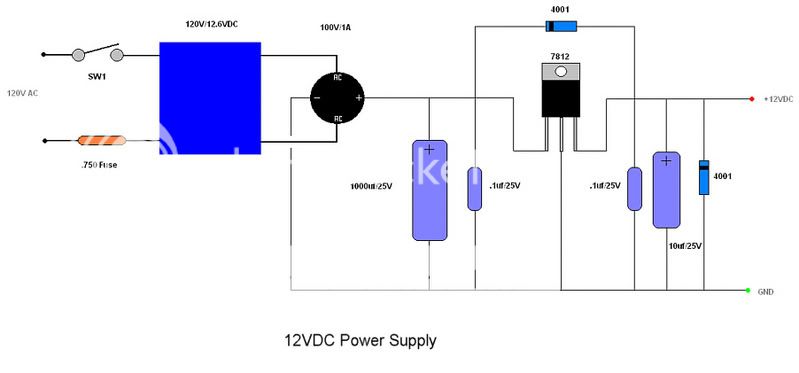
However, you plan to make an on-board constant 12V supply for the timer project.

You test the timer and every aspect will work perfectly, you try a fast-on, fast-off then back again; multiple times in extremely fast order.
Additionally, while the 0-30V is powering the timer project you pull the AC plug out of the wall then immediately push it back into the wall.
Regardless, as to what you try your timer project will time-out and work perfectly!

Next, after you design the PCB for the timer project you build a small +12VDC supply onboard to power the timer circuit; basic supply.

Wow, will you be let down...

All of a sudden when you try a fast on/off/on cycle the timer does not respond correctly, relay is engaging immediately, LEDs are flashing out of order etc...
The basic 12V supply cannot perform like your test bench 0-30V supply, you then try to load the 12V PCB mounted project supply to clamp the output voltage to zero but the minimal delay is still a problem; im talking strapping a 50ohm resistor across the 12V PCB supply is too slow!

The 0-30V is the ultimate supply but in real-world situations it is too perfect, unless you plan to buy or build another just to place in your project you may find the latter supply more of a tease than anything!

Trust me, i found out the hard way!

-Omni  ???


audioguru2

Apr 6, 2004
12,026
Joined
Apr 6, 2004
Messages
12,026
Hi Omni,
This power supply project reduces its output voltage to zero very quickly with its transistor Q1 when its power is turned off, so that the output voltage doesn't rise when the opamps lose some of their supply voltage. You don't want the output voltage to rise because  then it might destroy your load.


Omni

Apr 25, 2007
94
Joined
Apr 25, 2007
Messages
94
"very quickly" cannot be measured...

I would like to duplicate this feature on the link below.

My digital timer module will not work properly unless i have the "very quickly" feature!
The below link is the supply i am trying to use for a timer circuit but the decay on the output is creating havoc, i tried a 50 ohm shunt across the output it does help but not flawless like the 0-30VDC stabilized supply when adjusted to 12V.

12VDCpowersupplyschematic.jpg


If possible, please be specific as to how it may be performed.
Additionally, i understand if it is not possible etc...

Any help would be appreciated.


audioguru2

Apr 6, 2004
12,026
Joined
Apr 6, 2004
Messages
12,026
The 7812 doesn't have an on and off control. An LM317 voltage regulator could have its ADJ pin grounded by a comparator when you turn off the power which would quickly reduce the output voltage to about 1.3V.


Omni

Apr 25, 2007
94
Joined
Apr 25, 2007
Messages
94
Actually, if i spend the time i can get the posted pic (12VDC) circuit to simulate the clamp as designed on the 0-30V stabilized supply.
I was hoping someone had already designed a working model...

Your theory would not work in my situation since the LM317 would still produce a decay when power is turned-off, the timer circuit i designed will only draw 200mA of current when power is applied.
The latter circuit will also operate slightly below 4V at which time the extremely low current relay disengages.
Circuit current consumtion in today's digital designs are very low.
When a worst case scenario is applied such as power-on/off/on applied at both AC and DC levels digital design can take on a whole new meaning!


Although, i thank you for your concern.

-Omni


MP1

Dec 7, 2003
3,399
Joined
Dec 7, 2003
Messages
3,399
Did you build the original design or the one with the modified parts list?

MP


audioguru2

Apr 6, 2004
12,026
Joined
Apr 6, 2004
Messages
12,026
MP said:
Did you build the original design or the one with the modified parts list?

MP
It doesn't make any difference. They both have Q1 to quickly reduce the output voltage to zero when the power is turned off.
 
Top