0-30 Vdc Stabilized Power Supply

Omni

Apr 25, 2007
94
Joined
Apr 25, 2007
Messages
94
The original design will operate perfectly, i have completely tested the 0-30V supply and feel it is one of the best i have ever used.
I fabricated my own PCB using the internet supplied artwork along with PnP.
The only addition i added was a digital voltage & current meter; link provided.

http://www.hobbytron.com/UK203.html

I ordered all the parts for the supply from Futurlec, their prices are excellent!
The enclosure is a ventilated Bud (champion series).

http://www.budind.com/pdf/hb11202.pdf

Furthermore, the green (stock) 7-segment LEDs were replaced with Red since i fabricated the front panel enclosure out of dark red plexiglass.
However, you could also use a dark green plexiglass and use the stock LEDs.
(the Digital I & V meter uses stock green/yellow LEDs)

Plexiglass can be purchased in very small sizes from ebay, be carefuly when drilling, do not attempt to immediately drill a large hole (.25) above, start very small and work your way up.
Plexi has a tendency to grab the bit and a crack will easily occur (drill very slow), no pressure!

I hope i can get some time to post a few pics; perhaps this weekend.


audioguru2

Apr 6, 2004
12,026
Joined
Apr 6, 2004
Messages
12,026
Hi Omni,
How can your power supply have an output voltage of 30VDC with some current, with a 24VAC transformer that makes rectified only 32VDC?

Isn't the output full of ripple if the voltage is higher than 25VDC and the current is more than about only 2A?

How can the 24VDC/3A (72VA) transformer supply 32VDC x 3A= 96VA?

How can the 2N3055 dissipate 30VDC x 3A= 90W without overheating?

How can the little 2N2219 dissipate up to 3.6W without melting?


MP1

Dec 7, 2003
3,399
Joined
Dec 7, 2003
Messages
3,399
Thanks for the reply Omni. Others have also built the original with success.

MP


ante1

Jan 24, 2004
4,138
Joined
Jan 24, 2004
Messages
4,138
audioguru said:
Hi Omni,
How can your power supply have an output voltage of 30VDC with some current, with a 24VAC transformer that makes rectified only 32VDC?

Isn't the output full of ripple if the voltage is higher than 25VDC and the current is more than about only 2A?

How can the 24VDC/3A (72VA) transformer supply 32VDC x 3A= 96VA?

How can the 2N3055 dissipate 30VDC x 3A= 90W without overheating?

How can the little 2N2219 dissipate up to 3.6W without melting?
You don
 

Omni

Apr 25, 2007
94
Joined
Apr 25, 2007
Messages
94
One has to understand how a precision op-amp output biasing is performed before understanding the advanced principles of the stabilized output.
Within the circuit are many feedback paths that form/conduct the Vout in a very controlled manner.
Additionally, view the unique shunting path that is performed, the original circuit is a marvel!


The superb design of the DC clamp upon shut-off is magnificent.
However, it could never be easily performed on a basic 78xx series regulator using the design implemented on the 0-30V supply.
Although, there is always a work around that will perform a similar function using a more passive characteristic.
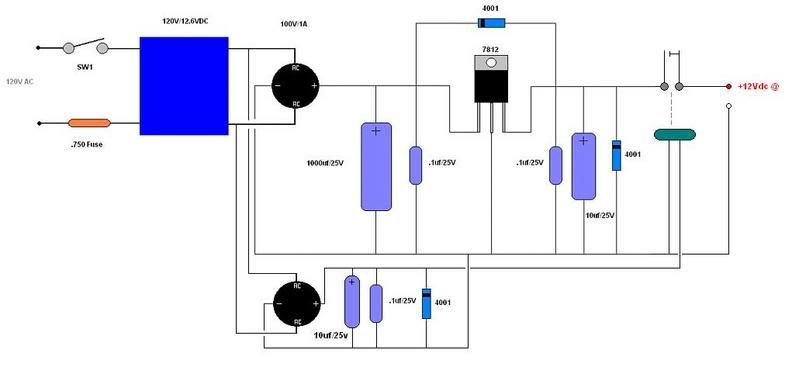
I provided the pic/link, one could also use an SCR in place of the relay but the region of operation can become subjective, using a basic high-quality sealed relay will remove all aspects of the subjective content.

12VDCpowersupplyschematic1.jpg


One could tap from the P/S bridge but an excessive capacitance is noted that would generally require a zener/resistor to the relay.
Using an isolated bridge with very minimal capacitance is the key since a relay is a basic coil, non-silicon device.
However, make sure to select the relay coil for minimal current consumption; 30mA etc...
The above can also be replaced with a relay on the AC side but i do not like the idea of RAW AC engaging a relay.
Although, arc supression can be be implemented it is far easier to use the secondary side to eliminate the large contact potential.
Please, understand higher current devices (project circuit) would cater to using an SCR but for low current applications like the timer circuit the 12VDC supply is powering (300mA) a relay is perfect.

Far too many designers reduce the secondary capacitive filtering along with installing a fixed load to pull the output decay rapidly, the latter causes excessive component wear along with increased loading on the P/S; heat generated is high!

 
Last edited by a moderator:

audioguru2

Apr 6, 2004
12,026
Joined
Apr 6, 2004
Messages
12,026
Omni said:
Within the circuit are many feedback paths that form/conduct the Vout in a very controlled manner.
The voltage setting pot has its voltage (0V to 11.2V) amplified by opamp U2. Its only negative feedback path is R12 and R11 which set its voltage gain to 3.074.
 

Omni

Apr 25, 2007
94
Joined
Apr 25, 2007
Messages
94
A feedback path can also be viewed as a dynamic feedback.

Ugh, different executions are performed throughout the circuit when required, bias shunting etc...

Including, certain parameters (power, voltage or current), establishing set points occur in a much more controlled level when using an op-amp design.

Enroll in a class (semester) concerning "Advanced Power supply design and circuit application", the latter is usually available at any University.


audioguru2

Apr 6, 2004
12,026
Joined
Apr 6, 2004
Messages
12,026
The opamp has a typical voltage gain of 200,000 at DC, so any very small change in the output voltage due to load current is reduced to nearly nothing.


indulis

Nov 21, 2005
488
Joined
Nov 21, 2005
Messages
488
Hello Omni

Enroll in a class (semester) concerning "Advanced Power supply design and circuit application"...
The original design will operate perfectly, i have completely tested the 0-30V supply and feel it is one of the best i have ever used.
Perhaps you could share with us the results of your "complete" testing? What were your results for things like gain and phase margine, cross over frequency, transient response time, short circuit recovery time, start-up time, line and load regulation, thermal derating... etc.
 

Omni

Apr 25, 2007
94
Joined
Apr 25, 2007
Messages
94
I remember at PENN a variety of students that always wanted me to provide an outline concerning a completed project; always looking for the answers without making any attempt on their own.   :'(

I would kindly state the below in a very respectful manner:

The only way you will learn the questions you are asking is to pull the legs one by one from the centipede.
When you have completed the above you will gain a much better understanding.  :)


I truly honor the individual that has presented this project, PCB artwork along with a brief functionality is so difficult to find today!
I view far too many circuits/projects on the internet that are continual copies of a basic format.
Today, we must learn how to work outside the box!

-Omni   :)


audioguru2

Apr 6, 2004
12,026
Joined
Apr 6, 2004
Messages
12,026
Hi Omni,
Does your power supply project provide 30VDC/3A with low ripple?
Does it provide 5V/3A without its transformer, 2N3055 transistor and 2N2219 transistor burning up?


Omni

Apr 25, 2007
94
Joined
Apr 25, 2007
Messages
94
The original design when properly built will work without any problems.
I favor the latter supply over my BK supplies along with an Hp supply.
Although, the BK & Hp can provide much more current, the simplicity of the 0-30V bench supply is far more useful for my purpose.
Added note: as i stated in a prior post/thread it can be a teaser since it has a few very unique features.

The ripple at 30V is very respectful, well within the aspect of the circuit design.
I have yet to notice any problems under full load at higher voltages.

Additionally, when building the supply make sure to board space any component that will generate heat; power resistors, diodes, zener's etc...

The 2N2219 along with the output transistor require the proper heat sink.
Obviously, with any power supply that will be used to maintain high current over an extended period of time should be carefully thermally sized.

Adequate clearance must be provided for the PT, use a high quality military grade or similar; do not purchase an inexpensive one from a surplus house...
Search the internet for a quality transformer, expect to pay around $45.00 - $60.00 (USA currency)

Furthermore, if the output drive transistor is mounted within the case a ventilated design along with a quality DC fan should be used.
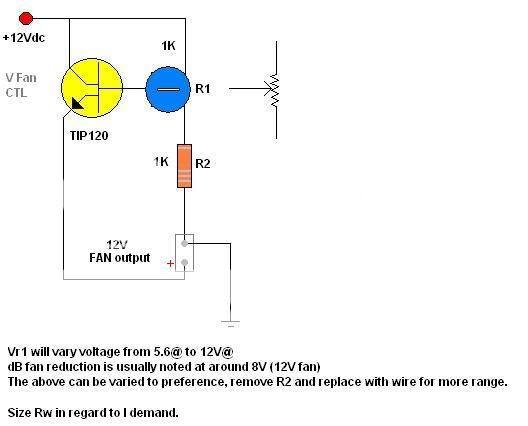
Remember, fan noise can be reduced considerable by lowering the fan voltage, a small/simple DC fan control circuit consisting of a voltage divider network along with a transistor is sufficient.
One could also use a darlington (TIP120) if fan current is above average.

12VDC_Fan_Ctl.jpg


Last edited by a moderator:

audioguru2

Apr 6, 2004
12,026
Joined
Apr 6, 2004
Messages
12,026
The 24VAC transformer has a peak of 34V which is dropped to 32VDC by the rectifier bridge. The tiny 3300uF main filter capacitor will create a peak ripple voltage of 2V so the lowest part of the unregulated supply is 30VDC when the load current is 3A.

The opamp U2 has a max output voltage of 28.8V and R15 has a voltage drop typically of 1.3V so the max voltage at the base of the 2N2219 is 27.5V. The typical Vbe of the 2N2219 is 1.0V and the typical Vbe of the 2N3055 is 1.1V so the typical max output is only 25.4VDC, not 30V.

If the transistors have low gain but are still within spec then the max output voltage is only about 22VDC.
That is why I recommend using a 30VAC transformer and a huge main filter capacitor for this project.


Omni

Apr 25, 2007
94
Joined
Apr 25, 2007
Messages
94
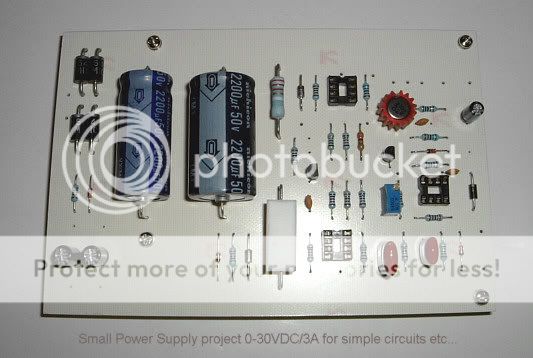
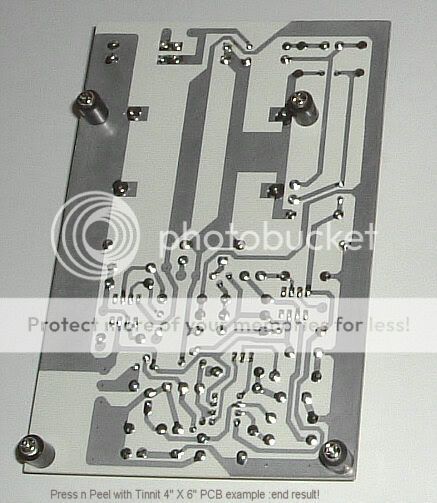
0-30VDC Stabilized pictures.

The supply was completed around 6 months ago, what an excellent project; a true performer!
Hopefully, i can post some pictures showing the enclosure and digital display module; magnificent original design!
In the past i really enjoyed taking digital pictures, anymore i lost my interest for digital photography.


PSPWBnearside.jpg


PSPWBfarside.jpg


Last edited by a moderator:

indulis

Nov 21, 2005
488
Joined
Nov 21, 2005
Messages
488
Omni said:
I remember at PENN a variety of students that always wanted me to provide an outline concerning a completed project; always looking for the answers without making any attempt on their own.   :'(

I would kindly state the below in a very respectful manner:

The only way you will learn the questions you are asking is to pull the legs one by one from the centipede.
When you have completed the above you will gain a much better understanding.  :)
Omni

I've been designing power supplies for a living for past 15 years. I am VERY familiar with parameters I asked about. I was just curious as to the knowledge level a one semester class in "Advanced Power supply design and circuit application" gets you. It would be QUITE unusual for the average hobbyist, student or even engineer to have access to some of the instruments needed to obtain some of those parameters. This isn't a learning exercise for me, so I'll ask again if you care to share some of the results of your "complete testing"?
 

Omni

Apr 25, 2007
94
Joined
Apr 25, 2007
Messages
94
Are you familiar with the curriculum requirement concerning Electrical Engineering?

In order to take an Advanced class study at Penn it is usually administered on a Graduate level.
A variety of courses are necessary before the latter course is even available.

My home laboratory could never duplicate the available test instruments at any University where most of the more elaborate stress testing was performed.
A basic Astro-Med Dash10 that most Universities have in multitudes is outside of my home lab affordability.
One has to take advantage of other resources when available, i believe you get the idea...

 
Last edited by a moderator:

audioguru2

Apr 6, 2004
12,026
Joined
Apr 6, 2004
Messages
12,026
Hi Omni,
It is easy to make basic measurements of the power supply:

Voltage Test:
1) Set the current pot to max and set the voltage pot for 30.0VDC at the output without a load.
2) Then connect a 10 ohms 100W resistor to the output.
3) Measure the output DC voltage and the output AC voltage.
The output voltage should be very close to 30.0VDC and the AC voltage should be less than 5mV.

Power test:
1) Connect a 1 ohm 10W resistor to the output.
2) Turn the voltage pot to 3.0V and the current pot to max.
Watch the original project smoke.
It should not get hot enough to make smoke. It should survive but it probably won't.


Omni

Apr 25, 2007
94
Joined
Apr 25, 2007
Messages
94
Load Transient Recovery time
Load Effect
Current Limit Characterization
PARD
Efficiency & Power Factor
Start-up response
Turn-off response
Temperature variation


The above is an abridged Agilent power supply test method that is used within the engineering community.
Additionally, i am not sure as to the level of control your concept will provide.

Truthfully, it would be best to use an electronic DC Load that is much more controlled.
I mean no disrespect concerning your method but would rather use a more defined approach.
Maintaining a controlled temperature variation while testing is difficult to achieve on a normal test bench using large power resistors.
Furthermore, charting the test using a recorder has many advantages, one could easily view an outside parameter that placed the UUT in a non-linear (abnormal) condition.
The latter failure may not have been the UUT but rather the uncontrolled method of test.

However, what i may consider notable you may believe otherwise.


audioguru2

Apr 6, 2004
12,026
Joined
Apr 6, 2004
Messages
12,026
Hi Omni,
Maybe you are afraid to make basic tests of the power supply at its max rated voltage, current and heating power because it will fail?

 
Last edited by a moderator:

Omni

Apr 25, 2007
94
Joined
Apr 25, 2007
Messages
94
Fear does not resolve into any formal test, maintaining a controlled method is an engineering approach/method that deserve's merit both from a logical standpoint along with a more calculated technique!

Furthermore, i stress a prior post notation:

The above is an abridged Agilent power supply test method that is used within the engineering community.
Additionally, i am not sure as to the level of control your concept will provide.

Please, understand i did not make-up the procedure.
The above outline is a proven method used throughout the industry both in Government and Commercial sectors.

 
Top