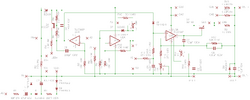
0-30 Vdc Stabilized Power Supply

L

liquibyte

Jan 1, 1970
0
audioguru said:
The transition frequency for the STN851 transistor is 130MHz, it is 190MHz for the BD139 and it is 250MHz for the original 2N2219 transistor. The STN851 will work fine.
How about this one rated at 120MHz and a higher wattage rating at 20? http://www.sanken-ele.co.jp/en/prod/semicon/pdf/2sc4883e.pdf

The higher frequency stuff just doesn't seem to come in a heavier package and has me thinking that maybe I need to learn more about switching frequencies.
 

audioguru2

Apr 6, 2004
12,026
Joined
Apr 6, 2004
Messages
12,026
liquibyte said:
How about this one rated at 120MHz and a higher wattage rating at 20? http://www.sanken-ele.co.jp/en/prod/semicon/pdf/2sc4883e.pdf
Are you making the latest improved circuit that has a 28V-30V transformer, TLE2141 opamps, a BD139 driver transistor and two 2N3055 output transistors?

Did you calculate the maximum amount of heat the BD139 will produce?

1) The minimum hFE of each 2N3055 transistor at 1.5A is about 43 so both bases need a maximum total of 70mA from the BD139.
2) The unregulated supply is about +40V and if the output of the project is shorted at 3A then the BD139 will dissipate a maximum of 70mA x 38.6V (1.4V dropped in R7)= 2.7W which is not much. If the hFE of the output transistors is typical or more then the maximum heating of the BD139 driver transistor will be much less. A suitable little heatsink on the pcb for the BD139 is fine. So a monster of a power transistor is not needed.
 
L

liquibyte

Jan 1, 1970
0
Yeah, I was working off of your parts list with a transformer from Digikey that is 28V @ 4.6A serial.  I couldn't find a 0.47R @10W, so I'm substituting a 16W version.  I noticed that the power max is 1.25W on the BD139 and was trying to idiot proof the whole thing at a worse case scenario and figured if I could find something with the same characteristics at about 5 or 10W a short would keep things within specs.  I'll try and sit down with it and understand more of what's going on.  I'm afraid I'm not that good yet but want to learn more.


audioguru2

Apr 6, 2004
12,026
Joined
Apr 6, 2004
Messages
12,026
liquibyte said:
I noticed that the power max is 1.25W on the BD139
I do not understand. I showed that in this circuit its maximum dissipation is 2.7W, not 1.5W.
In its datasheet it is spec'd to be able to dissipate 8W with a heatsink that cools its mounting base to 70 degrees C and shows that its thermal resistance is 10 degrees C per Watt then a suitable small heatsink can be selected.
 
L

liquibyte

Jan 1, 1970
0
Sorry, sometimes I get lost in datasheets. I was looking at the total device dissapation at TA and not TC.  Some of it is really Greek to me.
bd139_by_liquibyte-d7015on.png


audioguru2

Apr 6, 2004
12,026
Joined
Apr 6, 2004
Messages
12,026
liquibyte said:
Sorry, sometimes I get lost in datasheets. I was looking at the total device dissapation at TA and not TC.  Some of it is really Greek to me.
1) The datasheet for the BD139 shows that its maximum Operating and Storage Junction Temperature is 150 degrees C which is the maximum allowed internal temperature of its chip.
2) Its Thermal Resistance Junction to Ambient is 100 degrees C which is the chip's temperature rise when the transistor has no heat sink and is in free air (not enclosed). Then the chip will be at its maximum allowed temperature of 150 degrees C when the ambient air is 25 degrees C and it has 1.25W of power.
3) Its Thermal resistance junction to case is 10 degrees C so if you can cool its case to 0 degrees C then its chip will be 150 degrees C if it has 15W of power or if you cool its case to 25 degrees C then it can have 12.5W of power.

I never operate a transistor at its maximum temperature. Then my heatsink is a little larger than the minimum allowed size. In catalogs and online many heatsinks are rated for their maximum power in addition to their thermal resistance rating so I use one a little larger than is needed.
 
L

liquibyte

Jan 1, 1970
0
I've been doing this circuit in Eagle and I have another question.  What is the purpose of R2 and C2?  I don't understand why this connects to the AC.  I'm not sure I've seen anything like this before.


audioguru2

Apr 6, 2004
12,026
Joined
Apr 6, 2004
Messages
12,026
liquibyte said:
What is the purpose of R2 and C2?  I don't understand why this connects to the AC.  I'm not sure I've seen anything like this before.
R2 and C2 couple the AC from the transformer to D5 and D6 so these rectifiers can make the -1.3V negative supply. Sometimes the output of opamp U3 needs to be -0.7V so U3 uses the negative supply.
 
L

liquibyte

Jan 1, 1970
0
Thanks, I see it now.  That old schematic is kind of hard to look at sometimes.  Do you know what software made it?


audioguru2

Apr 6, 2004
12,026
Joined
Apr 6, 2004
Messages
12,026
liquibyte said:
Thanks, I see it now.  That old schematic is kind of hard to look at sometimes.  Do you know what software made it?
I do not know which schematic you have. Mine is crystal clear when you click on its address to make it fill your screen:View attachment 41991

 
L

liquibyte

Jan 1, 1970
0
I just meant that I'm used to Eagle schematics.  I'm in the process of rearranging this one now with all of the off board parts having pads.  Pay no attention to the TLC080P, I haven't found a TLE2141 yet and I think the pinout on this is the same.  I may have to make the part from this one.  I've also renumbered the parts to be more consistent.

quick-schematic.png

 
Last edited:

audioguru2

Apr 6, 2004
12,026
Joined
Apr 6, 2004
Messages
12,026
The revised and improved circuit WILL NOT WORK with TL080 opamps because their inputs do not work when their voltage is close to the negative supply. Also their maximum allowed supply voltage is too low so they will not be reliable and might fail immediately. Also a TL080 opamp needs a compensation capacitor that is inside all modern opamps.

Why can you not purchase Texas Instruments TLE2141 opamps? 

 
L

liquibyte

Jan 1, 1970
0
liquibyte said:
I just meant that I'm used to Eagle schematics.  I'm in the process of rearranging this one now with all of the off board parts having pads.  Pay no attention to the TLC080P, I haven't found a TLE2141 yet and I think the pinout on this is the same.  I may have to make the part from this one.  I've also renumbered the parts to be more consistent.
I meant the part in Eagle, not the actual part.
 
P

pascacio

Jan 1, 1970
0
Buenas noches

tengo una consulta , estoy construyendo la fuente de voltaje 0-30v
ya he adelantado bastante me parece muy interesante este proyecto
CONSULTA tendrán los datos de estos componentes  ya que la descargue de esta pagina pero  al empezar a poner los componentes no logro ver bien los datos (matricula) de los componentes , la lista esta bien clara  . la pregunta es en donde sale el PCB y los componentes esa impresión no la logro ver .
espero me puedan colaborar .

saludos. 

 
X

xwasx

Jan 1, 1970
0
Hi,

Why is collector of Q1 connected to output of opamp U2, why not to base of Q2 ?


As I see when Q1 turns on it will turn off Q2 and Q4, then output of opamp U2 will go to max voltage, and maximum current od U2-output will go trough Q2. If Q1 collector is conected to base of Q2 then much less curent will go trough U2-output and  Q1. ???

bye


audioguru2

Apr 6, 2004
12,026
Joined
Apr 6, 2004
Messages
12,026
xwasx said:
Why is collector of Q1 connected to output of opamp U2, why not to base of Q2?
That is another problem with the original circuit. I agree that Q1 should short the base of Q2 to ground (not the output of U2) when the power is turned off.

The TL081 opamp has the problem called "Opamp Phase Inversion" where the output suddenly goes high when an input voltage gets too close to its negative supply voltage (within a few volts) which occurs when the power to this project is turned off and the negative supply collapses before the positive supply. You do not want the output voltage to suddenly go as high as it can when the power is turned off so Q1 shorts the output of U2 to prevent it. The modified improved circuit uses opamps that do not have this problem so it does not have Q1.

Here is a 'scope-photo of the output of a TL081 suddently going high when its input voltage becomes low:View attachment 42050

 
X

xwasx

Jan 1, 1970
0
Hi.

I have read last 20 pages of this forum so I read your post about this inversion problem. I have also tried to reproduced that and I't happens on my tl082 but only when inverting is 0.5 volts under negative rail.
Anyways I have made this PS about 10 years ago but only for 0-20V (because I had only 20v transformer).

Now I have made another one based on xristos 3rd schematics. I't can regulate from 0-25 (because of transformer, and low supply voltage on tl082, it's   -4v / 30v ). I have put -4V to negativ rail  avoid possibility of having inversion.

Also he is using 3k+2xZener for reference which is OK if current trough Zener is constant. But current trough zener is constant only if positiv rail is stable.  My new PS have some voltage drop on positive rail when I put 2A load, so current trough Zener changes. When current trough Zener changes it also change reference voltage by little ( couple of mV). So I added jfet BF256 as current source instead of 3k resistor and now it's stable by 1mV under load.

Also I have looked at NE5532,  maximum supply is +-22, that 44v, so if we subtract -4v for negative supply we are left with 40v, that sould be enough to regulate from 0-30 ???


Bye

 
Last edited:

audioguru2

Apr 6, 2004
12,026
Joined
Apr 6, 2004
Messages
12,026
xwasx said:
But current through zener is constant only if positiv rail is stable.  My new PS have some voltage drop on positive rail when I put 2A load, so current trough Zener changes. When current trough Zener changes it also change reference voltage by little ( couple of mV). So I added jfet BF256 as current source instead of 3k resistor and now it's stable by 1mV under load.
Redwire recommends using a voltage regulator IC instead of this pile of parts that use a zener plus an opamp.

I have looked at NE5532,  maximum supply is +-22, that 44v, so if we subtract -4v for negative supply we are left with 40v, that sould be enough to regulate from 0-30 ???
We are using modern TLE2141 opamps that also have a max supply of 44V and inputs that work all the way down to the negative supply so we do not need a negative supply for opamp U2 (but opamp U3 needs its output to go to about -1V so it has a -1.3V negative supply and a 10V zener to reduce its positive supply.

Calculate all the voltage losses and you will see than a supply of about 37.5V is needed to guarantee good regulation at +30V/3A. The modified and improved circuit uses a 30VAC transformer that produces +40.4V when the output is +30V/3A. With no load the 30V transformer produces 31.0VAC which makes the positive unregulated supply +42.4V so the 44V opamps are fine.


Bye
 
X

xwasx

Jan 1, 1970
0
Hi,

I have tried folowing for voltage reference
1) opamp+5v6 zener
2) tl431 (set to 10v reference with 2 resistors)
3) 3k resistor + zener6v2 + zener3v3
4) bf256 + zener6v2 + zener3v3

The test was that I set output to 5.000v and I measured voltage with and without load (load was about 2.5A)
1), 2) and 4) where OK, i didn't noticed any change (my instrument has 3 decimal places)
3) like I said it have voltage drop of about 20mV, but that depends on positive rail (probably with stronger transformer there would be much less drop)

Than I have done temperature stability.
I have heated board from 20 deg. Celsius to about 60-70 deg. Celsius (I used electric fan heater)
4) was most stable, +-10mV change below 50 deg., and +20mV from 50-70 deg. (first was -5mV, than it started to rise to 5mV, and after 50 deg. it strated to rise  to +25mV)
2)  20-30mV change (I think it was +30mV)
1) 40mV
3) I haven't tried because of load voltage drop problem.

 
Last edited:

audioguru2

Apr 6, 2004
12,026
Joined
Apr 6, 2004
Messages
12,026
A 5.6V zener diode (a low current 5mA one should be used) was selected because a 5.6V to 6.8V zener diode has a stable voltage when the temperature changes. A lower voltage zener diode has a voltage decrease as the temperature rises and a higher voltage one has a voltage increase when the temperature rises.
Maybe the opamp was used to double the zener diode voltage so that the output amplifier has a low the effect from input offset voltage.

 
Top