0-30 Vdc Stabilized Power Supply

redwire

Nov 10, 2007
244
Joined
Nov 10, 2007
Messages
244
xwasx,  What is the capacity of your transformer?  2.5 A is a healthy load.    I'm curious about the effects when the current is lower.

Do you have a sketch of how you set up option  4) bf256 + zener6v2 + zener3v3. 

It seems you measuring output of the PS but what was happening at the output of the different voltage references?

 
X

xwasx

Jan 1, 1970
0
Hi,

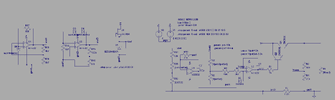
It's like this, but instead of LED it's 6v2+3v3.

fet-current-source-by-bf256-250x233.jpg


Transformer is from junk,  but its about 24-25V 3A i think.

Xristos in his 3rd version of supply is using 3k+6v6+3v3 which is probably ok if positiv rail is stable under load. If for example you set output of PS to 10V, and you put 2A load, if there is voltage drop on positiv rail (for example from 35v -> 34), current trough zener changes, and than there is change in reference voltage of zeners. With bf256 I'm geting about 10mA constant current no mater of positiv rail voltage.

I'll try to attach picture. In picture it's some other fet because I havent had time to find model for bf256B

btw: I think that vref4 configuration should give best reference voltage (by simulation). I found in local store 1n827 6v2 (temp compensated) zener for 4$, so maby in summer I'll try whit that diode and vref4 configuration. 1n827 needs 7.5mA for best result.

7.4.gif

 
Last edited:

audioguru2

Apr 6, 2004
12,026
Joined
Apr 6, 2004
Messages
12,026
Xwasx,
You are asking for your project to fail because you have a tiny low power 2N3904 transistor for Q2 and only a single 2N3055 for Q1.

The datasheet for a 2N3055 shows that with an output of 4A its minimum hFE is 20. A graph shows that its hFE is typically 35 at 2.5A but is typically 55 at 2.5A which is a difference of 55/35= 1.57 times. Then the minimum hFE at 2.5A is 20 x 1.57= 31.4. Then its base current (the output current of Q2) is 2.5A/31.4= 79.6mA. 

Your unregulated positive supply is probably 32VDC.
If the output current is 2.5A and the output voltage is set low or is shorted then the 2N3055 heats with 32V x 2.5A= 80W which is a lot of heat to remove. That is why the modified and improved circuit uses two 2N3055 transistors to share the heat.

The 2N3904 will have 31V x 79.6mA= 2.47W but its absolute maximum power dissipation is only 0.625W so it will fry. That is why a little power transistor with a heatsink is used. 

 
X

xwasx

Jan 1, 1970
0
Hi,

I know that, this i'm only simulating to see how voltage reference behaves, and i put 2n3904 and one 2n3055 because was first on list. In real circuit I'm using bd139 instead of 2n3904 and bd249 instead of 2n3055 at output. For now one bd249, probably two when I'll put everything in box.

2n3904 will not die in LTspice, and 2n3055 is OK too :)

 
Last edited:

audioguru2

Apr 6, 2004
12,026
Joined
Apr 6, 2004
Messages
12,026
Since you are only interested in simulation, not the real circuit then did you try a voltage regulator IC like a 78L05?


xristost

Jan 15, 2012
23
Joined
Jan 15, 2012
Messages
23
xwasx said:
Hi,

I have tried folowing for voltage reference
1) opamp+5v6 zener
2) tl431 (set to 10v reference with 2 resistors)
3) 3k resistor + zener6v2 + zener3v3
4) bf256 + zener6v2 + zener3v3

The test was that I set output to 5.000v and I measured voltage with and without load (load was about 2.5A)
1), 2) and 4) where OK, i didn't noticed any change (my instrument has 3 decimal places)
3) like I said it have voltage drop of about 20mV, but that depends on positive rail (probably with stronger transformer there would be much less drop)

Than I have done temperature stability.
I have heated board from 20 deg. Celsius to about 60-70 deg. Celsius (I used electric fan heater)
4) was most stable, +-10mV change below 50 deg., and +20mV from 50-70 deg. (first was -5mV, than it started to rise to 5mV, and after 50 deg. it strated to rise  to +25mV)
2)  20-30mV change (I think it was +30mV)
1) 40mV
3) I haven't tried because of load voltage drop problem.
Hi, in my variant I use resistor+ 2 zeners, because voltage is already regulated with LM317, so there will be no voltage drop (if supply voltage is high enough).
It's interesting to compare yet another solution for voltage reference - LM317L with resistors 270/1.8k. This will produce 9.58V. According to datasheet line regulation is 0.02%/V. If input voltage change with 1V, output will change with only 0.2mV.
Temperature stability is 0.65% which is 8mV in entire temperature range.
I think it's worth to try.

 
Last edited by a moderator:
X

xwasx

Jan 1, 1970
0
Hi.

I haven't try LM78xx but i tried TL431, and it's OK, only it's little more sensitive on temp. change.

real is in attachment. (I'm using bd249 instead of 2n3005).

Changed 10uF to 47uF (had oscillations)
Currently negative rail is -4 and positive +31. (changed resistor around LM3x7)
Also I'll change 3v3 zener on negative rail to 3.9 or 4.x.
TL082 are inside now, but when I get time to play I'll try with NE5532.

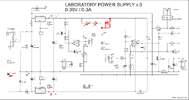
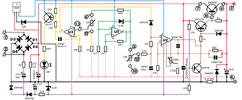
NOTE : schematics is from xristos i think.

psv3_mod2.gif


redwire

Nov 10, 2007
244
Joined
Nov 10, 2007
Messages
244
xwasx,  I don't see the benefit in adding a bunch of parts (LM317, LM337 and resistors necessary to set the voltage) to increase the  precision of the upper and lower rails of the op-amps when most of the PS's life will be well within those ranges .  It seems controlling  the voltage to the non-inverting pins of U2 and U3 would be more critical and would provide bang for the buck.  In this area you are utilizing a 6.2 and 3.3 Zener to get 9.5V.  Why aren't you using 2- 5.6v zeners which are less affected by  temperature change than the 3.3V zener or one part- a 7812.    If you have to have a negative rail of approx -4 then why not use a single 3.3 zener here similar to the 5.6 in the original design?
Because you are only supplying 9.5v to U2, you had to increase the gain in U2  from about 2.6  to about 3.5. As you increase the gain, the op-amp becomes more sensitive to change in your opamp inputs resulting in diminishing returns.  In the end are you really ending up with a meaningful improvement with the LM317 and 337?

 
X

xwasx

Jan 1, 1970
0
redwire, I have made xristos version because I didnt know that I'll have voltage drop because of week transformer, his PCB is realy good, and I had tl082 and all parts in my junk box.

This are some numbers numbers I have on real PS:
No load V+ = 36.8V,  LM317=31.45, LM337=-4.25
23V out 3A load -> V+ = 29.3

So on 23V/3A I have drop which effects curent trough zener. So solutionfor my problem  was to put BF256 as current source.
As you see I have 37V on positive rail so I must have some regulation to stay within spec. of opamp.
Of course that other type of regulation can be used (zeners or zeners+transistor) but xristos PCB is for LM3xx so I dont see any problems exept of aditional 1$ cost.

Temp coef of zener as I'm seeing in datasheet is: (min, typ,max) in mV
5v1 : -2,7,-0.8,1.2
5v6 : -2.0, 1.2, 2.5
3v3: -3.5, -2.4, 0
6v2: 0.4, 2.3, 3.7

So like xristos said 6v2+3v3 is about -0.1mV temp.coef.
Also datasheets for zener diodes are stating that temp. coef is also function of working current. (see attachment)
So by datasheet best cheap zener for reference is 5v1 with current of 10mA. (if we are talking about temp coef. problem)

I'll try with 1n827 which is special zener (5v6zener + regular diode in one package) which have 0.001%/C temp.coef. and its 4$

Normal LM317 have 0.02%/C, so if we have +20C change on 10V reference we get 40mV change in output.
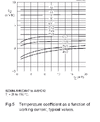
zener_tempco.gif

 
Last edited:

audioguru2

Apr 6, 2004
12,026
Joined
Apr 6, 2004
Messages
12,026
m00anj00 said:
Here is a version modified for 36v ac
You forgot to calculate that the single 2N3055 output transistor and the tiny 2N2219 driver transistor will melt if the output current is 3A and the output voltage is low or is shorted.

36VAC produces a peak of 50.9V which causes the positive unregulated supply to be 48.9V. Then the output transistor heats with 47.5V x 3A= 142.5W. 60W is very hot fore it so it will be destroyed with 142.5W.
You can work out the heating of the tiny 2N2219 driver transistor yourself.

That is why our fixed and improved version uses a 28VAC or 30VAC transformer, two 2N3055 output transistors and a BD139 modern power transistor as their driver.
 
Last edited by a moderator:
C

Canyoncruz

Jan 1, 1970
0
I have a question: on the prts list there is a D7, two diodes, but there is no D7 in the schematic!  where do they go?

 
L

liquibyte

Jan 1, 1970
0
Canyoncruz said:
I have a question: on the prts list there is a D7, two diodes, but there is no D7 in the schematic!  where do they go?
They're the unmarked 1N4148's in series on the schematic.  Bottom left, two in series on the right below the ground signal.
 

junee_bal

Dec 31, 2012
4
Joined
Dec 31, 2012
Messages
4
m00anj00 said:
Here is a version modified for 36v ac
I have problem is that when i switch of the 230VAC supply from transformer the DC output voltage reaches maximum voltage.

please give me a solution.
 

audioguru2

Apr 6, 2004
12,026
Joined
Apr 6, 2004
Messages
12,026
BalrajMohan said:
I have problem is that when i switch of the 230VAC supply from transformer the DC output voltage reaches maximum voltage.
please give me a solution.
The solution is to make the project properly using a 28VAC or 30VAC transformer then the rectified and filtered unregulated voltage with no load is 31VAC x 1.414= 43.8VDC - 1.4V= +42.4VDC. With a 3A load on the project then the rectified and filtered unregulated voltage will be +40.4VDC.

It is silly to use a transformer with an output voltage too high because then the output and driver transistors will get much too hot.   
 
A

ammar1262

Jan 1, 1970
0
Hello,

My first post here. I have tried to simulate PicMaster's version of power supply on multisim but it doesn't simulate instead it gives convergence error .
Here are the files of multisim that I've made..
Testing psu has added 0.27ohm 10W resistor.

5A_Supply.zip


Attachments

  • 5A_Supply.zip
    585.7 KB · Views: 82
T

thanos703

Jan 1, 1970
0
I made this circuit but i changed Q2 with one Tip41C with 50 hfe.Is it enough?

 
Last edited:

audioguru2

Apr 6, 2004
12,026
Joined
Apr 6, 2004
Messages
12,026
thanos703 said:
I made this circuit but i changed Q2 with one Tip41C with 50 hfe.Is it enough?
The TIP41 has an fT of only 3MHz so it is slow and its delays will probably cause the output amplifier to oscillate and have transient problems. The BD139 that should be used is very fast with an fT of 190MHz.

The hFE is not important because the minimum hFE of one of the two 2N3055 output transistors at 1.5A is 41 then the collector current of the BD139 must be a maximum of only (1.5A/41) x 2= 73mA where its minimum hFE is about 70 so the maximum output from opamp U2 must be only 73mA/70= 1mA but the minimum output from a TLE2141 opamp is much more at 20 so there is plenty of hFE available. 
 
Top