2 batteries selector

donkey

Feb 26, 2011
1,301
Joined
Feb 26, 2011
Messages
1,301
hey all was wondering if someone could help me out.
I want to make a few items that need constant power but was using batteries. I thought about it and have devised a cunning plan but need some help with the design (As usual)
so lets say i have 2 9volt batteries, I want the circuit to pick 1 (am thinking just a or b is default) but when that battery gets below a certain point (lets say 8.5volts) then it does 2 things, it switches to the second battery AND lights a LED to show its low.
I would like it to stay on the second battery until a point when it is too low and if for whatever reason it gets low too then an LED would light on there too, hopefully by then I would have changed out the battery for A and just need to charge b (I will remove the batteries for charging so no need for inbuilt charger... yet lol)
 

Bluejets

Oct 5, 2014
7,374
Joined
Oct 5, 2014
Messages
7,374
There is a pretty sneaky design floating around the rc forums using a single 2 input schotky diode as a battery backup. I realise it would need to be different to suit your application but the basic idea may spark your grey cells. Look for "simple bus tie".....
 

Harald Kapp

Moderator
Moderator
Nov 17, 2011
14,271
Joined
Nov 17, 2011
Messages
14,271
The advantage of the simple bus tie is the simplicity of the circuit.
The disadvantage of thie circuit is that it will drain both batteries (almost) equally which means that bot batteries will be 'low' at the same time. This is a contradiction to donkey's idea to have battery< #2 take over while he has time to change battery #1.

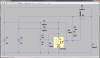
This is my idea of a circuit to start with (may need to be refined):

upload_2016-6-22_8-4-26.png

Batteries V1 and V22 supply comparator U2 via diodes D1 and D2 and capacitor C2 with a constant (unregulated) power supply.

In normal operation, Diode D4 supplies power to the output from V1 via D4, buffered by C1. Transistor M1 is off due to the positive gate voltage via R4.(see below)

Backup operation:
Comparator U2 compares battery voltage V1 to its internal reference (400mV) via voltage divider R1 and R2. When the voltage of V1 falls below ~8.5 V, the output of U2 goes low, turning on transistor (p-channel MOSFET) M1, thus delivering power to the output from V2 via M1. Since it is expected that V2>V1 in this mode, D4 is reverse biased and blocked. LED D3 indicates backup operation.

Output capacitor C1 smoothes the transistion from V1 to V2 when M1 is turned on. It may not be required depending on the load circuit.

A second comparator (there are dual versions of U2 available) can be used to supervise V2 and turn on a 2nd LED in case of low battery voltage of V2.
 

donkey

Feb 26, 2011
1,301
Joined
Feb 26, 2011
Messages
1,301
wow ty guys for the input, just a stup question harold... where do i put the load from your digram?
 

Harald Kapp

Moderator
Moderator
Nov 17, 2011
14,271
Joined
Nov 17, 2011
Messages
14,271
The load is on the output at the right, parallel to C1.
You may need to magnify the diagram, in the default size the connection between D4, M1 and C1 is not clearly visible.
 

Bluejets

Oct 5, 2014
7,374
Joined
Oct 5, 2014
Messages
7,374
The original tie arrangement was to use a 5 cell as a main and a 4 cell as backup.
You could also look at the max8211/8212
 
Last edited:

Harald Kapp

Moderator
Moderator
Nov 17, 2011
14,271
Joined
Nov 17, 2011
Messages
14,271
You could also look at the max8211/8212
The MAx8211/12 do a great job detecting undervoltage, but you'll have to add external components for switching between the two battery stacks.
 

Harald Kapp

Moderator
Moderator
Nov 17, 2011
14,271
Joined
Nov 17, 2011
Messages
14,271
Nice chip if the on-resistance of ~15 Ω is acceptable.

One drawback, gowever: It will switch between the two batteries to and fro as the active one gets draines, similar to the Schottky diode solution. This happens because the two battery voltages are directly compared and the higher one is selected to drive the output. There is neither hysteresis nor a simple way to use a fixed reference to compare with.
 

CDRIVE

Hauling 10' pipe on a Trek Shift3
May 8, 2012
4,960
Joined
May 8, 2012
Messages
4,960
Fig12 & Fig13 of the ICL7673 Datasheet shows a typical low & high current circuit that includes hysteresis.

Chris
 

Harald Kapp

Moderator
Moderator
Nov 17, 2011
14,271
Joined
Nov 17, 2011
Messages
14,271
I haven't looked that deep into the ds. Depending on the current consumption of the load it's figure 13 then.
 
Top