3V LED Chaser project

audioguru2

Apr 6, 2004
12,026
Joined
Apr 6, 2004
Messages
12,026
Hi Guys,
I drilled a CD-R to make another chaser and Disaster!
My workbench and I got covered in little bits of rainbow coloured metal, and the metallic film of the CD-R easily peeled off starting at the holes. A piece of tape removed the remainder of the metallic film.
I didn't know that the metallic film on a CD-R is not protected by a plastic layer like on ordinary CDs and CD-Roms. I better be extremely careful with the CD-Rs that I use for storing pics and programs.
I drilled another free CD-Rom from an ISP and its metallic film is inside a layer of plastic on both sides, well protected.


Dazza

Jun 21, 2004
591
Joined
Jun 21, 2004
Messages
591
Hi audioguru,
have you thought of trying a hot metal spike to melt a hold through the CD, maybe a high-powered soldering iron with a large TIP .

I have an idea that might be interesting to try. If you got a few pieces of Dow, and placed them flat in the shape of a cross, then place the CD on it and put it in the oven. It should distort evenly creating an interesting effect.
You might want to drill the holes first though.


Warning oven baked CD's are not edible ;D


audioguru2

Apr 6, 2004
12,026
Joined
Apr 6, 2004
Messages
12,026
Hi Guys,
You know what a traffic accident scene looks like on a highway at night? That's what my place looks like with my 3V LED Chaser projects flashing all around!

I was thinking about using the very expensive Lithium AA battery cells that I got as free samples for longer battery life, but the 1st project that I made with AA alkaline cells about 3 weeks ago is just as bright as the newest ones. Ordinary alkaline is fine.

I still have the CD-Rom where its metallic coating came off. It is clear with a green tint and has a rainbow reflection like a regular CD. My wifey says to paint it with metallic spray paint. I'll let you know how it looks.

I changed the Veroboard layout a bit so that the ribbon cable wiring to the LEDs is neater. I reversed the wiring for LEDs 1 and 2, and 9 and 10.

I finally found 1M linear pots for the speed controls. They have switches that I have to cut-off, and the threaded mounting part is loose requiring gluing with epoxy. They control the speed very smoothly.

I am trying to take a time-lapse pic showing the PWM pulses by moving the project or camera. I'll post the pic when I get it right.


audioguru2

Apr 6, 2004
12,026
Joined
Apr 6, 2004
Messages
12,026
Hi Guys,
I just finished building another 3V LED Chaser, but this time I used Ultra-bright BLUE LEDs. Of course since they need 3.2V to light, I had to use a 6V battery of four AA alkaline cells. I used the same box, with 2 cells inside like before, and the other 2 cells top of its lid, secured with the same screws. I changed the current-limiting resistor (R7) to 120 ohms and the transistor's base resistor (R6) to 1.8K ohms. A 6V supply is no problem for the 74HCxx IC's because their max is 7V.

How does it look? WOW! Extremely bright blue flashes that look like the strobe lights on snowplows. (Or the flashes that you see in front of your eyes when a coconut falls on your head from a tree, if you don't have snow). ;D

The next one will have Ultra-bright GREEN LEDs.


audioguru2

Apr 6, 2004
12,026
Joined
Apr 6, 2004
Messages
12,026
Hi Guys,
I knew it would happen.
When my daughter saw my "6V" Ultra-bright Blue LED Chaser, she liked it and took it to match the red 3V LED Chaser that I gave her a while ago. Her friends want the red ones and will probably want the blue ones too.

Luckily, my local electronic surplus parts store has Ultra-bright LEDs. I bought a few blue and white ones and they are very good for a low price. I'm going to take a 9V battery with current-limiting resistor and 2-pin jack over there to match a bunch of LEDs that I'll buy cheaply. I'll try for a quantity discount like Digikey gave me.

I guess the "6V" Ultra-bright Green LED Chaser that I am making will become another blue one, and I'll make a green one later.
I'm not running out of CD Roms to mount the LEDs on. I keep getting the free ISP CD Roms in my newspaper.


trigger

Aug 7, 2004
236
Joined
Aug 7, 2004
Messages
236
can I use astable transistors oscillator to give signal to the clock input to 74HC4017?


audioguru2

Apr 6, 2004
12,026
Joined
Apr 6, 2004
Messages
12,026
Hi Andrew,
A transistor multivibrator usually works fine with a supply voltage of 6V or less. Above 6V the transistors would need diodes in series with the emitters to protect their b-e junctions from reverse overvoltage breakdown.
But the output high-going switching time of a transistor multivibrator may not be quick enough for use as a clock signal for a 74HCxx device that has a maximum recommended input risetime of only 400ns.

The reasons that I used a Schmitt trigger inverter as a clock oscillator for this project are:
1) Its output risetime is only about 19ns.
2) I can easily control its duty-cycle for PWM brightness adjustment.
3) A Cmos Schmitt trigger oscillator uses hardly any supply current.


Hi Guys,
I went to my local parts store to buy some more blue ultra-bright LEDs. They didn't have any because someone must have seen my post and bought them all! (How did Dazza get up here?) ;D
I ordered them, they will have lots tomorrow. I bought some green ultra-bright LEDs there. Their brightness at only 17mA is awesome like the blue ones. It is too bad that they need about 3V minimum to light. Therefore the project needs a 6v battery (dropping to 4V when drained) instead of a 3V battery for red LEDs.
[move]Ultra-bright LEDs are awesome! [/move]


audioguru2

Apr 6, 2004
12,026
Joined
Apr 6, 2004
Messages
12,026
Hi Guys,
Today I finished another (I've lost count) chaser project. This one is also "6V" like the ultra-bright blue ones and uses green ultra-bright LEDs.
Wow, wow, wow and wow again! Is it ever BRIGHT!
I thought the blue ones were bright. This one is amazing, like little green magnesium explosions going off. I was right, our vision is most sensitive to green.

I changed the current-limiting resistor in the blue ones and this one down to 75 ohms, for a peak current of 24mA. The absolute maximum continuous current output rating for the 74HC4017 is 25mA, but my circuit pulses the outputs for only 30ms (or less when dimmed) so it is very safe.

Oh, oh. For a moment my whole room lit up. I have 5 chasers running and they must have synchronized for that moment.

I haven't seen the green one in the dark yet, 'cause it's dusk right now. I can see it reflecting off my monitor screen (it's about 6m behind me) and I bet it is bright enough to light-up the house far across the street! ;D


audioguru2

Apr 6, 2004
12,026
Joined
Apr 6, 2004
Messages
12,026
Hi Guys,
Oh, oh. I found a problem with the "6V" version of my ultra-bright LED chaser circuit:
It eats batteries!
My ultra-bright blue one wasn't as bright anymore because its battery voltage dropped to 5V (it started at 6.2V). I've had it for a month and turn-down its brightness and speed overnight so I thought it would last for months. I forgot to measure its current when turned-down like I measured the 3V ones that I posted as a project.
It draws nearly as much current when turned-down as it draws at full brightness and speed!

My circuit pulses the LEDs for only 30ms with a long pause between, so the average LED current is only about 7mA at full speed and brightness and much less at lower speeds and reduced brightness.
The 74HC14 Schmitt trigger IC draws very little current at 3V and less. I figured wrongly that since it is Cmos and its outputs switch very quickly, it would never draw much current.

Now I measured a supply current of 1.6mA for each oscillator at 6V. I discovered that the 74HC14's input Mosfet draws the current while it is a linear device following the timing capacitor's voltage.
A regular Cmos Schmitt trigger IC such as a 4584 draws only 20uA while its input is linear, at 5V. But its output current is way too low to drive LEDs. So I'll use a 4584 (or 74C14, same thing) for the 4V to 6V oscillators and another transistor to drive the LEDs.
Problem solved. I was afraid that I would have to put an off switch on the thingy. ;D

I discovered how to make it even brighter by removing a resistor on its PWM brightness oscillator! I'll let you know how it works out soon. ;D


ante1

Jan 24, 2004
4,138
Joined
Jan 24, 2004
Messages
4,138
Audioguru,

I think many here in the community expect a video clip soon, at least I do! ;D


audioguru2

Apr 6, 2004
12,026
Joined
Apr 6, 2004
Messages
12,026
Hi Guys,
It works perfectly!
My "6V" green ultra-bright LED Chaser is brighter than before and draws only 250uA from the battery between flashes and with the brightness turned down.

I replaced the 74HC14 hex Schmitt inverters IC that draws too much current at 4V to 6V with a 4584 (same as a 74C14) ordinary Cmos IC. Instead of using another transistor to boost its output current, I used a "mickey mouse" diode as a gate so the 30ms pulses from the master "speed" oscillator gates the PWM "brightness" oscillator.

I changed the brightness pot wiring to an "Ante's Special " type of wiring with diodes at each end and the inverter's output feeding the slider. Now the PWM brightness range is from almost zero (with all my lights off I could barely see the skinny pulses on my 'scope) to very close to 100%.

I'll modify my last remaining blue ultra-bright chaser the same way then MAKE A MOVIE for you guys to see and hear me singing (croak!) and all my blinkin' LEDs all around!


audioguru2

Apr 6, 2004
12,026
Joined
Apr 6, 2004
Messages
12,026
Hi Guys,
Correction: A 4584 IC isn't the same as a 74C14, and neither are the same for an oscillator's timing as a 74HC14 that is used in the 3V LED Chaser project.

Since the 74HC14 drew too much supply current for the oscillators with a 6V supply, I wanted to use an ordinary Cmos hex Schmitt trigger IC that draws much less current. The 4584 IC that I tried made the speed oscillator run too fast, so I increased its timing capacitors, C3 and C4, from the original total value of 800nF to 1.47uF, and it is still rather fast. I don't want to make the caps even bigger 'cause those metalized-film ones are big and expensive.

So I researched the hysteresis for all the Cmos hex Schmitt trigger ICs with a 5V supply:
- 74HC14 0.6V to 1.7V (original)
- 4584 0.25 to 1.0V (much less)
- 74C14 1.0 to 3.6V (much more)
- 40106 0.3 to 2.0V (too much variation)

The 74C14 is a good choice and the caps can be reduced to just one 330nF or 470nF one. The 4584 can be used, like I did, but the caps should be increased to a total of about 2uF.

I might post a separate project for a "6V Ultra-Bright LED Chaser".


ante1

Jan 24, 2004
4,138
Joined
Jan 24, 2004
Messages
4,138
Hi Audioguru,

This is a lot or info, maybe it


audioguru2

Apr 6, 2004
12,026
Joined
Apr 6, 2004
Messages
12,026
Hi Ante,
My original 3V LED Chaser project works fine.
I made a number of changes so it could use 3.2V to 3.5V ultra-bright green, blue or white LEDs, and a 6V battery. The changes are numerous so I'll post it as a new project.

I modified a 3V circuit with all the changes for the 6V circuit except it kept the original timing caps and the 74HC14 that works well with a supply down to 2V or less. I have it running beside an original one right now and they look and operate the same.


audioguru2

Apr 6, 2004
12,026
Joined
Apr 6, 2004
Messages
12,026
Hi Guys,
I was wondering why my original 3V LED Chaser project looks as bright as the new circuit I designed for ultra-bright LEDs and a 6V battery. The original circuit produces 15mA current pulses in its LEDs but the effective current is reduced to about 10.5mA by the max duty-cycle limit of 70 percent by its PWM brightness control. The new circuit has an effective LED current of 15mA because its "Ante's Special" PWM control can reach 100 percent duty cycle.

My first "6V" ultra-bright chaser had 24mA current pulses that were reduced to about 17mA by its original PWM circuit. The improved PWM control allows the full 24mA and it looks much brighter.

I tried reducing yhe value of the LED current limiting resistor in the original and modified 3V chasers to make them brighter and the LED current didn't increase! The 74HC4017 must be at its current limit with a supply of only 3V and must be current-limiting.

The 3V chaser's LED current (and brightness intensity) increase from 10.5mA to 15mA is a 43 percent increase which must be negligible since our vision's response to brightness is logarithmic. But the 6V ultra-bright chaser's same percentage increase in current probably overloaded my vision and created a sensation of increased brightness. They are extremely bright.

I will build all chasers from now on with the new circuit. I have a new idea of using a spare inverter to gate the chaser off for a short sleep after a few revolutions. It will double the battery's life and look more interesting. I will post my 6V ultra-bright circuit as a new project with a parts list and description. Its schematic is here:

View attachment 36382


audioguru2

Apr 6, 2004
12,026
Joined
Apr 6, 2004
Messages
12,026
You will notice that a new capacitor has been added at the transistor. It is used to attenuate extremely narrow PWM pulses at minimum brightness. Both the original 3V circuit and the new 6V circuit need it when using ultra-bright LEDs, because they are so bright.
You should see the new 1.8V orange ultra-bright LEDs I found!


ante1

Jan 24, 2004
4,138
Joined
Jan 24, 2004
Messages
4,138
Thanks for the new 6-volts schematic Audioguru, nice work! ;D


ibernez

Dec 30, 2004
7
Joined
Dec 30, 2004
Messages
7
Hey everyone. Im 17 and new to electronics and this is going to be my first real project. I play guitar in a band and I want to install this project in my guitar under the strings, and between the pickups for a little added stage wowing. Here is a picture of a guitar similar to the one I want ot put this in.-->
1003_md.jpg
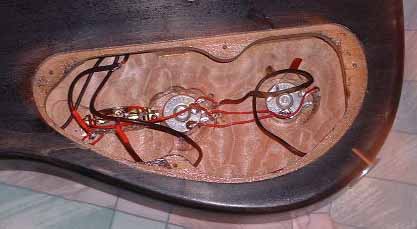
As I said I want to put it between the two pickups(2" gap), under the strings. I planned on making a back cavity (for those who don't know what that is, it's this)-->
12%20feb%2003%206%20b.jpg
to house the project, and drill holes for the LEDs and pots. Question #1 is, Where can I get all the parts to make this project? #2 Will the project make a hum or buzz in my sound? #3 Any advice? Thanks to any and all responses.


audioguru2

Apr 6, 2004
12,026
Joined
Apr 6, 2004
Messages
12,026
Hi Ibernez,
Welcome to our forum.
I have been making lots of these chasers. I have made some with Ultra-Bright LEDs, and they are really bright, probably more suitable for your guitar project. The Ultra-Bright LEDs need more than 3V so I modified the circuit a bit and use 4 AA alkaline battery cells. I'll post the modified circuit soon as an 6V Ultra-Bright LED Chaser project.
You might have a whine and a buzz in the guitar's sound if the project is mounted so close to the strings and pickups. I suggest mounting the circuit and its LEDs around the bottom edge of the guitar, to avoid interference with its sound and the LEDs would be seen better away from your "strumming" hand anyway.

Since you have AOL you are probably in North America, like me. I buy my stuff on-line from www.newarkinone.com or www.digikey.com since they have almost everything in stock and have pretty good prices. You pay online with a credit card and delivery is by courier the next day.


ibernez

Dec 30, 2004
7
Joined
Dec 30, 2004
Messages
7
Thanks for the advice. Im looking forward to the 6V Ultra-Bright LED Chaser. I figured the LEDs would make some kind of hum. The thing is is this is what us guitarists call a "project guitar". It's all hot-rodded with special pickups and stuff. I have broken pieces of mirror all over it and the only parts that aren't covered are the area under the strings and below the two pickups. So I guess I'll put it on the lower horn. Also, I forgot to ask, I'd like to put a on/off push switch in to turn it on and off. Maybe when you make the new mod circuit, you could tell what kind and where to put that in? Thanks.

 
Top