audioguru2
- Apr 6, 2004
- 12,026
- Joined
- Apr 6, 2004
- Messages
- 12,026
Transistors with the same part number have differences. Some are very good and others are not. There might be the same differences between two different RF transistors.


lets discuss it:But the mic in this simple circuit is driving the low input impedance of the transistor. Therefore the FET transistor in the mic won't have much more gain if R1 has a higher value. difference.
Correct. The drain of a jFET is a high impedance current sink like the collector of a transistor. But the signal modulates its constant current.walid said:1- is the mic is a constant current source that its current not effected by changes in R1 value.
The constant current becomes only a little higher when a lower resistance of R1 increases the voltage at the drain of the jFET.or this current increased by decreasing R1 value?
No. The signal modulates its constant current. Therefore a high load resistance allows the jFET to amplify the signal more than a low load resistance, like a transistor. A jFET doesn't have as much voltage gain as a transistor so changing the load/powering resistance doesn't make a big difference.2- the sensivity of mic is increased when more current pass through it?
No. The next low impedance stage is in parallel with R1 so increasing the value of R1 won't make much difference. R1 should be about 10k so that the mic's jFET can provide some voltage gain, and the input resistance of the next stage should be more than about 30k so that it isn't a low load resistance to the output of the jFET.3-when mic circuit driving a next low impedance stage, R1 must be low value,why?
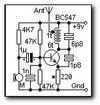
If it works, it will have a very low RF output power so its range might be only across a big room or across the street.What abou the circuit below, its Vcc is only 1.5 v!!!!
yes, it is very good point. i experiment with 3 mics, applying 9 volt dc to each and measure the drawn current with 1k then 10k ohm resistors.The constant current becomes only a little higher when a lower resistance of R1 increases the voltage at the drain of the jFET.
a high load resistance, u mean R1Therefore a high load resistance allows the jFET to amplify the signal more than a low load resistance, like a transistor.
as a role always take R1 = 10KA jFET doesn't have as much voltage gain as a transistor so changing the load/powering resistance doesn't make a big difference.
If the next stage i/p impedance is in parallel with R1, and the next stage i/p impedance is 30K, then 30//10 = less than 10The next low impedance stage is in parallel with R1 so increasing the value of R1 won't make much difference. R1 should be about 10k so that the mic's jFET can provide some voltage gain, and the input resistance of the next stage should be more than about 30k so that it isn't a low load resistance to the output of the jFET.
with 1k the total = 762 ohm as u saidSo increasing R1 to 10k for more gain from its jFET won't make much difference.
I calculate Zin at the base the Ic=0.1 mA, Zin = 52KI think the total input impedance of the mic preamp should be 30k or more and R1 should be 10k if the supply voltage allows it.
heheheheI have never made an electret mic but I think if its diaphraghm spacing is reduced then it will be more sensitive but then its max sound pressure level will be less.